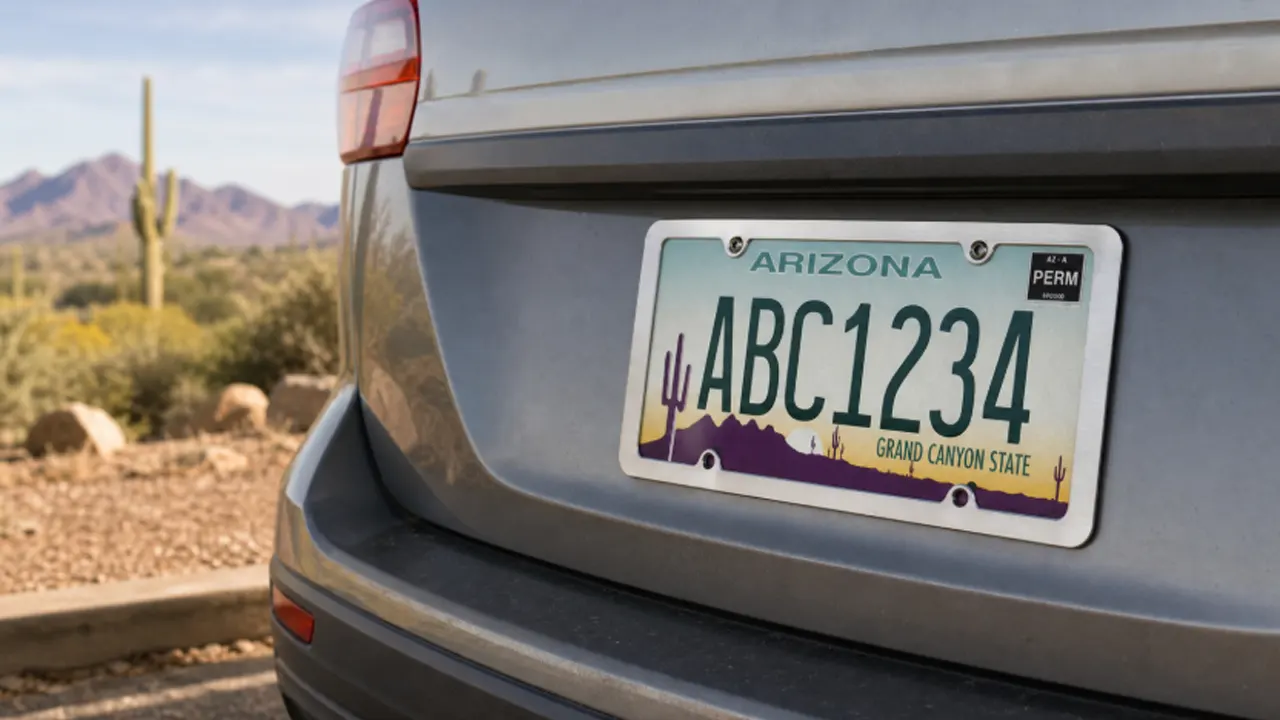
License plate frames are legal in Arizona only when they leave the plate fully legible. The frame or any covering cannot obscure the plate’s numbers, characters, year tabs, or the word “Arizona” at the top. Those elements must remain visible from every angle.
Arizona Revised Statutes §28-2354 is especially clear about the state name. A stylish bottom rail is not the only concern; a thick top rail can create a violation even when the registration number remains open.
Arizona’s protected plate elements
| Element | What your frame must do |
|---|---|
| Numbers and characters | Leave every mark fully visible and legible from any normal angle. |
| Year tabs | Do not overlap the tab with a corner, cap, badge, or face cover. |
| “Arizona” at the top | Keep the complete state name visible; this is expressly required. |
| Plate face | A covering, substance, film, or device cannot obscure or distort the information. |
| Mounting position | The plate must be secure, visible, legible, and at least 12 inches above the ground. |
“From any angle” is a useful design warning. A raised inside wall can look harmless from straight behind yet hide the top of a character when viewed from the side. Include rail depth in the fit review, not only the size of the opening.
How Arizona enforces a covered state name
A violation based only on obscuring “Arizona” is subject to secondary enforcement. An officer may not stop or cite a driver solely for that state-name issue unless there is reasonable cause to believe another motor-vehicle law has been violated.
The statute sets a $30 civil penalty for that state-name violation and $100 for a second or later violation within 12 months. Secondary enforcement does not make the frame legal, and it does not protect an installation that also hides characters, year tabs, or otherwise violates the display rules.
Arizona’s one-plate rule is more flexible than many summaries suggest
Arizona generally issues one plate, which is displayed at the rear. When two plates are issued, the owner may display one at the rear or one at the front and one at the rear, subject to the statute’s conditions. Special rules apply to certain vehicles, including vehicles transporting a person with a wheelchair.
For a product listing, say which plate position and vehicle bracket you verified. Do not turn a general “rear frame” into a promise that covers every commercial, specialty, or accessibility application.
Top-rail design deserves first attention
Many promotional frames reserve the widest rail for the bottom. In Arizona, the top rail can be the critical dimension because the state name appears there. Measure the clearance after coating, printing, chrome plating, or molded decoration—not only in the uncoated CAD drawing.
If the logo needs more area, shorten it or reduce its height. Moving the inside edge over the state name is not a workable compromise. The size guide explains how to specify the clear opening separately from the outer dimensions.
Check the complete assembly, not the bare frame
- Install a current Arizona plate with its year tab.
- Add the actual gasket, screw caps, camera bracket, and hardware.
- Confirm that “Arizona” is readable across the full top edge.
- Read every character from straight behind and from both rear corners.
- Look for tab overlap at each mounting point.
- Inspect the plate under direct sun and the vehicle’s night lighting.
- Check again after the fasteners are fully tightened; the frame must not slide.
Use the installation guide if you are replacing the entire assembly. An open frame still needs correct fasteners and a secure bracket.
Clear, tinted, and electronic films are not a shortcut
Arizona reaches covers, substances, and electronic or electrochromatic films that obscure the plate from any angle. A transparent appearance in normal light does not prove that the plate stays readable in sunlight, flash photography, or nighttime illumination.
A frame that leaves the face open avoids many of these optical problems. If the goal is protection, focus on a corrosion-resistant finish, drainage, and compatible hardware instead of placing a shield across the official plate.
What to do if the frame covers “Arizona”
Remove the frame or install one with a lower top rail and larger opening. Do not reposition the year tab, cut or file the plate, bend the edge, or paint over official artwork. Recheck the bare plate for damage and mount it securely.
If the frame uses only two screws and vibrates, consider non-obstructive lower support. Compare the options in the two-hole versus four-hole guide.
OEM, dealer, and private-label approval checklist
- Current Arizona plate included in first-article inspection
- Minimum top clearance around the complete state name
- Year-tab zones kept open
- Inside rail depth checked from angled views
- Decoration and caps kept outside the plate field
- Opening verified after the final finish
- Instructions tell the customer to confirm visibility after installation
For a multi-state program, Arizona may determine the maximum acceptable top-rail height even if another state has more open artwork. Build the shared SKU around the strictest verified opening, or separate the frame designs by market.
Frequently asked questions
Can a frame cover only part of the word “Arizona”?
No. The state name at the top must not be obscured. A partial view is not a sound design target.
Can police stop me only because the state name is covered?
The state-name-only violation is secondary enforcement under §28-2354. That limitation does not apply in the same way when other plate information or another vehicle-law requirement is involved.
Are tinted plate covers legal in Arizona?
Not when they obscure or reduce the visibility of protected plate information from any angle. The safest approach is no face cover.
Does Arizona require a front plate?
Most ordinary vehicles use one rear plate. When two plates are issued, the statute provides display options. Check the vehicle and plate issuance rather than assuming from another state’s rule.
Is this legal advice?
No. This article translates official requirements into product and installation checks. Verify the current statute for a citation, fleet rule, or unusual vehicle.
Review an Arizona frame design
Send the target plate, vehicle or bracket, opening, hole layout, artwork, finish, hardware, quantity, and packaging requirements through the contact form. We can help review physical fit while you complete legal approval.