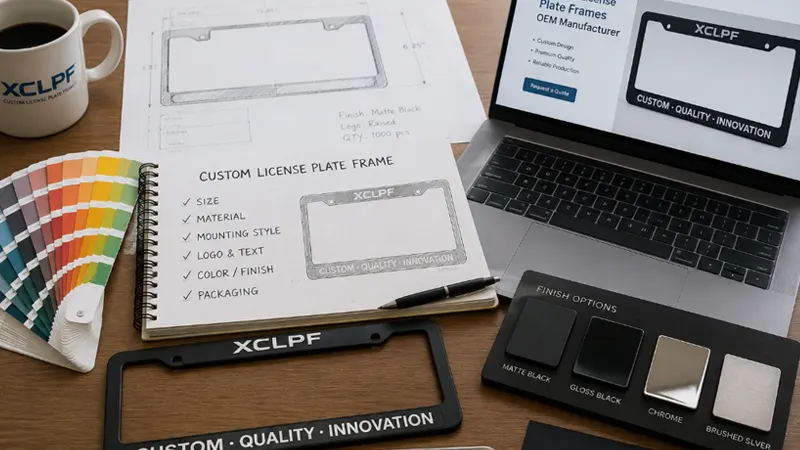
Customizing a license plate frame involves much more than adding a logo or choosing a color. A successful custom frame needs to match the target license plate size, vehicle mounting structure, material requirements, branding method, surface finish, packaging and expected production volume.
For automotive brands, dealerships, wholesalers, distributors and private-label companies, these decisions directly affect product fit, appearance, manufacturing cost and long-term consistency.
At XCLPF, we manufacture custom license plate frames in plastic and metal materials for different vehicle and regional plate formats. This guide explains the key information you should prepare before starting an OEM or custom license plate frame project.
What Can Be Customized on a License Plate Frame?
Almost every major part of a license plate frame can be customized, depending on the material and manufacturing process.
Common customization options include:
- Frame dimensions
- License plate opening size
- Mounting-hole positions
- Clip and locking structures
- Frame material
- Surface color
- Surface finish
- Dealer name
- Company logo
- Website or phone number
- Printed graphics
- Raised lettering
- Decorative badges
- Carbon-fiber-look patterns
- Chrome appearance
- Retail packaging
- Private-label packaging
The first step is therefore not choosing a logo method. It is defining how and where the frame will be used.
Step 1: Confirm the Target Market and License Plate Size
License plate dimensions vary between countries and vehicle types.
A frame developed for a US plate will not necessarily fit a European, Japanese or motorcycle plate. Even within the same market, vehicle applications can use different mounting positions or plate proportions.
Before requesting a quotation, confirm:
- Destination country
- Vehicle type
- License plate width
- License plate height
- Plate thickness
- Mounting-hole positions
- Front or rear application
- Available clearance around the plate
Common Market Considerations
| Market / Application | Key Consideration |
|---|---|
| United States | Common passenger-car plates are typically shorter and taller than European plates |
| Europe | Long horizontal plate formats require wider frame structures |
| Japan | Plate proportions differ from US and EU formats |
| Thailand | Automotive and motorcycle formats may require different structures |
| Motorcycle | Smaller dimensions and mounting areas often require dedicated frame designs |
| Custom Market | Dimensions should be confirmed from actual plate drawings or samples |
If you are not sure about the correct size, send us a plate photo, dimensions or sample for evaluation.
Related Guide: License Plate Frame Size Guide
Step 2: Choose the Right License Plate Frame Material
Material selection affects weight, rigidity, surface appearance, corrosion resistance, tooling and product cost.
We commonly manufacture license plate frames in plastic and metal materials.
ABS Plastic License Plate Frames
ABS is widely used for molded automotive accessories because it provides good rigidity and surface appearance.
It is suitable for:
- Molded frame structures
- Custom shapes
- Dealer frames
- Chrome-plated finishes
- Printed logos
- High-volume production
ABS is a good choice when the project requires design flexibility combined with a premium plastic appearance.
PP Plastic License Plate Frames
PP is lighter and more flexible than many rigid plastics.
It may be suitable for:
- Lightweight frames
- Flexible structures
- Clip-on designs
- High-volume projects
- Cost-sensitive programs
The correct material should be selected according to the required frame structure and finish.
Stainless Steel License Plate Frames
Stainless steel provides a premium metallic appearance and good outdoor durability.
Common customization options include:
- Polished surfaces
- Brushed surfaces
- Black finishes
- Laser engraving
- Printed logos
- Custom decorative elements
Stainless steel is often selected for premium automotive accessory programs.
Aluminum License Plate Frames
Aluminum combines low weight with a clean metal appearance.
Available processing options may include:
- Brushing
- Polishing
- Anodizing
- Painting
- Laser engraving
- Printing
Aluminum is useful for projects that require lightweight metal construction and flexible finishing options.
Zinc Alloy License Plate Frames
Zinc alloy is suitable for molded metal structures and more decorative frame designs.
It may be used for:
- Raised details
- Decorative patterns
- Badges
- Plated finishes
- Premium styling
The appropriate material depends on your required appearance, structure, production volume and budget.
Step 3: Select the Frame Structure
License plate frame structure affects installation, retention and visual appearance.
Common structures include:
Full-Frame Design
A full frame surrounds most or all of the outer edge of the license plate.
It provides a traditional appearance and a clear area for branding.
Semi-Open Frame
A semi-open structure reduces border coverage while keeping the plate positioned.
This can create a cleaner visual appearance.
Screw-Mounted Frame
The frame is fixed using screws through designated mounting holes.
Hole positions should match the target plate and vehicle mounting area.
Clip-On Frame
Clip structures can simplify plate installation and removal.
Clip design normally requires confirmation of:
- Plate thickness
- Clip position
- Retention force
- Frame material
Custom Mounting Structure
For special vehicle or market requirements, mounting features can be developed according to samples or drawings.
This may include:
- Custom holes
- Slots
- Tabs
- Snap-fit locks
- Retaining clips
- Integrated brackets
Step 4: Decide Where the Branding Will Appear
Before selecting a printing or logo process, determine where the branding should be placed.
Common areas include:
- Top frame border
- Bottom frame border
- Side borders
- Integrated logo panel
- Raised branding area
- Separate badge or nameplate
Dealer license plate frames often use the upper or lower border for:
- Dealer name
- Website
- Phone number
- Slogan
- Brand name
For custom OEM projects, the branding area can also be incorporated into the frame tooling.
Step 5: Choose the Logo and Decoration Method
Different materials and visual effects require different branding processes.
UV Printing
UV printing is suitable for detailed and full-color artwork.
It can be used for:
- Full-color logos
- Country flags
- Gradients
- Graphic patterns
- Promotional artwork
- Multi-color designs
UV printing is especially useful when the design contains multiple colors or detailed graphics.
Silk Screen Printing
Silk screen printing is suitable for simple logos and spot-color designs.
Common applications include:
- Dealer names
- Simple company logos
- Websites
- Phone numbers
- Short slogans
It is often a practical choice for repeat production of simple branding.
Raised Lettering
Raised lettering gives the logo or text a three-dimensional appearance.
It can be used for:
- Dealer names
- Brand names
- Slogans
- Decorative text
The raised effect may be created through molding, separate components or other manufacturing methods depending on the frame design.
Laser Engraving
Laser engraving is especially suitable for metal frames.
Typical applications include:
- Company logos
- Text
- Serial information
- Decorative lines
- Simple graphics
It provides a clean and permanent appearance without adding a separate printed layer.
Custom Badges and Nameplates
A separate badge or nameplate can be added when the project requires a stronger three-dimensional or premium branding effect.
Possible materials and finishes depend on the final design.
Step 6: Choose the Surface Finish and Color
Surface finishing changes both the appearance and perceived value of the frame.
Common options may include:
- Gloss black
- Matte black
- Chrome
- Silver
- Brushed metal
- Polished metal
- Anodized colors
- Painted colors
- Carbon-fiber-look patterns
- Decorative metallic finishes
Plastic Frames
Plastic frame appearance may be created through:
- Molded color
- Painting
- Plating
- Printing
- Surface texture
Metal Frames
Metal frame appearance may involve:
- Polishing
- Brushing
- Anodizing
- Coating
- Plating
- Laser processing
For projects with strict color requirements, provide a Pantone reference, approved sample or physical color standard whenever possible.
Step 7: Decide Whether Custom Tooling Is Required
Not every custom project requires a new mold.
If an existing frame already matches your plate size and mounting structure, customization may only involve:
- Logo
- Color
- Finish
- Printing
- Packaging
However, new tooling may be required if you need:
- A new frame size
- A different opening dimension
- New clip positions
- New mounting-hole locations
- A unique frame profile
- Integrated raised lettering
- A custom logo panel
- Special decorative features
Information Helpful for Tooling Evaluation
Please provide:
- 2D drawing
- 3D file, if available
- Physical sample
- Plate dimensions
- Frame dimensions
- Mounting details
- Material preference
- Logo location
- Expected order quantity
The more complete the initial information, the more accurately the tooling route can be evaluated.
Step 8: Prepare Your Logo Artwork
Good artwork reduces production errors and speeds up sample development.
Preferred artwork files may include:
- AI
- EPS
- SVG
- High-resolution vector files
For printed designs, also provide:
- Pantone colors
- Logo size
- Printing position
- Artwork orientation
For raised logos or molded lettering, dimensioned vector artwork is especially helpful.
Avoid using low-resolution screenshots whenever possible.
Step 9: Choose the Packaging
Packaging should be considered during product development rather than after production.
Different sales channels require different packaging.
Bulk Packaging
Suitable for:
- Wholesalers
- Dealer groups
- Assembly programs
- Distribution centers
Individual Packaging
Options may include:
- Poly bags
- Protective sleeves
- Individual cartons
- Inserts
Retail Packaging
Retail programs may require:
- Header cards
- Printed boxes
- Barcodes
- Labels
- Product instructions
- Country-specific packaging information
Private-Label Packaging
Private-label customers can combine:
- Custom frame
- Custom logo
- Brand packaging
- Barcode
- Product labeling
- Shipping carton markings
Packaging details should be confirmed before mass production.
Step 10: Prepare the Information Needed for a Quote
A complete RFQ helps manufacturers evaluate your project accurately.
For a custom license plate frame quotation, prepare the following information:
| Information | What to Provide |
|---|---|
| Target Market | Country or region where the product will be sold |
| Plate Size | Width × height |
| Vehicle Type | Car, motorcycle or other application |
| Material | ABS, PP, stainless steel, aluminum or preferred option |
| Structure | Full frame, semi-open, clip-on, screw-mounted or custom |
| Logo | Artwork and required position |
| Finish | Color, chrome, brushed, polished, printed or other |
| Packaging | Bulk, retail or private label |
| Quantity | Estimated order quantity |
| Reference | Drawing, sample or product photo if available |
If you do not know every detail, send the information you already have. We can help evaluate the remaining manufacturing options.
Existing Frame vs Fully Custom Frame
There are generally two ways to start a custom project.
Option 1: Customize an Existing Frame
This is suitable when an existing frame already matches your plate and installation requirements.
You may only need to customize:
- Logo
- Printing
- Finish
- Color
- Packaging
This approach can simplify product development.
Option 2: Develop a New Frame
This is required when you need a unique:
- Size
- Shape
- Mounting structure
- Logo panel
- Decorative design
- Retention system
A new product may require tooling, sampling and approval before mass production.
How the Custom License Plate Frame Process Works
A typical OEM development process includes the following stages.
1. Requirement Review
We review:
- Target market
- Plate dimensions
- Vehicle type
- Material
- Structure
- Logo
- Quantity
2. Manufacturing Evaluation
The appropriate tooling, molding, metal processing, finishing and branding methods are reviewed.
3. Quotation
Product specification, tooling requirements and commercial scope are confirmed.
4. Tooling or Sample Development
If required, tooling and product samples are prepared.
5. Sample Approval
The customer reviews:
- Fit
- Dimensions
- Color
- Logo
- Surface finish
- Packaging
6. Mass Production
Production begins according to the approved specification.
7. Quality Inspection
Typical checks may include:
- Dimensions
- Mounting features
- Surface appearance
- Logo position
- Color
- Assembly
- Packaging
8. Packaging and Delivery
Finished frames are packed according to the approved packaging requirements.
How to Choose the Right Customization Method
The correct customization method depends on your project goal.
| Project Requirement | Recommended Direction |
|---|---|
| Low-cost dealer frame | ABS or PP + simple printed logo |
| Premium metal appearance | Stainless steel or aluminum |
| Full-color graphics | UV printing |
| Simple 1–2 color logo | Silk screen printing |
| Permanent metal logo | Laser engraving |
| Strong 3D branding | Raised lettering or badge |
| Bright metallic appearance | Chrome-plated finish |
| Custom regional plate size | Custom dimensions or tooling |
| Retail program | Custom product + private-label packaging |
This table is only a general starting point. The final manufacturing route should be confirmed according to the actual product design.
Common Mistakes to Avoid When Customizing License Plate Frames
Choosing the Design Before Confirming Plate Size
A good-looking frame is useless if the opening or mounting points do not match the target plate.
Confirm plate dimensions first.
Using the Same Frame for Every Country
Different markets can use different plate proportions and mounting systems.
Country-specific dimensions should be verified before production.
Selecting a Finish That Does Not Match the Material
Not every material supports the same finishing process.
Material and finish should be selected together.
Providing Low-Resolution Artwork
Poor artwork can cause unclear logos, inaccurate dimensions and unnecessary design revisions.
Use vector files whenever possible.
Ignoring Packaging Until the End
Retail packaging can affect product dimensions, barcode layout, shipping cartons and project cost.
Confirm packaging early.
Approving Appearance Without Checking Fit
For a new structure, both appearance and installation should be checked during sample approval.
Why Work With a License Plate Frame Manufacturer?
Working directly with a manufacturer is especially valuable when your project requires more than a standard off-the-shelf frame.
A manufacturing partner can help evaluate:
- Material selection
- Product structure
- Tooling
- Mounting compatibility
- Surface finish
- Logo method
- Manufacturing feasibility
- Quality inspection
- Packaging
At XCLPF, we manufacture plastic and metal license plate frames for OEM, dealer, wholesale and private-label programs.
Our capabilities include tooling, injection molding, metal processing, surface finishing, logo application, assembly, inspection and packaging.
Frequently Asked Questions
Can I customize the size of a license plate frame?
Yes. Frame dimensions, plate opening, border width and mounting positions can be evaluated according to the target license plate and vehicle application. New tooling may be required for a completely new structure.
What materials can be used for custom license plate frames?
Depending on the design, options can include ABS, PP, stainless steel, aluminum, zinc alloy and other suitable materials.
Can you add my company logo to the frame?
Yes. Available methods may include UV printing, silk screen printing, laser engraving, raised lettering, molded logos, badges and custom nameplates.
Can I customize the frame color?
Yes. Available color methods depend on the material and surface process. Plastic frames may use molded or painted colors, while metal frames may use coating, anodizing, plating or other finishes.
Do I need a new mold for a custom frame?
Not always. If an existing frame meets your required size and structure, you may only need branding, color or packaging customization. New tooling is generally required for new dimensions or structural features.
Can I order a sample before mass production?
Sample options depend on whether the project uses an existing product or requires new tooling. For custom OEM projects, sample approval is recommended before mass production.
Can you make license plate frames for different countries?
Yes. Frames can be evaluated according to the destination market, actual plate dimensions, mounting requirements and vehicle application.
Can you customize retail packaging?
Yes. Packaging options may include individual bags, header cards, retail boxes, labels, barcodes, inserts and private-label packaging.
What information should I send for a quotation?
Send the destination market, plate dimensions, vehicle type, preferred material, frame structure, logo artwork, finish, packaging requirements and estimated quantity. Drawings or samples are especially useful.