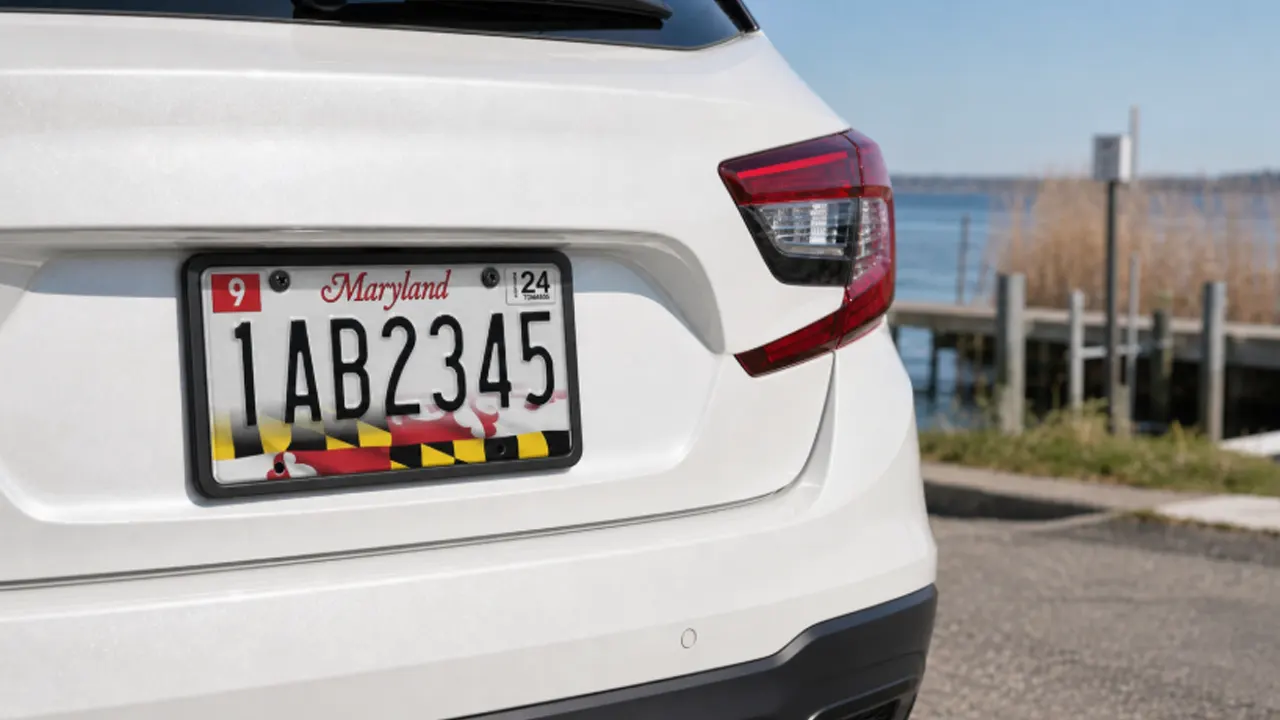
A normal edge frame is not automatically illegal in Maryland, but it cannot make the registration plate hard to read. Maryland law requires the plate to be securely fastened, horizontal, visible, and clearly legible. The plate must also be free from foreign material.
Maryland now draws an important line between an object that simply frames or borders the plate and a “registration plate cover” designed to obscure characters or distort a recorded image. Treating those accessories as interchangeable leads to bad advice.
Frame, border, or cover: why the category matters
| Accessory | How Maryland treats it | Practical decision |
|---|---|---|
| Open edge frame | An object that frames or borders the plate edges has a specific secondary-enforcement rule. | Use only if the complete plate stays clearly legible. |
| Tinted, colored, painted, marked, or illuminated cover | Can fall within the statutory definition when designed to obscure or block characters or distort an image. | Do not put it over the plate face. |
| Camera-interference device | Directly conflicts with the cover restrictions. | Exclude it from the product and instructions. |
| Dirt or foreign material | The plate must remain free from material that reduces legibility. | Clean the assembly and drainage path regularly. |
A 2025 change removed the word “clear” from the defined list of cover types. That does not mean every transparent accessory is safe: the design purpose and actual effect still matter, and §13-411 independently requires clear legibility.
What secondary enforcement means for an edge frame
For an object that frames or borders the plate edges, Maryland’s statute limits enforcement to situations in which the officer has already detained the driver on suspicion of another violation. In plain language, an edge-frame issue is not intended to be the sole reason for the initial stop under that provision.
This affects enforcement procedure, not product compliance. A frame that makes the plate unreadable is still a poor design and can still be addressed once a lawful detention occurs. Do not market “secondary offense” as “legal to cover the plate.”
Maryland’s basic plate display requirements
The plate must be securely fastened to prevent swinging, mounted horizontally, visible at all times, and maintained so that it is clearly legible. The required front or rear location depends on the vehicle and how many plates are issued.
A frame can create problems without physically touching a character. A deep lip may block an angled view; a glossy rail may reflect the plate lamp; an overlapping camera bracket may push the frame off-center. Review the installed stack, not the loose frame.
How to inspect a Maryland frame
- Clean the plate and place it in the finished frame.
- Install the intended screws, caps, gasket, and camera bracket.
- Read every character and the official plate identity from straight behind.
- Move to each rear corner and look for obstruction caused by rail depth.
- Confirm that the frame cannot slide or swing after tightening.
- Inspect night illumination and camera clearance.
- Remove any face cover that adds tint, glare, marking, or distortion.
A narrow border with extra visible space is more reliable than a frame that just barely clears the characters. Compare inner openings in the license plate frame size guide.
Maryland also restricts the sale of plate covers
Section 13-411.1 prohibits the sale and advertising of registration plate covers as defined by the law. A false representation that a prohibited cover is lawful can also be treated as a deceptive trade practice. That matters to importers, marketplaces, distributors, and private-label sellers—not only drivers.
Keep the product description accurate. Do not use “camera proof,” “anti-photo,” or “Maryland legal” language without a documented basis. An open decorative frame and an image-distorting cover should not share the same listing.
Front and rear applications need separate review
Many Maryland passenger vehicles display both front and rear plates. The front bracket may be flat plastic, offset, or dealer-installed, while the rear mount may sit near a camera or trunk release. The same frame can behave differently at the two positions.
Use the correct hardware for each bracket and avoid adding holes casually. The two-hole vs four-hole guide helps you decide when lower support is appropriate.
Dealer and private-label design checklist
- Keep the plate face open with no optical cover.
- Set the minimum clear opening before adding the logo.
- Review both front and rear brackets.
- Control raised lettering and cap diameter.
- Check finish buildup and inside-edge flatness.
- Provide drainage so dirt and water do not collect.
- Do not advertise camera-interference performance.
If one SKU will be sold across several states, use the strictest verified opening or create separate drawings. Maryland’s enforcement detail should not be used to weaken the physical design for another state.
If your frame already covers the plate
Remove it and reinstall the plate securely without the accessory, or replace it with a slimmer open frame. Do not trim the issued plate, relocate official markings, or add a homemade transparent shield. Follow the installation steps when refitting the hardware.
Frequently asked questions
Are license plate covers illegal in Maryland?
Maryland prohibits the defined registration plate covers and restricts their sale and advertising. The definition focuses on specified objects designed to obscure or block characters or distort recorded images.
Can a frame cover part of “Maryland”?
Avoid it. The plate must remain clearly legible and visible as an official registration plate. Leave the jurisdiction and all characters open.
Can an officer stop you only for an edge-frame violation?
The specific rule for an object that frames or borders the plate edges limits enforcement to a driver already detained for suspected violation of another law. Other plate conduct or other violations may involve different rules.
Are two plate frames required?
No. The plates may be required, but decorative frames are optional. You can install the plates securely without frames.
Is this legal advice?
No. This is a practical summary based on official sources checked on the date above. Obtain advice for a citation, enforcement dispute, or unusual vehicle.
Review a Maryland-ready frame or retail program
Send the target plates, front and rear brackets, opening, artwork, finish, hardware, quantity, packaging, and sales-channel requirements through the contact form. Physical fit and legal review should both be completed before release.