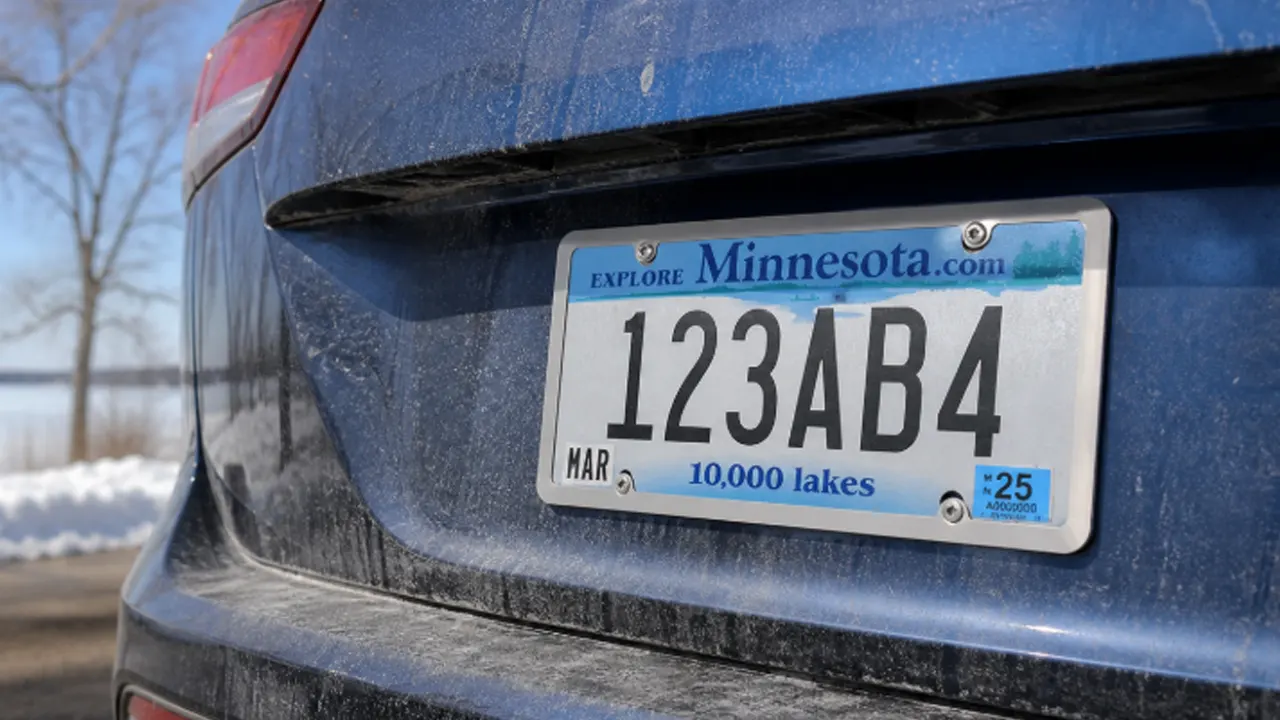
Minnesota allows a frame only when the plate remains legible and unobstructed. You cannot cover any assigned letters or numbers or the name of the state with any material. The rule even includes clear or colorless material when it affects visibility or reflectivity.
Most Minnesota passenger vehicles need a plate at both the front and rear. That means compliance is not only about the frame opening; you also need the right bracket, orientation, and hardware at two different mounting locations.
What Minnesota Statutes §169.79 protects
| Requirement | What it means for your frame |
|---|---|
| Assigned letters and numbers | Every character must remain completely open and readable. |
| State name | The word “Minnesota” cannot be covered by the top rail. |
| Visibility and reflectivity | Clear or colorless material is a problem if it changes how the plate can be seen or reflected. |
| Clean condition | Grease, dust, snow, road salt, or trapped dirt cannot blur the lettering. |
| Secure orientation | Plates must be secure, horizontal, outward-facing, and upright unless a specific exception applies. |
Month and year stickers are normally displayed in the lower corners on plates that require validation: month at the lower left and year at the lower right. Keep those zones open even though the quoted covering sentence specifically names characters and the state name.
Most vehicles need front and rear plates
For motor vehicles not assigned to one of the statute’s special categories, one plate goes on the front and one on the rear. Motorcycles, motor scooters, motorized bicycles, sidecars, certain trailers, semitrailers, and dealer-plated vehicles generally use one rear plate. Truck-tractors, road-tractors, and farm trucks use one front plate.
Collector vehicles and several other categories have separate choices. If you are preparing fleet packaging, build a vehicle-class matrix instead of saying “Minnesota always requires two plates.”
Front and rear frames often need different hardware
The front plate may attach to a plastic bumper bracket, while the rear plate may use threaded inserts in a trunk lid or liftgate. Screw diameter, pitch, and length can differ. The border must remain steady at both positions and cannot drift over a character after vibration.
When you add a frame, gasket, or decorative cap, recheck screw length. Follow the installation guide and never force a screw that binds after the first turn.
Snow and road salt make maintenance part of compliance
Minnesota’s visibility rule is not limited to the day of installation. Winter buildup can collect along a deep lower rail, and a face cover can trap moisture, salt, and grit. Brush snow from both plates and clean the frame channel without scratching the reflective surface.
Choose an open design with drainage and enough clearance to wipe the plate. A corrosion-resistant frame does not make steel screws rust-proof, so specify compatible hardware and inspect it after winter use.
Why a clear cover can still violate the rule
The statute expressly includes clear or colorless material that affects visibility or reflectivity. A glossy cover may create flash glare, distort characters at an angle, or become hazy after abrasion. “Transparent” describes its appearance, not its legal effect.
Use an open frame if you want decoration without changing the plate’s optical surface. The U.S. frame range provides material and design starting points.
A seven-point Minnesota check
- Confirm whether the vehicle needs two plates or falls within a one-plate category.
- Fit a current Minnesota plate in the production frame.
- Leave the state name, all characters, and lower-corner sticker zones visible.
- Install the correct front and rear hardware.
- Check that each plate is horizontal, upright, and secure.
- View both plates from normal traffic angles in daylight and at night.
- Clean snow, salt, grease, and dust whenever they reduce legibility.
Opening dimensions matter more than the nominal outer size. Use the size guide to compare the protected opening, then test the actual plate.
What to do with an obstructive frame
Remove it or replace it with a slimmer open frame. Do not move the stickers, scrape the reflective face, bend the plate, or rotate a horizontal plate to suit an aftermarket bracket. Reinstall it securely in the required position.
If a two-screw frame chatters against the plate, add non-obstructive support rather than overtightening. The mounting comparison explains the available approaches.
Design notes for Minnesota dealer and fleet programs
- Approve both front and rear assemblies.
- Keep a defined margin around the state name and all characters.
- Reserve the lower corners for validation stickers.
- Provide drainage and winter-cleaning access.
- Specify hardware by mounting system, not as “universal.”
- Check coating thickness and rail depth after production.
- Avoid any face cover that changes reflectivity.
For a multi-state frame, Minnesota’s state-name and reflectivity language should be part of the shared approval checklist. Do not loosen the opening simply because another state’s statute protects fewer named elements.
Frequently asked questions
Can a frame cover the word “Minnesota”?
No. The statute expressly prohibits covering the state name with any material.
Are clear plate covers legal in Minnesota?
Not when they affect visibility or reflectivity. The law specifically reaches clear and colorless material with that effect.
Does Minnesota require a front license plate?
Most passenger vehicles need front and rear plates, while motorcycles, certain trailers, dealer vehicles, and other listed categories follow different rules.
Can a motorcycle plate be vertical?
A motorcycle may display a vertical plate when it is issued as a vertical plate under the referenced statute. Do not rotate a horizontal-character plate simply to fit a bracket.
Is this legal advice?
No. It is a design and maintenance summary based on the current published statute reviewed above. Confirm current law for a citation or specialized vehicle.
Plan a Minnesota-ready frame set
Send the vehicle classes, front and rear brackets, plate sample, opening, artwork, finish, hardware, quantity, and packaging requirements through the contact form. We can review the physical design while you finalize legal approval.