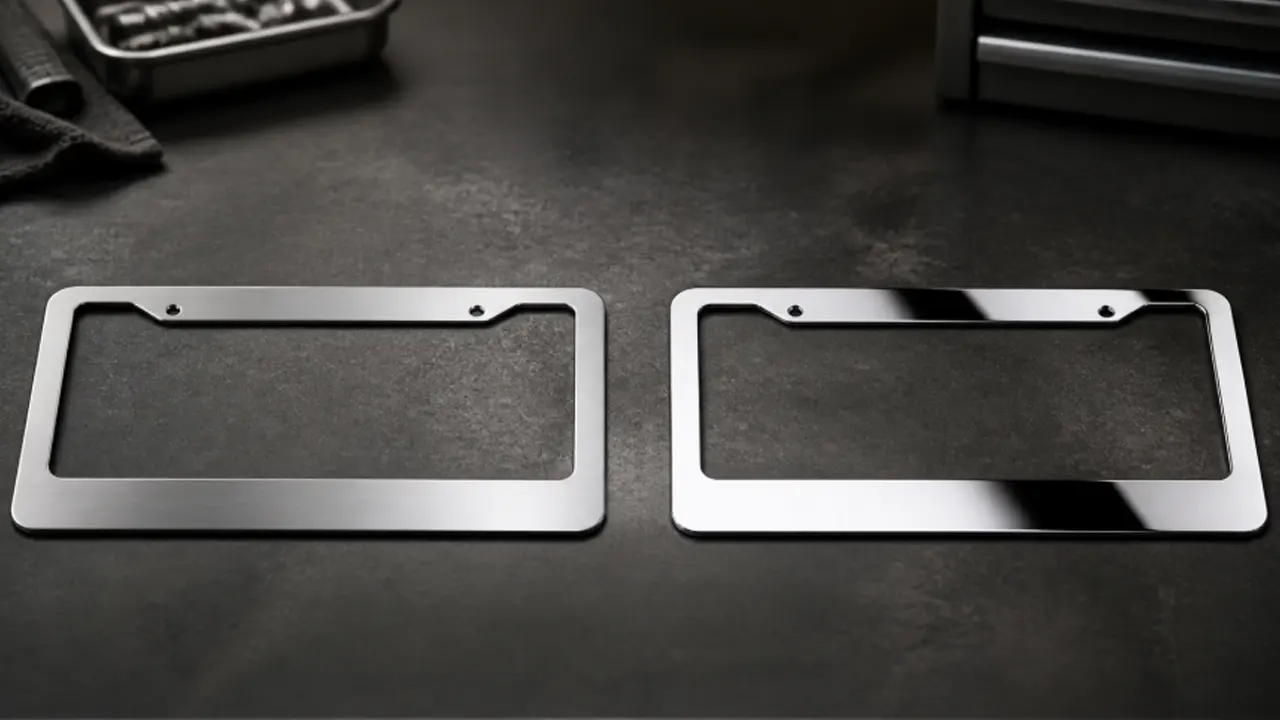
Choose a brushed stainless steel license plate frame when you want a directional, lower-reflectivity metal surface that is generally more forgiving of fine handling marks. Choose a polished frame when the product brief calls for a bright, reflective, chrome-like stainless appearance. The polished option demands tighter control of waviness, fine scratches, fingerprints, and protective packaging.
Brushed and polished are not complete finish specifications. Suppliers may use different abrasives, sequences, pressure, line direction, base sheet, and final buffing while applying the same marketing name. Approve a physical master and define measurable or observable limits before production.
Brushed vs Polished at a Glance
| Decision Factor | Brushed Stainless | Polished Stainless |
|---|---|---|
| Appearance | Directional grain, satin-to-bright metal look, reduced reflections | Bright reflective surface; mirror quality depends on polishing level |
| Handling marks | Fine marks may blend with the grain if direction and depth are similar | Fingerprints, swirls, and small scratches are often more visible |
| Lot consistency | Control grain direction, line density, tone, and transition at corners | Control reflectivity, haze, waviness, distortion, and buff marks |
| Brand character | Technical, understated, OEM-style, industrial, or modern | Decorative, luxury, classic chrome-like, or show-oriented |
| Branding | Laser marks and printed contrast must be checked against the grain | Engraving, badges, and printing must work with strong reflections |
| Packaging | Needs separation and grain-safe handling | Usually needs more protective control against contact and residue |
Finish Names Need a Reference
Worldstainless lists No. 4 as a general-purpose brushed or polished finish and No. 8 as a bright polished mirror finish. Those designations help, but a finished license plate frame can include forming, local polishing, coatings, decorative layers, and supplier-specific finishing after the sheet is purchased. A catalog label such as brushed, satin, bright, or mirror does not prove an ASTM or EN designation.
Do not infer surface roughness from the word brushed. If roughness matters to cleaning, appearance, or a later decoration process, state the measurement parameter, cutoff, direction, sampling locations, instrument, and limit. For visual programs, a controlled physical master viewed under agreed lighting may be more useful than one roughness number.
When a Brushed Finish Works Better
A brushed finish gives the frame a deliberate linear texture. It can reduce distracting reflections around the plate and fit vehicles with satin trim, dark accents, or an OEM-style exterior. Because the surface already has a direction, light scuffs that follow the same direction may be less obvious than on a mirror surface.
The grain becomes a design feature that must stay consistent. Specify whether the lines run horizontally or follow each frame segment. Corners, curved transitions, punched edges, and logo panels can show abrupt changes. If parts are reworked by hand, the repaired area may have a different line density or brightness. Decide whether local rebrushing is allowed and approve a limit sample.
When a Polished Finish Works Better
Polished stainless suits a product that should read as bright metal from a distance. A high-reflectivity surface can match chrome exterior details without using a chrome-plated base, provided the steel grade and finish are genuine and documented. The visual effect is highly sensitive to shape: a flat panel can reflect evenly, while a formed or slightly wavy border distorts highlights.
Define what polished means for the project. A bright commercial polish, near-mirror finish, and true mirror specification are not the same purchasing requirement. Inspect haze, directional polishing lines, orange-peel appearance, edge brightness, pits, buffing compound residue, and image distortion. If the frame uses several formed or assembled pieces, confirm that their brightness and tone match.
Scratch Visibility Is Not Scratch Resistance
Brushed finishes often hide fine, aligned marks better; that does not make the stainless harder. Polishing also does not automatically make a frame scratch-proof. Scratch formation depends on grade, work hardening, surface process, contact material, pressure, debris, cleaning, packaging, and use. The finish mainly changes what the eye notices.
Test handling and cleaning on the approved surface. Use the cloth, cleaner, direction, load, and number of cycles expected in the program. A circular wiping mark can be conspicuous on a brushed frame because it crosses the grain. An abrasive cleaner can turn a polished panel hazy. Care instructions should match the finish actually supplied.
Finish and Corrosion Must Be Evaluated Together
Smoother stainless surfaces can be easier to clean, while deep or inconsistent lines can retain contamination. Corrosion performance still depends on stainless grade, surface contamination, embedded iron, crevices, cut edges, salts, cleaning, and water retention. Do not promise that polished always resists corrosion better than brushed without controlling those variables.
Require post-fabrication cleaning appropriate to the process and prevent carbon-steel contamination during finishing and handling. If a passivation or chemical treatment is specified, name the method and acceptance evidence. Finish samples should use the same grade, forming, polishing, and cleaning route as production.
Branding Changes How the Finish Is Read
Laser marking on brushed stainless must have enough contrast against the grain and remain legible from the intended angle. On polished stainless, the background can mirror nearby colors and reduce apparent contrast. Printed logos, recessed color fills, raised nameplates, and badges introduce their own adhesion, edge, and color controls.
Approve the complete branded frame under diffuse and directional light. Check the logo from straight on and at realistic viewing angles. If the artwork spans a corner or changing grain direction, do not rely on a flat digital mockup.
Packaging Is Part of the Finish Specification
Polished frames commonly need protective film or individual nonabrasive wrapping. Brushed frames also need separation because one part can mark another across the grain. Define where film is applied, peel strength, residue limit, storage duration, label position, stacking orientation, separator material, and carton load.
Run a pack-out trial through expected handling and transport conditions, then inspect the parts using the production cosmetic standard. A finish that passes at the polishing station but arrives with rub marks has not passed the product requirement.
Sample and Inspection Checklist
| Control | Brushed Finish | Polished Finish |
|---|---|---|
| Reference | Physical grain and tone master | Physical brightness and reflection master |
| Direction | Grain orientation on each border and corner | Any residual polishing direction or local mismatch |
| Defects | Cross-grain scratches, patchy lines, edge damage | Swirls, haze, waviness, pits, buff marks, residue |
| Lighting | Diffuse plus directional light at fixed distance | Diffuse light plus reflected-line or image check |
| Handling | Gloves, grain-safe cleaning, separators | Gloves, minimal contact, film or individual wrap |
| Branding | Contrast and legibility across the grain | Contrast under changing reflections |
How to Specify the Finish in an RFQ
State the stainless grade and thickness, base sheet finish, final process, finish designation where applicable, grain direction, approved physical master, critical surfaces, defect limits, inspection lighting, branding method, protective film, and pack-out. Include acceptance samples for allowed and rejected defects. Terms such as premium brushed or mirror-like are not inspection criteria.
Use Xingchang’s stainless steel license plate frame page to review polished and brushed product directions. If grade is still open, compare 201 and 304 stainless steel license plate frames before locking the cosmetic standard.
Frequently Asked Questions
Does brushed stainless steel scratch less than polished stainless?
Not necessarily. Brushed grain can make certain fine, aligned marks less visible, while cross-grain scratches may stand out. Scratch resistance depends on the material and contact conditions; the finish changes visibility.
Is polished stainless the same as chrome plating?
No. Polished stainless is the exposed stainless surface refined by mechanical finishing. Chrome plating is a deposited coating over a substrate. Both can look bright, but the material stack and failure modes differ.
Is No. 4 finish always brushed?
No. 4 is commonly associated with a general-purpose brushed or polished appearance, but the final visual result varies with the abrasive, base material, process, and supplier. Reference the applicable standard and approve a sample.
Is mirror polish always No. 8?
No. 8 is a common bright-polished mirror designation, yet sellers may use mirror as a marketing description without meeting a defined standard. Specify the required designation or a controlled appearance master.
Which finish shows fingerprints more?
Highly polished surfaces usually make fingerprints more noticeable because they disrupt a uniform reflection. Brushed surfaces can still show oils, especially under directional light. Cleaning and handling rules remain necessary for both.
Which finish is easier to maintain?
That depends on the soil, cleaning method, grain depth, polish quality, and acceptable appearance. Polished surfaces may wipe clean easily but reveal swirls; brushed surfaces may hide fine marks but require wiping with the grain.
Can a brushed frame be refinished after scratching?
Sometimes, but local rework can create a patch with different grain, tone, or line density. Define whether rework is allowed and approve a repaired limit sample before production.