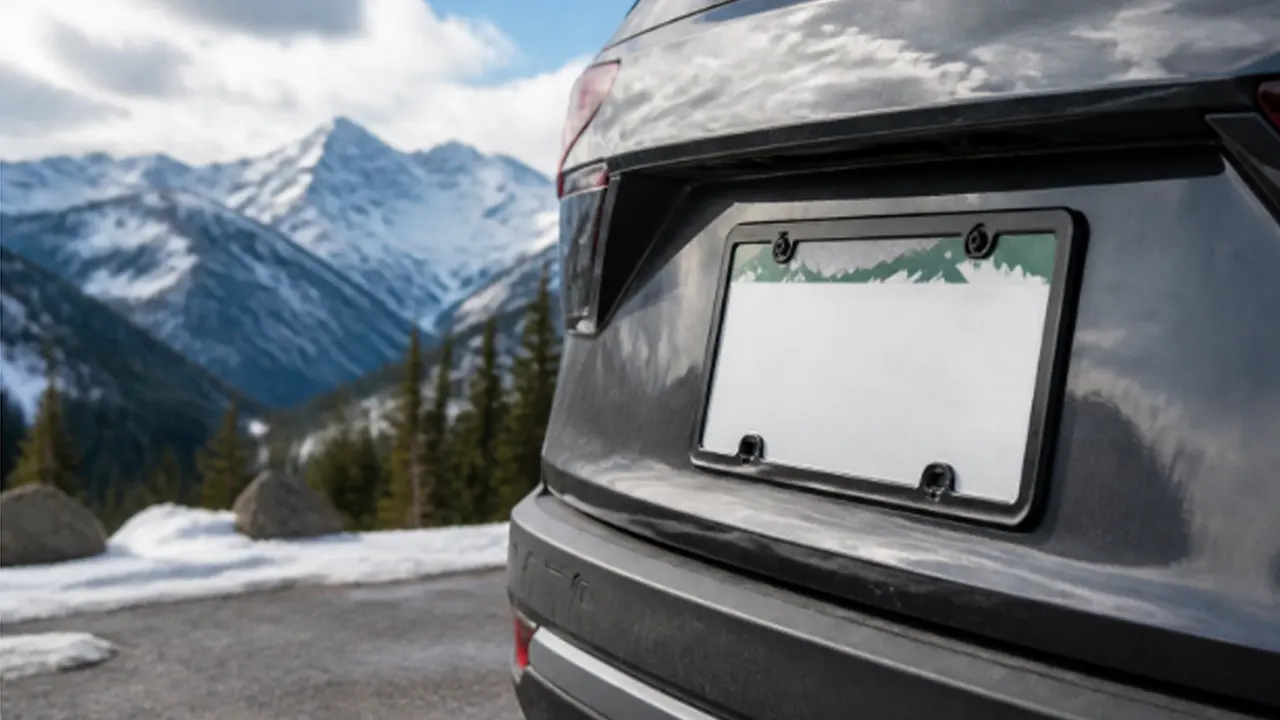
License plate frames are not automatically illegal in Colorado. A frame is acceptable only when it leaves the plate clearly visible and legible, keeps the month and year tabs exposed, and does not make any part of the plate unreadable to an automated vehicle-identification system.
That last requirement matters. A cover or coating can look readable to you from directly behind the car yet still violate Colorado law if it changes color, distorts an angled view, or interferes with camera recognition.
Colorado’s frame rules at a glance
| Requirement | What it means for your frame |
|---|---|
| Plate must be clearly visible and legible | No rail, badge, screw cap, dirt, or bracket over the readable face |
| Rear month tab | Keep the bottom-left corner open |
| Rear year tab | Keep the bottom-right corner open |
| Automated-system readability | Avoid smoked, tinted, scratched, dirty, color-altering, or angle-distorting covers |
| Ordinary § 42-3-202 violation | Class B traffic infraction |
| Device/substance that defeats automated reading | Class A traffic infraction and $100 fine |
Colorado Revised Statutes § 42-3-202 was checked in the official 2026 compilation on August 24, 2026.
Start with the two bottom corners
Many decorative frames are sold with a heavy bottom rail because that is where a dealer name or slogan is easiest to print. On a Colorado rear plate, that design can collide with the current month tab in the lower-left corner and the current year tab in the lower-right corner.
The statute says those tabs or stickers must be visible at all times. Do not approve a frame by looking only at the registration characters in the center. Install the actual tabs—or use an accurate plate sample—before measuring the usable border.
Corner screw caps can cause the same problem. A small cap may not touch the registration number but can still overlap a validation tab once the plate and frame are stacked on the vehicle.
Colorado regulates the plate’s position, not just its readability
For an ordinary rear plate, the law requires more than a clear opening. Unless another rule applies, the plate must be:
- horizontal;
- at least 12 inches above the ground, measured from the bottom;
- clearly visible;
- free from foreign material and clearly legible;
- approximately centered across the vehicle; and
- mounted on or within 18 inches of the rear bumper.
The front plate must be horizontal in the location designated by the vehicle manufacturer, free from foreign material, and clearly legible.
A frame cannot correct a plate that is mounted too low, tucked deep under the bumper, or moved away from the manufacturer’s front location. If an aftermarket bumper or winch mount changes the plate position, evaluate the whole bracket assembly.
Colorado generally requires front and rear plates
Self-propelled vehicles normally display one plate at the front and one at the rear. Motorcycles, autocycles, street rods, trailers, semitrailers, drawn vehicles, and special mobile machinery are among the listed rear-plate-only categories.
For a passenger-car frame program, that means you should test both positions. The rear may have a recessed pocket and validation tabs; the front may sit on a curved bracket or grille mount. A frame that lies flat at the rear can bow at the front and push a corner into the plate.
The automated-reader rule is broader than “I can read it”
Section 42-3-202 prohibits operating a vehicle with an attached device or substance that makes all or part of the plate unreadable by a system used to identify a vehicle automatically.
The statute gives concrete examples:
- a cover that distorts visibility from an angle;
- a cover that changes the plate’s color;
- smoked or tinted material;
- a scratched cover; and
- a dirty cover that impairs legibility.
This is why a transparent cover is not automatically safe. Plastic can create reflections in bright sun, collect fine scratches, or become cloudy after winter use. Colorado’s mountain weather, road grit, de-icing chemicals, and rapid temperature changes make those failure modes more than theoretical.
A plain open frame avoids the optical layer entirely.
What happens if the frame or cover violates the rule?
A violation of § 42-3-202 is generally a class B traffic infraction. A violation involving a device or substance that makes the plate unreadable to an automated identification system is a class A traffic infraction with a $100 fine under the section.
The official annotations also show why dirt matters. Colorado courts have recognized that an obstructed plate can support a traffic stop even when the officer can later determine enough information to check the registration. Do not assume winter grime is harmless simply because the frame itself is narrow.
Test the frame in real Colorado conditions
A showroom inspection is useful, but it does not reveal every problem. Try this sequence:
- Install the frame, plate, tabs, washers, and caps on the actual bracket.
- Confirm both lower tabs are fully visible.
- View the plate straight on and from each rear-quarter position.
- Photograph it in sunlight without flash and again with the vehicle lights on.
- After a wet or dusty drive, inspect where dirt collects around the inner lip.
- Check whether the plate remains flat. A warped frame can change angled visibility.
- Clean the plate and repeat the inspection during winter use.
If the frame rattles or lifts away from the bracket, check whether the mounting pattern provides enough lower-edge support. The two-hole vs four-hole guide explains the difference, and the installation guide covers tightening and alignment.
A better specification for Colorado sales programs
When you source a custom frame, separate “fits a 12 × 6 inch plate” from “leaves a Colorado plate compliant.” They are not the same promise.
| Drawing or QC item | Colorado-specific check |
|---|---|
| Inner opening | Full serial and plate legends remain readable |
| Lower corners | Month tab at left and year tab at right stay open |
| Optical layer | No smoked, tinted, reflective, or color-altering cover |
| Side profile | No angle distortion from a thick lip |
| Flatness | Frame does not bow the plate on the vehicle bracket |
| Finish durability | No flaking, clouding, or surface buildup entering the opening |
| Installed photos | Front, rear, left-quarter, and right-quarter views |
For a dealer group selling across state lines, document the Colorado version separately instead of using one photo to support a national legality claim. You can compare the common formats in the US license plate frame guide and define the required opening with the size guide.
Colorado license plate frame FAQ
Can a Colorado frame cover the month or year sticker?
No. The current month tab on the lower left and current year tab on the lower right of the rear plate must remain visible.
Are smoked plate covers illegal in Colorado?
A smoked cover is specifically identified as a device that can impair legibility for an automated identification system. Do not use one.
What if a clear cover is easy to read in person?
It can still be a problem if it distorts an angled view, changes color, or becomes scratched or dirty enough to impair automated readability.
Does Colorado require a front plate?
Most self-propelled vehicles display front and rear plates. The statute lists rear-only categories, including motorcycles, autocycles, street rods, trailers, and certain other vehicles.
How high must the rear plate be mounted?
Unless an exception applies, the bottom of the rear plate must be at least 12 inches above the ground. The plate must also be approximately centered and on or within 18 inches of the rear bumper.
Is dirt around the frame a legal issue?
Yes. The plate must be free from foreign material and clearly legible. A deep frame lip that traps mud or snow can turn a compliant frame into a visibility problem.
Bottom line
Use a slim, open frame in Colorado and keep both lower validation tabs completely exposed. Avoid any cover or substance that adds tint, color change, scratches, glare, or angle distortion. Then check the mounting position and cleanliness of the full assembly—not just the center opening.
For a custom project, send the target plate, vehicle bracket, opening dimensions, finish, hardware, logo area, and quantity through the contact form.
This article provides general information, not legal advice. Use the current official statute for a citation, fleet rule, or product-compliance decision.