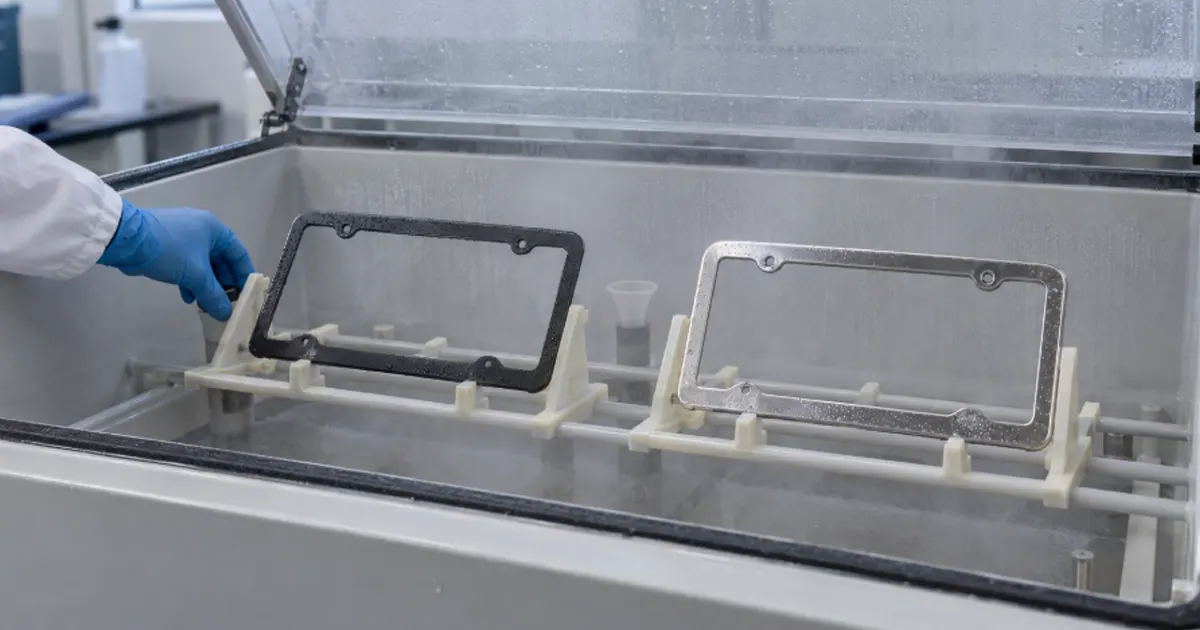
A salt spray report can be useful when you are comparing two finished license plate frames. It can reveal how a metal or coated surface behaves in a controlled corrosive fog. It cannot, by itself, tell you how many years a frame will last on every vehicle, in every climate, with every cleaner, fastener, or road condition.
What a salt spray test is actually testing
Salt spray exposure places specimens in a controlled salt-fog environment. ASTM B117 describes the apparatus and operating conditions for that environment. It is commonly used to generate comparative corrosion-resistance information for metals and coated metals tested in the same chamber under the same agreed evaluation rules.
That makes the test valuable for a license plate frame when the question is narrow: which sample shows earlier corrosion, blistering, staining, lifting, or other visible damage under the stated conditions? The answer becomes much less useful when the report does not identify the exact frame construction or what the evaluator counted as a failure.
What the test can and cannot tell you
| Question | What salt spray can help show | What it cannot prove alone |
|---|---|---|
| Surface comparison | Relative behavior of stated samples in the stated test environment | That every version of the frame will perform the same way |
| Coating condition | Visible corrosion-related damage, lifting, or staining under agreed evaluation | That the coating will never chip, fade, or wear in service |
| Exposure time | How long the named samples remained under the defined chamber conditions | A direct conversion from test hours to years outdoors |
| Product claim | Evidence for a carefully limited statement about the tested construction | A blanket “corrosion-free” or lifetime claim |
ASTM B117 itself is clear that the practice does not prescribe the exposure period or the interpretation for a specific product, and that standalone salt-spray results do not reliably predict natural-environment performance. That boundary is not a weakness in the test. It is the reason the test report needs context.
For a license plate frame, the specimen matters
A flat coupon and a finished frame do not expose the same weak points. A real frame has holes, corners, formed edges, decorative rails, possible joints, and contact zones for screws, washers, plates, backing holders, and vehicle surfaces. If a frame is plated, painted, powder coated, or otherwise finished, the test sample should represent the intended production construction.
Check whether the chamber held a flat panel, a cut part, or the completed frame. A panel can be useful for comparing materials or finish conditions. It cannot automatically show how the inside edge of a mounting hole, a folded return, or an assembly joint will behave. When you want to understand a complete accessory, include at least one finished frame alongside any laboratory panels.
Read the damage location, not only the headline result
“Passed salt spray” is not enough to interpret the result. Look at where the first defect appeared. Damage on a hidden uncut test edge has a different meaning from corrosion at a visible chrome rail, bubbling around a screw hole, staining at a folded edge, or finish lifting beside a plate-contact point.
Photographs taken before and after exposure help, especially when they use the same viewing angle and lighting. The report should also state whether the sample was scratched or scribed before exposure. A scribed sample may be used to examine under-film behavior, but it answers a different question from an intact cosmetic surface. Do not compare those results as if they were interchangeable.
What to look for in a useful report
| Report item | Why it matters for a frame |
|---|---|
| Sample identification | Links the result to the correct base material, finish stack, and drawing revision |
| Test method and chamber conditions | Shows which environment was used rather than relying on a vague “salt test” label |
| Exposure duration | Records the actual comparison period without converting it into a service-life promise |
| Sample count and orientation | Helps explain variation and whether finished geometry was represented |
| Preconditioning or scribe condition | Clarifies whether the surface was intact, intentionally damaged, cleaned, or otherwise prepared |
| Acceptance criteria | Defines the permitted defect, location, area, or visual standard |
| Before-and-after images | Makes cosmetic and localized damage easier to evaluate |
Salt spray is one part of a sensible durability plan
A license plate frame may see ultraviolet light, rain, road grit, detergents, vibration, hand contact, automatic car-wash exposure, and metal-to-metal contact. Salt fog does not reproduce all of those conditions. If color retention matters, add a weathering evaluation. If the frame carries a coating or printed logo, add an adhesion and abrasion check suited to that construction. If screws or a holder touch the finish, include an installation trial with the intended hardware.
For a bright decorative surface, define the test sample around the actual chrome-plated frame construction. For a metal frame program, the stainless steel frame options and aluminum frame options are separate material directions, not substitutes for a model-specific corrosion report.
A practical way to use the result
Use salt spray to compare like-for-like finished samples, not unrelated materials or coatings. Keep the result tied to the identified construction. If the base material, plating or coating system, pretreatment, geometry, or hardware changes, the old report may no longer represent the part in front of you.
A well-documented result narrows uncertainty. It does not remove it with a single headline number.
FAQ
How many salt spray hours should a license plate frame pass?
There is no universal number that applies to every material, finish, market, and product design. Set the duration and acceptance criteria against the actual construction and expected exposure, then compare like-for-like samples.
Does a salt spray test prove a license plate frame will not rust?
No. It provides comparative information under a controlled test environment. Service corrosion can also depend on damage, moisture traps, road salts, vehicle location, fasteners, cleaning, and natural weather cycles.
Should plastic license plate frames be salt spray tested?
It depends on the construction. A plastic frame with metalized, plated, coated, printed, or metal hardware elements may have corrosion-related questions. Identify which component and finish you are trying to evaluate first.