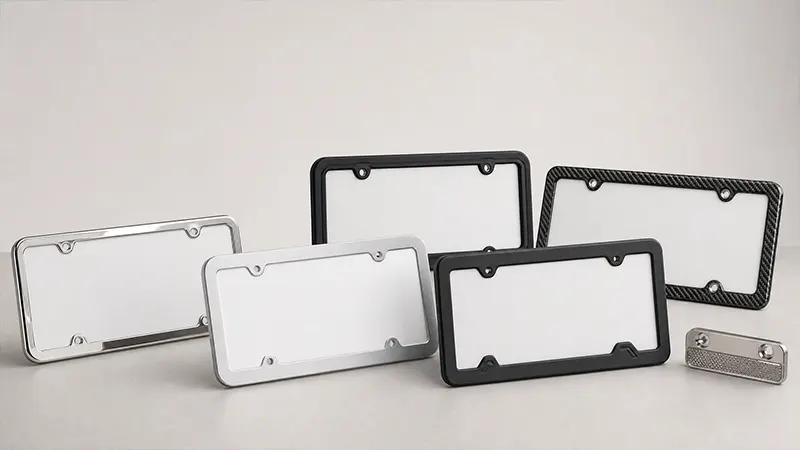
The main types of license plate frames are metal, plastic, silicone, zinc-alloy, and composite frames. You can also classify them by slim or wide border, two-hole or four-hole mounting, open or wraparound construction, passenger-car or motorcycle size, and decorative or commercial use. The best category is the one that fits your plate and vehicle, keeps every required mark visible, and matches the environment—not simply the material with the most impressive name.
A Quick Classification Table
| Frame type | Main strength | Best starting use | Check before buying |
|---|---|---|---|
| Stainless steel | Rigid, slim metallic construction | Premium retail, dealer, exposed-metal designs | Grade, edge finish, polish or coating, hardware |
| Aluminum | Low mass and broad finish choice | Printed graphics, colored programs, fleet branding | Alloy, temper, thickness, pretreatment, sealing |
| Zinc alloy | Deep cast detail and raised decoration | Logos, emblems, sculpted promotional frames | Porosity, plating stack, rear coverage, drainage |
| Rigid plastic | Molded ribs, clips, texture, and color | Volume programs and integrated features | Resin, UV package, wall thickness, warpage |
| Silicone | Soft contact and noise isolation | Drivers prioritizing rattle and edge protection | Drainage, fit, tear resistance, dirt retention |
| Carbon composite | Real woven appearance and low mass | Performance-themed and premium accessories | Authenticity, laminate, edge sealing, UV clear coat |
| Carbon-look frame | Carbon visual theme at lower cost | Decorative retail products | Base material, print or film durability, honest labeling |
License Plate Frame Types by Material
Stainless steel frames
Stainless steel is a strong choice when you want a thin frame that still feels rigid. It can be polished for a bright appearance, brushed for a quieter metallic finish, or coated for color. The words “stainless steel” are not enough for a purchasing specification: grade, sheet thickness, forming, edge treatment, welds or attachments, and the hardware set all affect outdoor performance.
Choose stainless steel when the visible metal itself supports the design. Check the rear face as carefully as the front. Burrs, sharp corners, unfinished edges, or hard contact points can mark paint and make installation uncomfortable.
Aluminum frames
Aluminum gives you low mass and flexible decoration options. Anodizing, powder coating, painting, UV printing, screen printing, and laser marking can produce very different looks. Aluminum does not form red iron rust, but it can oxidize, stain, pit, or suffer coating failure, especially where cut edges and dissimilar hardware are exposed.
It is a practical starting point for colored graphics and branded programs when the alloy, temper, finish stack, and sealing are controlled. Compare aluminum and stainless steel in our material comparison before you approve only on appearance.
Zinc-alloy frames
Die-cast zinc alloy makes raised lettering, recessed color, emblems, deep borders, and complex decorative surfaces economical at production volume. It feels substantial and can support polished or plated finishes that are difficult to create from flat sheet.
Its durability depends heavily on casting and finishing quality. Porosity, incomplete polishing, trapped plating solution, thin coverage on edges, and scratches through the coating can produce blisters or white corrosion. A bright chrome appearance does not identify the alloy or prove the finish system.
Rigid plastic frames
Injection-molded plastic can integrate ribs, screw-head recesses, clips, textures, drainage, and branding areas in one part. It is lightweight and well suited to larger volumes. “Plastic” is still too vague for a technical description. Resin family, grade, recycled content if used, UV stabilization, color system, wall thickness, and mold design affect fading, warpage, brittleness, and screw-hole strength.
A carbon-fiber pattern molded or printed on plastic is a visual style, not a carbon-fiber composite. Clear naming helps buyers compare it fairly.
Silicone frames
A silicone frame wraps around the plate edge and separates the metal plate from the vehicle. This can reduce rattling and hard-edge contact. It cannot correct wrong screws, a loose vehicle bracket, or a frame that blocks plate information. The channel should fit without bunching, and low points should drain after rain or washing.
Silicone is a useful choice for quiet daily use, but inspect the rear surface occasionally because grit and moisture can collect between the plate and the vehicle. See our silicone license plate frame range for the construction category.
Carbon-fiber and carbon-look frames
Real carbon-fiber frames use reinforcing fibers in a resin matrix. Some are full laminates; others combine carbon material with a supporting core. Carbon-look frames use printed film, hydrographic decoration, molded texture, or a patterned insert over another substrate. Neither construction is automatically better for every buyer, but the description must be precise.
For a real composite, check the fiber layout, laminate support around holes, trimmed-edge sealing, clear-coat UV resistance, and installation instructions. For a carbon-look product, check adhesion, scratch resistance, edge wrapping, and how the pattern ages outdoors.
Types by Border Shape and Opening
A slim frame keeps more of the plate visible and is the safer default when the issuing jurisdiction places names or registration tabs close to the edge. A wide frame gives you more room for dealer names, slogans, colors, and emblems, but it needs a carefully controlled opening. “Universal” should never mean “covers a little on some plates.”
Top-heavy and bottom-heavy frames concentrate branding on one bar. Reversible designs can move the larger message area away from registration tabs, but only if the hole pattern and artwork remain correct. Corner-only or partial frames minimize border coverage. Full-surround frames protect the plate edge more completely but need enough clearance and drainage.
Two-Hole and Four-Hole Frames
A two-hole frame normally uses the upper vehicle mounts. It is common and easy to install, but the unsupported lower edge can vibrate if the frame or plate is not flat. Pads, lower clips, a properly fitted backing plate, or a wraparound design can control movement without drilling the vehicle.
A four-hole frame supports all corners when the vehicle provides four matching mounting points. It can improve alignment and reduce vibration, but you should never force lower screws into locations that were not designed as mounts. Check the vehicle bracket, screw thread, and depth before choosing. The detailed decision is covered in our 2-hole vs 4-hole license plate frame guide.
Passenger-Car, Motorcycle, and Regional Formats
North American passenger plates commonly use the 12 × 6 inch format. European plates are typically much longer and narrower, while Japanese and other national formats use different proportions and mounting systems. Motorcycle plates are not covered by one universal U.S. size, even though 7 × 4 inch products are common in the aftermarket.
Choose the frame for the issuing plate, not just the vehicle brand or country where the frame is sold. Measure the plate, hole centers, slot range, available outer envelope, and required visible information. Our regional starting points include U.S. license plate frames, European plate holders, and Japanese-format frames.
Open Frames, Holders, and Covers Are Not the Same
An open frame borders the plate but leaves its face exposed. A holder may support the plate from behind, use clips, or provide a mounting adapter. A wraparound surround captures the plate edge. A cover places material over the plate face. These products solve different problems and face different legal risks.
If your goal is branding or edge finish, an open slim frame is usually the simplest starting point. If your goal is adapting a plate to a bracket, specify a holder or adapter. Avoid tinted, reflective, angled, or distortion-producing covers; even a product marketed as protective can be unlawful when it impairs visual or electronic recognition.
Types by Intended Use
| Use | Useful design direction | Questions to settle |
|---|---|---|
| Dealer advertising | Readable logo, controlled message bar, durable high-volume construction | Target states, artwork size, order quantity, installation time, pack-out |
| Retail accessory | Finish choice, clean edges, broad vehicle fit, complete hardware | Material claims, warranty, shelf packaging, legal opening |
| Fleet branding | Repeatable color, identification, easy replacement | Vehicle mix, exposure, wash chemicals, inventory control |
| Premium custom program | Metal, cast relief, emblem, or verified composite | Master sample, finish stack, logo tolerances, cosmetic inspection |
| Noise and paint protection | Soft isolation, flat support, sealed edges, drainage | Actual rattle source, pad placement, moisture and grit management |
| Motorcycle application | Compact frame with verified plate and hole geometry | State plate dimensions, bracket clearance, vibration, lighting |
How to Choose the Right Type
- Identify the country, state, or province and the exact plate format.
- Measure the plate, mounting holes or slots, and vehicle recess.
- Mark the information that must stay visible, including tabs and jurisdiction name.
- Rank your purpose: branding, appearance, noise control, edge protection, or adaptation.
- Choose a construction and finish that suit the exposure and order volume.
- Check hardware, rear-face contact, drainage, camera and lamp clearance.
- Install and inspect the complete assembly from straight on and at normal viewing angles.
If you are developing a branded range, send the target plate format, frame style, material preference, artwork, finish, quantity, and packaging requirements through our project inquiry form. Those inputs let the manufacturer recommend a process instead of guessing from a reference photo.
Frequently Asked Questions
What is the most durable type of license plate frame?
Durability comes from the complete construction. A well-specified stainless or aluminum frame can be highly durable, while a properly stabilized plastic or silicone design may perform better where soft contact matters. Compare grade, geometry, finish, hardware, drainage, and validation—not only material names.
What type is least likely to rattle?
A correctly fitted silicone surround or a rigid frame with well-placed isolation pads can reduce plate noise. First confirm that the rattle is actually coming from the plate assembly rather than the trunk trim, bracket, camera housing, or loose hardware.
Are wide license plate frames legal?
That depends on what the installed border covers and the jurisdiction that applies. A wide frame is higher risk because plate information often sits close to the edges. Choose the opening using the real plate and current official rules.
Is a license plate holder the same as a frame?
No. A frame is mainly a visible border. A holder or bracket supports or adapts the plate to the vehicle. Some products combine both functions, so check the rear construction and mounting method.
Can the same frame fit the front and rear?
Often, but not always. Plate size may match while the recess, camera, lamp, bracket, and screw depth differ. Test both positions instead of assuming the visible plate is the only interface.