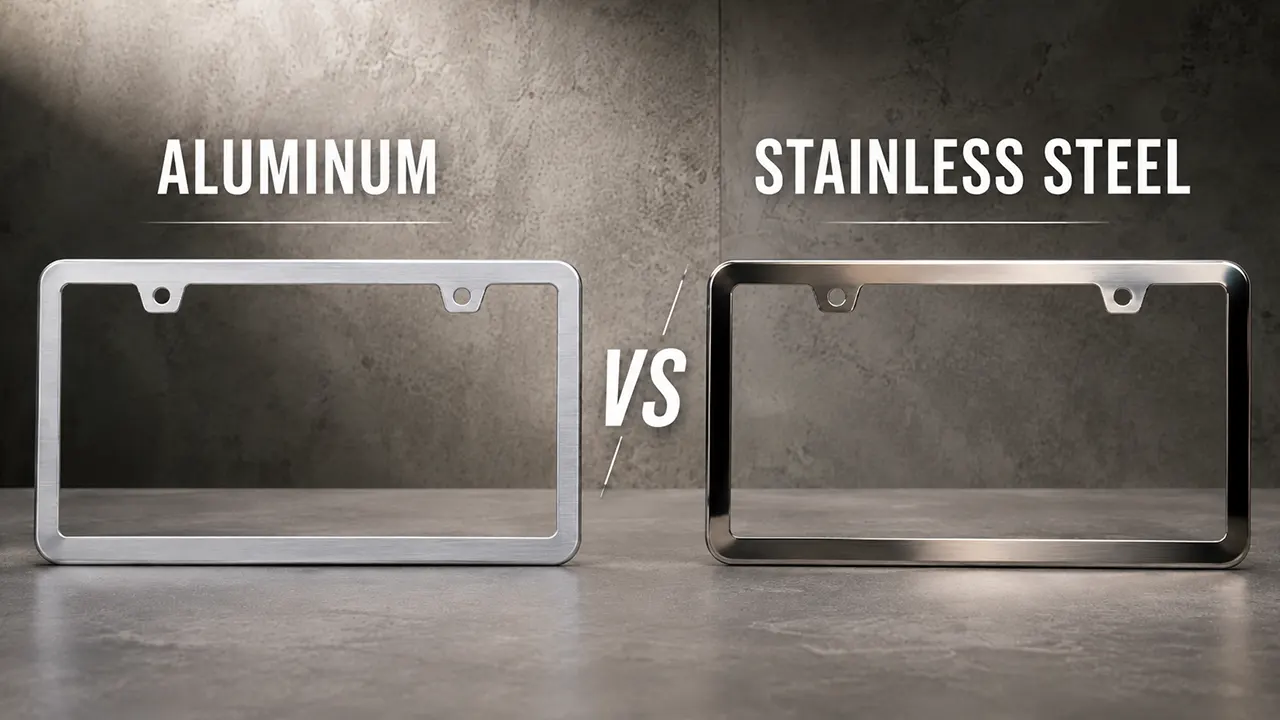
Choose aluminum when low unit weight, colored finishes, or printed graphics drive the program. Choose stainless steel when you need more rigidity in a slim profile or a polished or brushed metallic appearance. Neither material is automatically better for corrosion; the alloy or grade, finish, hardware, drainage, and exposure determine the installed result.
At the same geometry, aluminum is much lighter while stainless steel has substantially higher elastic stiffness. Finished-frame performance can reverse that simple comparison: a thicker formed aluminum section may resist flex better than a thin flat stainless frame.
Before you approve either option, compare the exact material designation, thickness, formed geometry, finish system, fastener set, assembled-product tests, packaging, and landed cost. A quotation that names only the material family is not a complete specification.
Quick comparison: start with the job
| Decision factor | Aluminum frame | Stainless steel frame | What you should verify |
|---|---|---|---|
| Unit weight | Lower at the same geometry | Higher at the same geometry | Finished unit weight, not material name |
| Elastic stiffness | Lower modulus; design may need more section depth or thickness | Higher modulus; can feel more rigid at equal geometry | Thickness, formed profile, opening, and sample flex |
| Corrosion behavior | Protective oxide forms naturally; alloy and finish still matter | Passive chromium-rich film provides protection; grade and surface condition still matter | Alloy/grade, finish, cut edges, hardware, and exposure |
| Color and graphics | Well suited to specified anodized, painted, powder-coated, or printed systems | Often selected for polished or brushed metal effects; coatings and graphics still need qualification | Actual finish stack, color tolerance, adhesion, and abrasion test |
| Thin-profile rigidity | Possible through geometry and thickness design | Often easier to achieve because of higher modulus | Approved drawing and physical sample |
| Wet or salty service | Can corrode or pit if the system is poorly specified or damaged | Can stain, pit, or develop crevice corrosion when the grade or design is unsuitable | Assembled-part test with real fasteners and acceptance criteria |
| Cost | May save mass, but finish and scrap can dominate | May use a thinner section, but material and forming can cost more | Total landed cost at the same performance specification |
The comparison becomes useful only when both options are quoted against the same opening, border width, hole layout, artwork, package, and acceptance standard. Review the available aluminum license plate frames and stainless steel license plate frames as starting points, then confirm the exact construction for your program.
At the same geometry, aluminum is lighter and stainless is stiffer
The weight difference is large enough to matter in packaging and high-volume freight. The Aluminum Association’s sheet-product data lists a density range of 2.66-2.84 g/cm^3 and a typical elastic modulus of 69-73 GPa for aluminum sheet. The worldstainless technical-property tables list 304 stainless steel at 7.9 g/cm^3 and 200 GPa, and 430 stainless steel at 7.7 g/cm^3 and 220 GPa.
At equal dimensions, a stainless part is therefore roughly three times as dense and has roughly three times the elastic modulus of an aluminum part. Density affects mass. Elastic modulus affects how much the material deflects under load. Neither value tells you the finished frame’s tensile strength, impact resistance, or resistance to permanent bending.
Those outcomes depend on details the material label leaves out: alloy or stainless grade, temper or cold-work condition, thickness, formed lips, local embossing, corner radii, hole geometry, and unsupported span. A stamped aluminum frame with a formed section can outperform a thin flat stainless frame in a hand-flex comparison. The reverse can also be true.
Ask each supplier to provide the finished unit weight and thickness tolerance, then test samples built to the same drawing. Comparing two unmatched catalog items only tells you which design is different, not which material is better.
Corrosion resistance depends on alloy, finish, and assembly
Stainless steel protects itself through a thin chromium-rich passive oxide film. Nickel Institute guidance on pickling and passivation explains that this passive layer forms naturally on a clean stainless surface and can reform when sufficient oxygen is available. That mechanism is valuable, but it is not a promise that every stainless grade is immune to staining, pitting, or crevice corrosion.
For a license plate frame, check the grade, surface condition, cut edges, formed corners, and areas trapped under caps or washers. Contamination introduced during cutting or polishing can also undermine the appearance of a stainless surface. If a quotation states only “stainless steel,” you do not know whether the supplied grade and finish match a coastal, road-salt, or mild inland program.
Aluminum also develops a protective oxide, but the alloy and surface process change the result. The Aluminum Anodizers Council’s specification guidance tells buyers to define the aluminum alloy and temper, mechanical finish, preparation, anodic-oxide type, appearance, and service environment. The word “anodized” alone is incomplete. Coating thickness, sealing, color system, and exposed cut edges all affect the finished part.
Aluminum does not produce the red iron oxide normally called rust, yet it can still corrode, pit, discolor, or form white corrosion products. “No red rust” and “no corrosion” are not the same claim. Stainless steel can also show corrosion when its grade, surface, geometry, or environment defeats the passive condition. Avoid “rust-proof” for either material unless the supplier defines the exact product, exposure, test method, duration, and acceptance criteria.
Do not ignore stainless hardware on an aluminum frame
Moisture and road salts can turn a dissimilar-metal joint into a galvanic couple. NASA’s corrosion guidance shows that steel or stainless steel in electrical contact with aluminum can accelerate attack on the aluminum when an electrolyte is present. Insulating washers, sleeves, sealants, coatings, and drainage can reduce the risk, but the assembled design needs verification.
Test the frame with the screws, caps, washers, backing pads, and plate material intended for sale. A bare material coupon cannot reveal water traps, coating damage around punched holes, or metal-to-metal contact created during installation.
Salt-spray hours are comparative data, not a life-expectancy clock
ASTM B117 creates a controlled salt-fog environment for relative corrosion information. ASTM also states that stand-alone salt-spray results have seldom correlated with natural-environment performance and that extrapolation is not always predictable. A claim such as “500 hours equals five years” is not supported by B117 itself.
When you request a corrosion test, define the complete specimen, preparation, scribe or damage condition if relevant, exposure duration, inspection intervals, evaluation area, and pass/fail criteria. Record whether the supplier tested a flat coupon, a finished frame, or the assembled product. Those are not interchangeable results.
Finish and branding can change the material decision
Material choice and finish choice are linked. A frame that looks convincing as a bare metal sample may behave very differently after coloring, printing, forming, edge finishing, assembly, and retail packaging.
Aluminum can be a practical starting point for color-led programs. Anodizing, painting, powder coating, printing, and other decoration methods can support different looks, but the word anodized is not a complete specification. The Aluminum Anodizers Council recommends defining the alloy and temper, mechanical finish, pretreatment, anodic-oxide requirements, and service environment. Color and surface appearance can also change with the alloy, pretreatment, coating build, sealing, and production lot. Approve a sample made with the intended production route, not a generic color chip.
Stainless steel is often selected for a polished or brushed metal appearance. It can also be coated, printed, or marked, but the supplier still needs to control surface preparation, graphic adhesion, edge quality, and handling. Highly reflective finishes can reveal scratches and fingerprints that a coarser texture would hide, so protective film and individual packaging may be part of the cosmetic specification rather than optional extras.
| Branding requirement | Questions for an aluminum frame | Questions for a stainless steel frame |
|---|---|---|
| Natural metal appearance | Which alloy, pretreatment, anodic finish, gloss, and color range are approved? | Which grade, polish or brush direction, gloss, and surface-protection method are approved? |
| Black or colored finish | What is the coating system, target color tolerance, edge coverage, and UV/exposure requirement? | What surface preparation and coating system are used, and how are adhesion and cut edges checked? |
| Printed graphics | Which ink or print process is used, and what abrasion, solvent, and color criteria apply? | How is the surface prepared, and what adhesion and abrasion criteria apply after forming? |
| Engraved or marked logo | How does the mark affect the protective finish and visual contrast? | What marking method and depth preserve the intended surface appearance? |
| Raised or recessed details | Can the selected temper and thickness form cleanly without unacceptable distortion or finish damage? | Can the grade, thickness, and tool design achieve the detail without excessive springback or marking? |
| Retail presentation | What film, sleeve, separator, and carton prevent rub marks or transfer? | What protection prevents scratches, fingerprints, and metal-to-metal contact in transit? |
A finish sample is meaningful only when it uses the intended material designation, thickness, surface preparation, production process, artwork, and packaging. If any of those inputs change, treat the new sample as a new approval.
Compare total landed specification, not raw material price
A statement such as “aluminum is cheaper” or “stainless is more expensive” is not reliable without a drawing and a complete specification. The useful comparison is the total landed cost of conforming parts:
Material mass + material price and yield + forming and deburring + finish + artwork + tooling + hardware and assembly + inspection and rework + packaging + freight.
Aluminum’s lower density can reduce unit mass and shipping weight when the geometry is comparable. That advantage can disappear if the chosen finish, artwork, scrap rate, cosmetic rejection rate, or protective packaging is expensive. Stainless may require more forming force and can carry more mass, but a thin, efficient design with a standard finish and stable yield may still be commercially competitive. Request both quotations against the same drawing, acceptance criteria, packing method, order quantity, and destination.
| RFQ line item | Detail to define | Evidence to request |
|---|---|---|
| Material identification | Aluminum alloy and temper, or stainless grade | Mill certificate, material declaration, or agreed supplier record |
| Thickness and tolerances | Nominal thickness plus allowable variation | Dimensioned drawing and sample measurement report |
| Frame geometry | Outside size, plate opening, border width, hole pattern, corner shape, edge condition | Approved drawing, fit check, and controlled sample |
| Finish system | Mechanical finish, pretreatment, coating or anodic layer, color, gloss, sealing, and edge coverage as applicable | Finish specification and production-representative sample |
| Artwork | File revision, print area, color tolerance, registration, and approved logo appearance | Signed artwork proof and decorated sample |
| Unit weight | Maximum or target mass when freight and handling matter | Sample weight and production-control method |
| Hardware and isolation | Screw, cap, washer, backing pad, adhesive, and any dissimilar-metal barrier | Bill of materials and assembled sample |
| Durability checks | Relevant corrosion, abrasion, adhesion, UV, vibration, or wash exposure with pass/fail criteria | Test method, configuration, photographs, and report, not a bare hour count |
| Packaging | Film, sleeve, separator, inner quantity, carton limits, label, and drop or transport needs | Pack-out sample and packaging specification |
| Production control | Cosmetic limit, critical dimensions, sampling plan, traceability, and nonconformance process | Inspection standard and pre-shipment report |
This structure also makes supplier quotations easier to compare. If one quote includes controlled artwork, isolated hardware, cosmetic inspection, and protective packaging while another does not, the lower unit price is not a like-for-like result.
Match the material to the buying program
The best starting material changes with the product program. These are screening rules, not release decisions.
| Buying program | Reasonable starting point | Release condition |
|---|---|---|
| High-volume colored or printed retail frame | Aluminum when low mass and a color-led surface are important | The specified finish, artwork, edge coverage, cosmetic limits, and pack-out pass on production-representative samples |
| Slim polished or brushed dealer frame | Stainless steel when a rigid section and stable metallic appearance are priorities | The exact grade, thickness, edge condition, surface direction, and scratch protection are approved |
| Coastal, humid, or winter road-salt exposure | Neither material wins by name alone | The proposed alloy or grade, finish, fasteners, drainage, and assembled construction pass a relevant comparative test |
| Multi-market program | Start with the required plate opening and mounting layout before choosing material | Each regional plate format, visible-character area, hole pattern, and vehicle interface is checked separately |
| Motorcycle or high-vibration installation | Start with mounting geometry, section design, hardware retention, and backing protection | A vehicle-representative assembly passes fit, vibration, and finish-rub checks |
| Premium gift or accessory pack | Choose the material and finish together to achieve the intended hand feel and appearance | The signed cosmetic sample and retail packaging remain acceptable after transport simulation |
A coastal label or a winter-use claim should never rest on the base-metal name alone. Water traps behind the frame, damaged edges, deposits, road chemicals, mixed-metal fasteners, poor drainage, and repeated washing can change the result. Describe the actual environment to the supplier and test the exact proposed assembly.
For multi-market sourcing, resolve fit before appearance. License plates, mounting holes, camera positions, sensors, tabs, stickers, and legally required visible areas can vary. A material comparison cannot rescue an opening or border that is wrong for the intended vehicle and market.
Approve the frame as an assembled product
A flat material coupon cannot reveal every failure mode of a formed, decorated, fastened, and packaged frame. Use the following release sequence:
- Define the interface. Identify the target country or state, plate format, vehicle mounting points, allowable border, visible areas, camera or sensor clearance, and any dealer-specific installation method.
- Freeze the material designation. Record the aluminum alloy and temper or the stainless grade. “Aluminum” and “stainless steel” are families, not purchase specifications.
- Freeze the section and dimensions. Control thickness, formed profile, outside size, opening, hole locations, edge condition, flatness, and unit weight where it matters.
- Approve the complete finish. Sign a production-representative sample with the final pretreatment, color, gloss, texture, artwork, and edge appearance.
- Approve the hardware and interfaces. Record screws, caps, washers, pads, adhesives, isolation features, drainage paths, and the vehicle-contact surface.
- Test the assembled frame. Select corrosion, adhesion, abrasion, UV, wash, vibration, fit, or packaging tests that reflect the expected risk. State the sample configuration, conditioning, duration or cycle count, inspection method, and pass/fail criteria before testing.
- Lock production and packaging controls. Keep a signed master sample, controlled drawing, bill of materials, artwork revision, inspection limits, traceability method, and pack-out specification.
The signed master sample should not replace measurable requirements. Use it to define appearance and workmanship alongside dimensions, material records, test criteria, and packaging instructions. When the supplier changes a material source, finish route, tool, artwork, hardware item, or packaging method, decide whether reapproval is required before shipment.
Which material should you specify?
Choose aluminum when low unit mass, colored decoration, or a graphics-led retail program is the main priority, and when the fully specified finish passes approval on the intended alloy, geometry, and packaging.
Choose stainless steel when rigidity in a slim section or a polished or brushed metallic appearance is the main priority, and when the selected grade, edge condition, surface protection, and installed assembly meet the exposure requirement.
For coastal, road-salt, or other demanding service, do not select from the material label alone. Ask for matched prototypes built to the proposed production specification. Compare fit, appearance, unit weight, hardware interfaces, and assembled-part test results against written acceptance criteria.
A useful quote request should include the target market and plate format, vehicle mounting layout, dimensioned drawing, material options, finish and artwork target, order quantities, packaging, destination, and approval evidence. For an OEM or wholesale program, send those inputs through the custom license plate frame service or contact the Xingchang team.
Frequently asked questions
Is stainless steel always more corrosion-resistant than aluminum?
No. Stainless and aluminum each include multiple grades or alloys, and the installed result also depends on the surface condition, finish, fabrication, fasteners, deposits, drainage, and environment. Stainless steel relies on a chromium-rich passive film; aluminum forms a protective oxide and may use a specified anodic or coating system. Compare defined constructions under relevant conditions instead of treating the family name as a corrosion rating.
Does an aluminum license plate frame rust?
Aluminum does not produce the red iron oxide normally meant by rust, but it can still corrode. Depending on the alloy, finish, exposure, and assembly, you may see staining, white corrosion products, pitting, or attack near damaged areas and dissimilar-metal contacts. “Does not rust like carbon steel” is more accurate than “corrosion-proof.”
Which license plate frame is lighter?
For the same external geometry and thickness, an aluminum frame will normally be lighter because aluminum sheet has roughly one-third the density of common 304 or 430 stainless sheet. Real frames rarely share exactly the same thickness, formed section, border, hardware, or decoration, so compare measured finished-unit weights before making freight or handling calculations.
Which material is better for winter road salt or coastal use?
There is no responsible material-only answer. Define the exact aluminum alloy or stainless grade, finish, cut-edge condition, mounting hardware, dissimilar-metal isolation, drainage, and cleaning exposure. Then test the assembled sample with agreed criteria. A high salt-spray-hour claim by itself does not predict a fixed number of years on a vehicle.
Can stainless steel screws be used with an aluminum frame?
They can, but the interface needs attention when moisture or road salt can bridge the two metals. NASA’s corrosion guidance identifies aluminum coupled to stainless steel in an electrolyte as a galvanic-corrosion risk. Suitable washers, sleeves, coatings, sealants, backing pads, drainage, or other isolation details may reduce exposure. Validate the production assembly rather than assuming the screw and frame materials are harmless together.
Which material is better for a custom logo?
Both can support custom branding, but the right choice depends on the required appearance and process. Start with the artwork, color, surface texture, relief, wear exposure, and retail presentation. Approve the logo on the actual material, finish, formed geometry, and packaging; a digital proof or an unrelated flat sample cannot show final adhesion, contrast, distortion, or scratch behavior.