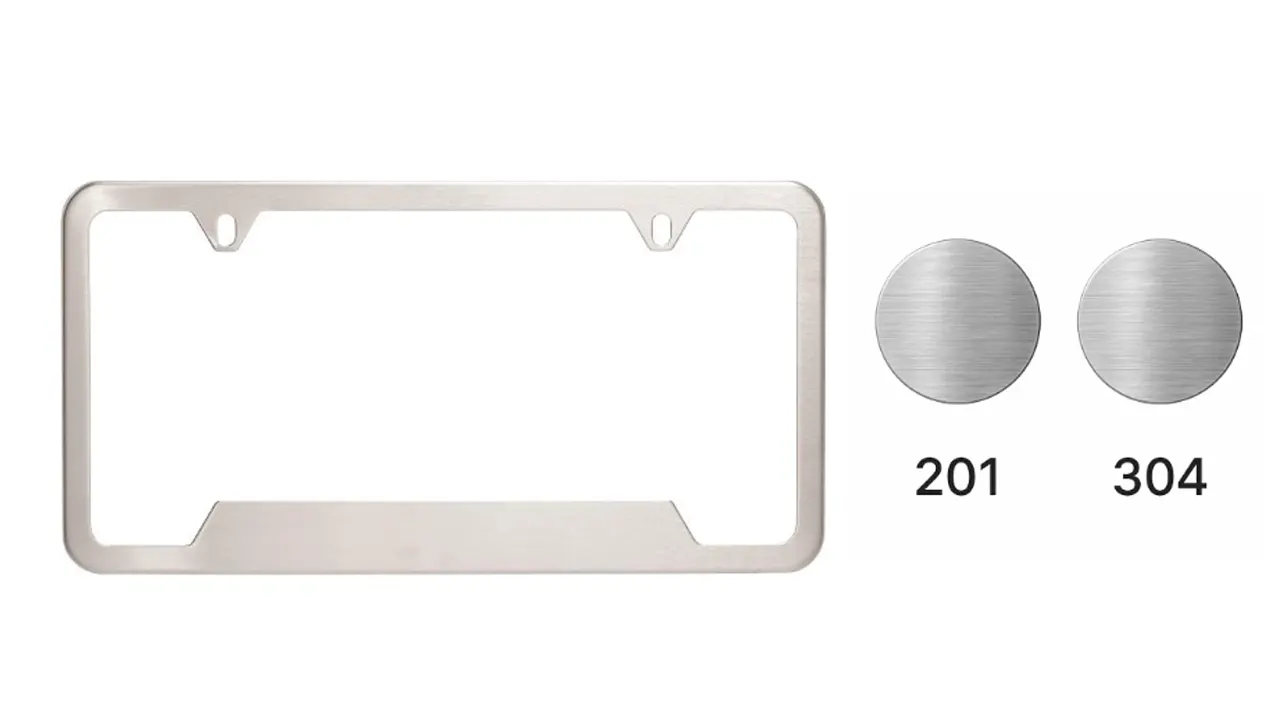
For a license plate frame that will face rain, washing, humidity, and winter road salt, 304 stainless steel is usually the safer grade. It offers a wider general corrosion margin than 201. Grade 201 can reduce alloy cost, but a buyer should not treat it as an invisible substitute for 304 or approve it from appearance alone.
The grade is only one part of the finished frame. Sheet thickness, forming, cut-edge condition, polishing, coating, hardware, water traps, installation, and packaging all influence what the customer sees after months on a vehicle. A good specification connects the material grade to the complete assembly and its expected environment.
Why 201 and 304 Can Look Almost Identical
Both 201 and 304 belong to the austenitic stainless-steel family. Both use chromium to form a thin passive oxide film that helps resist corrosion, and both can be polished into a bright decorative surface. On a new frame under showroom lighting, you may not be able to distinguish them reliably.
The important difference is the alloy design. Type 201 reduces nickel and uses substantially more manganese, with nitrogen also contributing to its properties. Type 304 contains more nickel and less manganese. That chemistry affects forming behavior, material cost, and the corrosion margin available when the frame is exposed outdoors.
Composition Ranges Show the Real Difference
| ASTM A240 chemistry by weight | Type 201 / UNS S20100 | Type 304 / UNS S30400 |
|---|---|---|
| Chromium | 16.0–18.0% | 17.5–19.5% |
| Nickel | 3.5–5.5% | 8.0–10.5% |
| Manganese | 5.5–7.5% | 2.0% maximum |
| Nitrogen | 0.25% maximum | 0.10% maximum |
| Carbon | 0.15% maximum | 0.07% maximum in the cited ATI 304 specification |
These are specification ranges, not a promise that every finished frame contains a particular midpoint. If grade matters to your product claim, the purchase order should identify the grade and relevant material standard, and the supplier should retain traceable material evidence.
What the Grade Difference Means on a Vehicle
Worldstainless explains that stainless steel depends on a chromium-rich passive film and can still corrode under certain conditions. Chlorides, crevices, surface contamination, and mixed-metal contact can all matter. The Nickel Institute’s comparison of Types 304, 201, and 430 found that 304 had equivalent or higher resistance in the reported general-corrosion test environments.
That does not mean every 201 frame will show rust or every 304 frame will remain spotless. It means 304 gives you more room when the product faces an uncontrolled mix of road spray, deicing salts, coastal air, wash chemicals, scratches, and long wet periods.
| Project condition | 201 stainless frame | 304 stainless frame |
|---|---|---|
| Dry, mild climate and price-led program | May be viable if the approved sample, finish, hardware, and test plan match the claim. | Provides additional corrosion margin but may exceed the project’s cost target. |
| Year-round consumer use across many US regions | Higher risk of staining complaints when exposure is not controlled. | Usually the more defensible default for a premium stainless claim. |
| Coastal or heavy road-salt exposure | Requires careful validation; the lower margin may be unacceptable. | Better than 201 in general, but still not “rust-proof” and still needs appropriate design and care. |
| Bright polished or plated appearance | Can look convincing at shipment; the finish must not be used to hide an unspecified grade. | Can also stain if polishing residue, contamination, crevices, or hardware create local problems. |
| Private-label product with a named-grade claim | Accept only as 201 when the listing and specification say 201. | Verify before publishing “304 stainless steel” on packaging or product pages. |
Where Corrosion Complaints Usually Begin
Cut edges and stamped holes. Forming and trimming expose fresh surfaces and may leave burrs, embedded tooling contamination, or areas that retain water. Inspect the inside opening and screw slots, not only the polished front face.
Behind the plate. A tight assembly can trap moisture, road salt, and cleaning residue. Crevices stay wet longer than exposed surfaces, so drainage and spacing deserve attention.
Around screws and caps. The frame, screw, washer, plate, and vehicle bracket may use different materials. Water held beneath a cap or washer can create a local environment that the flat frame surface never sees.
At scratches and contaminated surfaces. Steel particles from shared tooling or poor handling can rust on top of stainless steel and make the frame appear to be failing. Cleaning and process segregation matter even when the base grade is correct.
Under a decorative coating. Chrome-colored plating, paint, or another finish changes appearance but does not turn 201 into 304. If the coating is damaged or poorly bonded, the base material and process quality determine what happens next.
Our rust-resistant license plate frame guide explains why the body, finish, fasteners, and mounting environment need to be evaluated as one assembly.
Can a Magnet Identify 201 and 304?
No simple magnet test can confirm the grade. Austenitic stainless steels are generally low in magnetic response when annealed, but cold working during rolling, stamping, and forming can make them more magnetic. Both 201 and 304 may respond after fabrication, and the strength of the response is not a reliable chemistry report.
A magnet can be a screening clue when you already understand the process, but it should not be the basis for accepting a “304” shipment. Use traceable documentation and, when the risk justifies it, positive material identification such as X-ray fluorescence performed with an appropriate method and sampling plan.
How to Verify the Grade You Ordered
Put the grade on the drawing and purchase order. “Stainless steel” leaves room for different grades. State 201 or 304, the applicable standard or agreed chemistry, and whether substitutions require written approval.
Request a mill test certificate or material certificate. Check that the heat or coil identification can be connected to the material used for the order. A certificate with no traceability to the production lot provides weak assurance.
Use PMI or XRF as a verification tool. Define who performs the test, how many pieces or material locations are sampled, what acceptance limits apply, and how results are recorded. Testing a retained sheet offcut may be easier than testing a narrow finished border.
Inspect the formed and finished frame. Material identity does not replace visual and dimensional inspection. Check burrs, flatness, opening size, hole geometry, finish, coating coverage, and screw fit.
Test the real assembly. If you use a corrosion test, record the method, duration, specimen preparation, scribe condition if any, evaluation criteria, and acceptable change. “Passed salt spray” without those details is not a useful specification.
Why the Cheapest Grade Is Not Always the Lowest-Cost Program
Grade 201 often costs less because it uses less nickel. Your landed result, however, includes more than raw sheet price. Thickness, forming difficulty, polishing, reject rate, inspection, coatings, hardware, packaging, warranty exposure, and customer returns all contribute.
If a 201 frame needs a more complex finish or heavier inspection to support the same appearance promise, part of the material saving disappears. If a 304 claim improves buyer confidence in a premium channel, the higher alloy cost may support the positioning. The useful comparison is total program cost at an agreed performance level, not price per kilogram alone.
A Practical Selection Rule
Choose 304 when your frame will be sold for long-term exterior use across varied climates, when winter salt or coastal exposure is likely, or when “304 stainless” is part of the premium product promise. Choose 201 only when the lower corrosion margin is understood, the market and finish are defined, the sample has been validated, and the product is described honestly.
If the supplier has not confirmed the grade, do not publish one. The current stainless steel license plate frame page can help you review available constructions, while our aluminum versus stainless steel comparison is useful when grade is not the only material decision.
RFQ and Approval Checklist
- Named grade: 201, 304, or another specified alloy
- Applicable material standard and acceptable chemistry
- Sheet thickness and finished-frame dimensional tolerances
- Forming, deburring, edge, and polishing requirements
- Any plating, coating, passivation, or cleaning requirements
- Screw, washer, cap, and backing-pad materials
- Target plate format, opening, hole layout, and vehicle bracket
- Exposure market and required validation method
- Material traceability and PMI sampling plan
- Cosmetic standard, approved master sample, and packaging protection
Frequently Asked Questions
Will a 201 stainless steel license plate frame rust?
It can stain or corrode under unfavorable exposure, especially where chlorides, trapped moisture, contamination, or coating damage are present. It still belongs to the stainless family, but it generally offers less corrosion margin than 304.
Is a 304 stainless steel license plate frame rust-proof?
No. Grade 304 is corrosion-resistant, not immune to corrosion. Salt, crevices, contamination, mixed-metal contact, poor finishing, and inadequate cleaning can still cause staining or localized attack.
Can chrome plating make 201 perform like 304?
A decorative coating can add barrier protection while it remains intact, but it does not change the base alloy. Grade and coating system should be specified separately.
Can I tell 201 from 304 by color or shine?
Not reliably. Surface finish, polishing direction, lighting, coating, and contamination can change appearance. Chemistry documentation or a suitable material-identification test is more dependable.
Is 304 always worth the higher cost?
Not for every program. It is usually easier to justify for broad outdoor distribution and premium positioning. A tightly controlled cost-led project may use 201 if the performance boundary, test plan, and labeling are clear.
What evidence should support a 304 product claim?
Use a purchase specification, traceable material certificate, retained records, and risk-based verification such as PMI. The evidence should connect to the production lot, not just to a generic sample.
Turn the Grade Choice Into a Complete Specification
Send the target market, exposure conditions, plate format, frame drawing, grade, thickness, finish, hardware, quantity, packaging, and validation requirements together. For a private-label or wholesale project, review the custom license plate frame options and contact us with your specification. We will not assume a grade that has not been confirmed.