Powder coating is often the practical choice for a metal license plate frame when you want an even, durable finish and the part can tolerate oven curing. Liquid paint gives you more freedom with color effects, localized application, and materials that cannot take powder-coating temperatures. Neither finish is automatically better: the base material, pretreatment, coating system, frame geometry, and exposure conditions matter more than the label alone.
Powder coating and paint are applied differently
Powder coating uses dry, electrically charged particles that are sprayed onto a prepared part and then melted and cured with heat. Liquid paint carries pigments and resins in a liquid system, then dries or cures according to its chemistry. That basic process difference affects which parts can be coated, how the finish builds around edges, and how easily it can be repaired.
| Point to compare | Powder-coated frame | Painted frame |
| Typical application | Dry powder is electrostatically applied, then heat-cured | Liquid coating is sprayed or otherwise applied, then dried or cured |
| Common base material | Usually heat-tolerant, conductive metal | Metal and some plastics, depending on the coating and cure |
| Film character | Often builds a relatively even, substantial layer | Can range from thin color coats to multi-layer systems |
| Color and effect range | Broad range of colors, textures, gloss levels, and metallic effects | Especially flexible for precise colors, fades, special effects, and local details |
| Small repair | Touch-up can be visible because the original finish was oven-cured as one layer | Localized touch-up may be easier, although matching color and gloss can still be difficult |
| Main caution | The part, inserts, and adhesives must tolerate curing heat | Performance varies widely with paint chemistry, preparation, thickness, and cure |
The base material makes the first decision
Most powder-coated license plate frames are metal because the part must accept the electrostatic charge and pass through a curing oven. Aluminum and steel are common candidates, but both still need suitable cleaning and pretreatment. Powder over a contaminated or poorly prepared surface can look excellent at first and later lose adhesion.
Liquid paint is less restricted by conductivity and may cure at lower temperatures. That can make it suitable for certain plastics or assemblies with heat-sensitive components. A plastic frame still needs a paint system compatible with its actual resin and surface condition; “plastic-safe paint” is not a universal specification.
If material is still your first question, compare the construction of aluminum license plate frames with plastic license plate frames before choosing the decorative finish.
Appearance depends on more than gloss
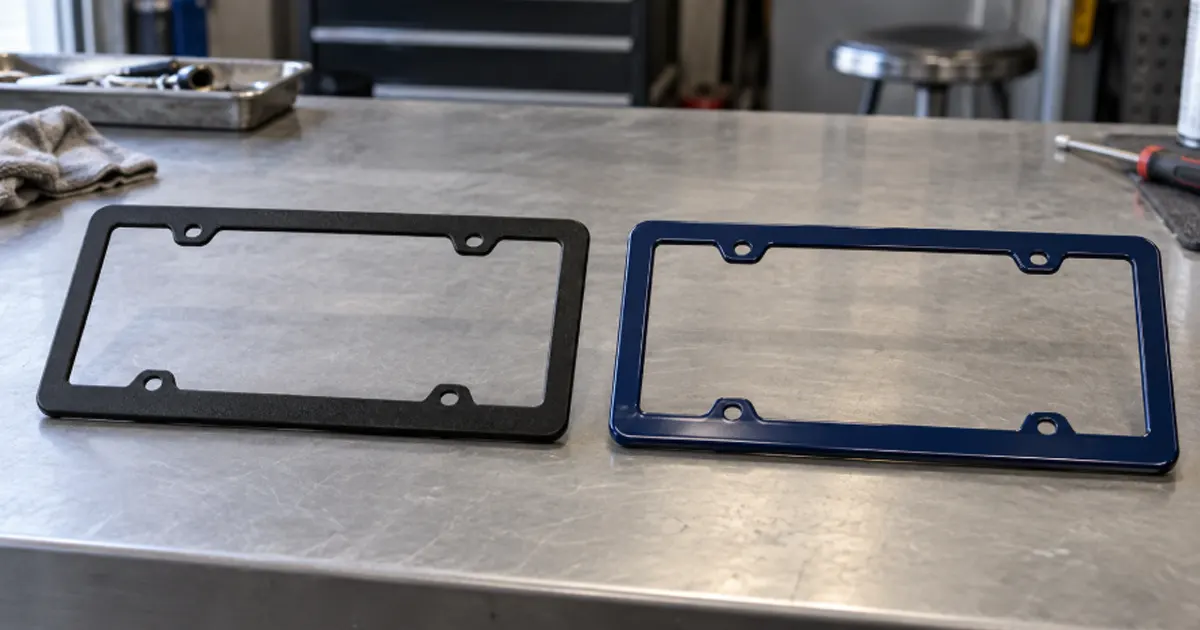
Both processes can produce gloss, satin, matte, textured, and metallic finishes. Powder coating is well suited to consistent single-color coverage across a metal frame. Liquid paint becomes attractive when the design needs a very specific color match, a layered visual effect, or coating only in selected areas.
Frame geometry can change the result. Narrow rails, recessed lettering, inside corners, mounting holes, and cut edges may not receive the same film thickness as a broad flat surface. A coating that looks smooth on the front face can be thin at an edge or heavy inside a recess. Examine the actual frame rather than judging the finish from a flat color chip.
Which finish resists chips, scratches, and corrosion better?
Powder coating has a strong reputation for toughness, but the word “powder-coated” does not guarantee a particular scratch, chip, or corrosion result. Resin type, pretreatment, cure, film thickness, edge coverage, and damage all affect performance. Liquid paint ranges from simple decorative coatings to demanding automotive and industrial systems, so it cannot be treated as one durability level either.
It helps to separate three different failure modes:
- Scratching marks the surface through contact with tools, brushes, plate edges, or road debris.
- Chipping removes a localized piece of finish, often after an impact or at a sharp edge.
- Corrosion occurs when a metal substrate is exposed and the surrounding environment supports a reaction.
A thick coating may resist one type of damage while still failing at a poorly covered edge. Once a steel frame is exposed, corrosion can spread beneath either powder or paint. Aluminum does not rust like steel, but exposed aluminum can still oxidize and change appearance.
Paint is usually easier to touch up
If a small area is damaged, liquid paint is generally easier to apply locally. The repair may still differ in color, texture, or gloss, particularly on metallic and high-gloss finishes. Powder coating is more difficult to restore invisibly outside the original process because the surrounding finish has already been cured.
For a low-cost accessory, replacement may be more practical than refinishing. On a custom or sentimental frame, a careful paint touch-up can slow further exposure, but it will not recreate the original factory finish.
Choose by use, not by the finish name
| Your priority | Better starting point | What to confirm |
| Uniform solid color on a metal frame | Powder coating | Pretreatment, edge coverage, cure, and final thickness |
| Exact color or unusual visual effect | Liquid paint | Color standard, layer sequence, clear coat, and cure |
| Heat-sensitive part or assembled component | Liquid paint may be easier | Material compatibility and cure temperature |
| Occasional small touch-up | Liquid paint | Availability of a matching repair coating |
| Textured, matte, or single-color outdoor metal frame | Either can work | Actual coating system and exposure evidence, not the label |
On a finished frame, look closely at mounting holes, inside corners, narrow borders, formed edges, and contact points under washers. These locations reveal more about process control than the middle of a broad rail. If you are developing a branded frame, the useful specification is the complete finish stack and acceptable appearance, not simply “powder” or “paint.” The available custom license plate frame options can then be matched to the intended material and decoration method.
FAQ
Is powder coating always more durable than paint?
No. A suitable powder system can be very durable, but a well-designed liquid coating can also perform well. Preparation, chemistry, cure, thickness, geometry, and exposure determine the result.
Can a plastic license plate frame be powder-coated?
Conventional powder coating usually favors conductive parts that tolerate oven heat. Some specialized low-temperature systems exist, but a plastic frame should not be assumed compatible without material-specific evidence. Liquid coating or molded-in color is more common.
Will a powder-coated frame rust?
The coating itself does not rust, but a steel frame can corrode where the finish is damaged or coverage is incomplete. Edge preparation, pretreatment, coating continuity, and hardware contact all matter.
Which finish is better for a matte black frame?
Both can produce matte black. Compare the actual texture, cleanability, edge coverage, resistance to polishing from repeated contact, and compatibility with the base material.