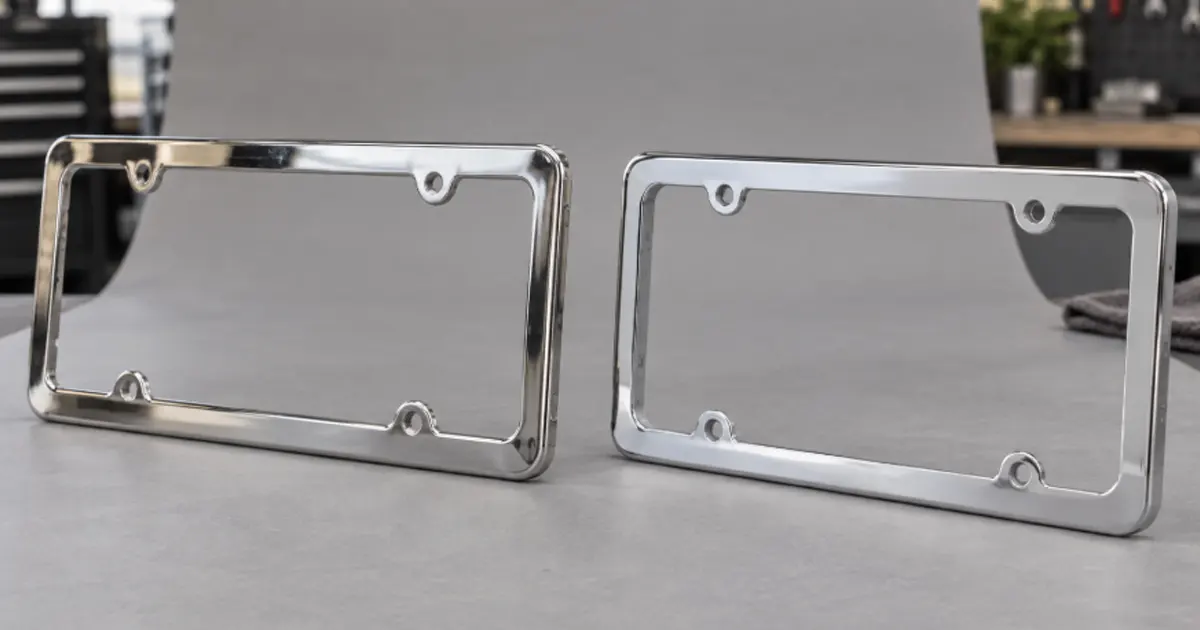
A chrome-plated license plate frame is identified by how its finish is made: a metallic layer is deposited through a plating process. A chrome-look frame is identified only by appearance. It may use a metallic coating, vacuum-deposited layer, film, paint system, or polished surface to create a bright silver effect. The two can look similar in a product photo while differing in base material, finish structure, weight, wear pattern, and price.
The label describes either a process or a look
| Question | Chrome plated | Chrome look |
| What does the term mean? | A metallic plating process is part of the finish | The surface resembles chrome; no single process is defined |
| What can the base be? | Often metal, or a suitably prepared nonmetallic part in a specialized plating system | Metal or plastic |
| Can appearance prove the process? | No | No |
| Typical visual goal | Bright, reflective metallic finish | Bright silver, mirror-like, or metallic appearance |
| Main uncertainty | The exact base metal and plating stack | The actual surface process hidden behind the appearance term |
Electroplating uses an electrical process to deposit metal onto a prepared surface. Decorative chrome systems often include other layers beneath the visible chromium, but the complete stack varies with the substrate and process. The word “plated” therefore tells you more than “chrome look,” yet it still does not reveal every layer or predict service life.
Chrome look is not one material
A chrome-look license plate frame may be molded plastic with a reflective decorative layer, coated metal with a bright metallic finish, or another construction designed to imitate chrome. That makes “chrome look” useful as a style description but weak as a technical specification.
This does not automatically make it inferior. A lightweight chrome-look plastic frame may be the sensible choice when cost, low mass, and a bright retail appearance matter more than a traditional plated-metal construction. The important step is to identify what the frame is made from and how the visible layer is applied.
Compare plastic license plate frames and aluminum license plate frames separately from the surface color. A silver appearance cannot tell you what is underneath.
Can you tell them apart by sight?
Sometimes, but not reliably. A good chrome-look coating can appear convincing, especially in online images. Weight can hint at the base construction, although a light frame could be aluminum rather than plastic. The back surface, cut edges, mounting holes, and any damaged spot may reveal more, but none of these is a substitute for an accurate material and finish description.
Look for consistency around corners and recesses. Uneven reflection, cloudy zones, visible base color at an edge, or a different finish on the rear can help you understand how the surface was built. These observations describe the part in front of you; they do not prove the exact manufacturing route.
How the two finishes tend to wear
Both can scratch. A reflective surface makes fine marks, water spots, and cleaner residue easier to see than a textured black frame. Wear also depends on the hardness and thickness of the decorative layer, the material beneath it, edge coverage, installation contact, washing habits, and road exposure.
- On a plated metal frame, damage can expose an underlying layer or the base metal. If the substrate is steel, a breach may also create a path for corrosion.
- On a chrome-look plastic frame, a scratch may reveal the plastic or a darker base coat. The part will not develop steel rust, but the decorative surface can peel, haze, or lose reflectivity if the finish system is damaged.
- Around screws and washers, either finish can mark when hardware turns directly against the visible surface.
- At narrow edges, poor coverage or repeated contact may become visible sooner than on a broad flat rail.
A salt-spray result can help compare corrosion behavior under stated conditions, but it cannot by itself prove years of vehicle service. The more useful question is whether the report identifies the exact frame, base material, finish stack, edge condition, and evaluation criteria.
Cleaning bright finishes without dulling them
Start with water, a mild automotive cleaner, and a soft microfiber cloth. Rinse away grit before wiping so that road particles are not dragged across the reflective surface. Avoid dry scrubbing, abrasive pads, metal polish, and strong solvents unless the finish manufacturer specifically allows them.
Do not assume a polish intended for solid metal is safe for a thin decorative layer. If you do not know whether the frame is plated metal or chrome-look plastic, use the gentler cleaning method and test any product on a hidden area first.
Which one should you choose?
| Your priority | Useful starting point | What still needs checking |
| Traditional plated-metal construction | Chrome-plated frame | Base material, plating stack, edge coverage, and corrosion evidence |
| Bright appearance at lower weight | Chrome-look plastic frame | Actual finish process, scratch behavior, and heat compatibility |
| Lowest risk of visible cleaning marks | Neither term answers it alone | Surface hardness, texture, care instructions, and real samples |
| Outdoor appearance retention | Either can work | Weathering, adhesion, cleaner resistance, and construction-specific testing |
| Custom branded design | Choose the base and finish together | Artwork method, logo position, mounting clearance, and finished appearance |
If you are specifying a custom version, replace vague wording such as “chrome finish” with the known base material, actual surface process, target appearance, and acceptance limits. Xingchang’s chrome-plated license plate frame options show one finish direction, while the broader custom license plate frame range can accommodate other material and decoration choices.
FAQ
Does chrome look mean chrome plated?
No. Chrome look describes a bright metallic appearance. Unless the construction is identified as plated and the process is documented, do not assume the surface is electroplated chromium.
Is a chrome-plated frame always metal?
Not necessarily. Nonmetallic parts can receive specialized conductive preparation and plating, although metal bases are common. Check the actual substrate instead of inferring it from the surface.
Which finish is more durable?
The names alone cannot answer that. Durability depends on the complete finish stack, base material, preparation, geometry, exposure, cleaning, and installation contact.
Why is my chrome-look frame peeling?
Peeling can come from poor surface preparation, weak adhesion between layers, flexing, edge damage, incompatible cleaners, heat, or weathering. Once the decorative layer lifts, replacement is often more practical than an invisible repair.