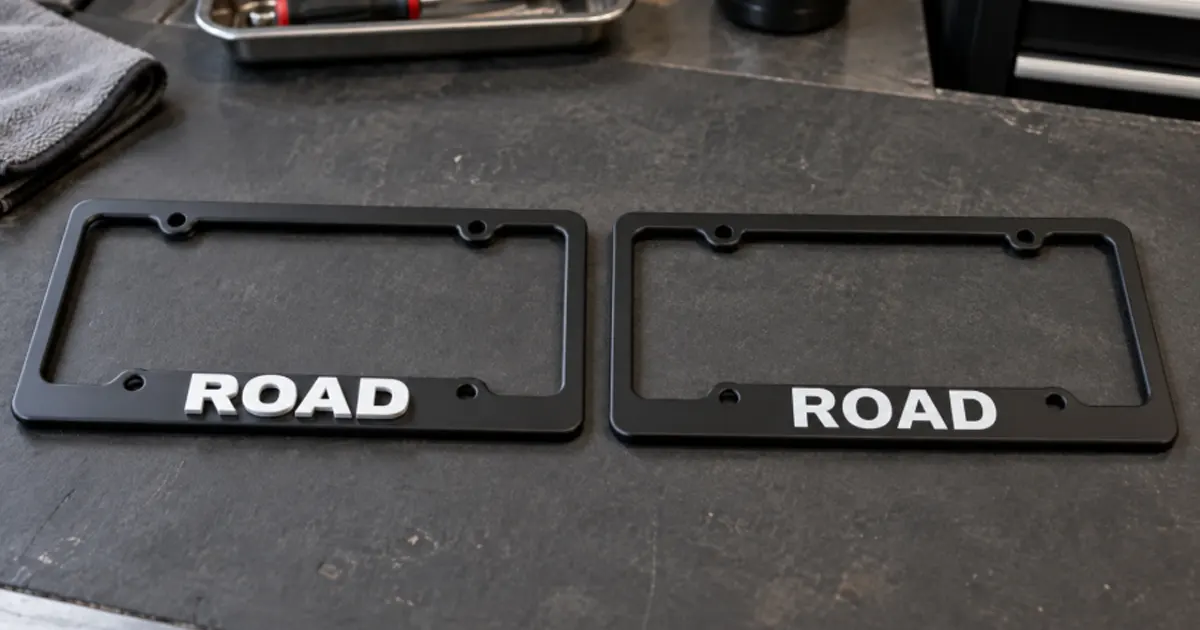
Raised lettering gives a license plate frame physical depth, stronger shadows, and a more dimensional look. Printing keeps the decoration close to the surface and handles small text, multiple colors, fine lines, and detailed logos more easily. Choose raised lettering when shape and tactile presence carry the design; choose printing when color accuracy and artwork detail matter more.
The main difference is depth
Raised letters project above the surrounding rail or sit as a separate dimensional element. Their height changes how light falls across the message, so even a one-color design can look bold. Printed decoration adds color or graphics without intentionally building the same physical relief.
| Design factor | Raised lettering | Printed decoration |
| Visual effect | Dimensional, shadowed, tactile | Flat, graphic, color-led |
| Best-suited artwork | Short names, bold type, simple emblems | Fine text, multiple colors, line art, gradients, detailed logos |
| Space required | More room around letters and mounting features | Can use narrow rails more efficiently |
| Common wear area | Highest points and exposed edges | Ink or coating edges, broad printed zones, and hardware contact |
| Cleaning | Dirt can collect around letter edges | Smoother surface is usually easier to wipe |
| Main design risk | Small counters and narrow strokes may lose definition | Tiny details may print but still be unreadable from normal distance |
Raised lettering works best with simple artwork
Depth does not rescue an overcomplicated logo. Thick strokes, open letter shapes, and generous spacing usually reproduce more clearly than delicate scripts or tightly packed text. Very small gaps may close visually once the letters gain height, while narrow projections can be vulnerable to impact or repeated wiping.
Raised lettering is also a design effect rather than one fixed manufacturing process. The letters may be molded as part of a plastic frame, formed in metal, cast as part of the component, or attached separately. Those routes do not have identical edge definition, height, strength, or finish behavior.
Examples of raised-letter license plate frames help show the dimensional style, but the exact construction should still be identified for the model you choose.
Printing gives detailed artwork more room
Printing is usually the more flexible route for multicolor logos, small lettering, contact information, gradients, and seasonal artwork. It also keeps the face comparatively flat, which can help on a slim border where mounting holes and plate visibility leave little room.
“Printed” is a broad description. UV printing and screen printing are different decoration routes with different strengths. The result depends on ink chemistry, surface preparation, cure, artwork coverage, and the material beneath the print.
Judge the message at its real size
Artwork that looks clear on a monitor can become cramped on a license plate frame. The top and bottom rails are narrow, the mounting holes interrupt usable space, and the installed plate remains the most visually important element. Check the design at full physical size before deciding that either process can hold another word or detail.
| Artwork check | Why it matters |
| Read it from normal standing distance | Fine details that are technically present may disappear in use |
| Keep letters away from screw heads and washers | Hardware can cover or damage decoration |
| Check the plate’s state name, number, and stickers | The frame must not obscure required plate information |
| Review narrow counters and gaps | Raised letters can close visually; printed details can fill or blur |
| Confirm front and angled views | Raised letters create shadows, while reflective print can change with light |
Where wear tends to appear
Raised designs are most exposed at their high points. Rings, brushes, cloths, road debris, and packing contact can polish, scratch, or chip those areas before the recessed background changes. Dirt and wax may also collect around the letter edges, so a soft brush is often more useful than hard scrubbing.
Printed designs remain flatter, but the surface can still abrade or lose adhesion. Large ink areas may make scratches more visible, and print near mounting holes can be damaged by turning hardware. A clear top layer can change gloss and chemical resistance, yet it does not make every print system equally durable.
For both styles, use mild automotive cleaner and a soft cloth. Avoid abrasive compounds unless the finish is specifically designed for them.
Choose the style that supports the artwork
| If the design needs… | Better starting point |
| A short name with a bold, premium, three-dimensional feel | Raised lettering |
| Several colors or a detailed logo | Printing |
| Very small text | Printing, followed by a real-size readability check |
| A single-color design that should stand out through shape | Raised lettering |
| A slim rail with limited depth and clearance | Printing |
| A combination of depth and color | Raised features with a compatible printed or filled-color treatment |
There is no reason every element must use the same technique. A frame can use a dimensional brand name for the main message and printed color for a smaller accent, provided the combined build does not interfere with screws, the plate, or the vehicle surface. When developing a branded version, start with the artwork and available rail space, then match them to the relevant custom license plate frame options.
FAQ
Are raised letters more durable than printing?
Not automatically. Raised letters can lose finish at exposed high points or be damaged if narrow features project too far. Printed decoration can wear or lose adhesion. Material, process, geometry, exposure, and care determine the result.
Can raised lettering include several colors?
Yes, depending on the construction and decoration method. Multiple colors add alignment, masking, fill, or printing considerations, so simple color placement is usually easier to control.
Is printing better for small logos?
Usually. Printing can reproduce finer details than most raised constructions, but a small logo still needs to remain legible at the actual frame size and normal viewing distance.
Do raised letters interfere with installation?
They can if they extend into mounting holes, washer zones, the plate opening, or nearby bodywork. Check the complete stack and clearance on the intended vehicle before regular use.