A painted, plated, printed, or metallic-look license plate frame can look perfect when it leaves the line and still fail where it matters: around a mounting hole, at a sharp inside corner, beneath a washer, or at a printed logo edge. An adhesion test helps answer one focused question: does the stated coating remain attached to the stated substrate under the stated test method?
What an adhesion test tells you
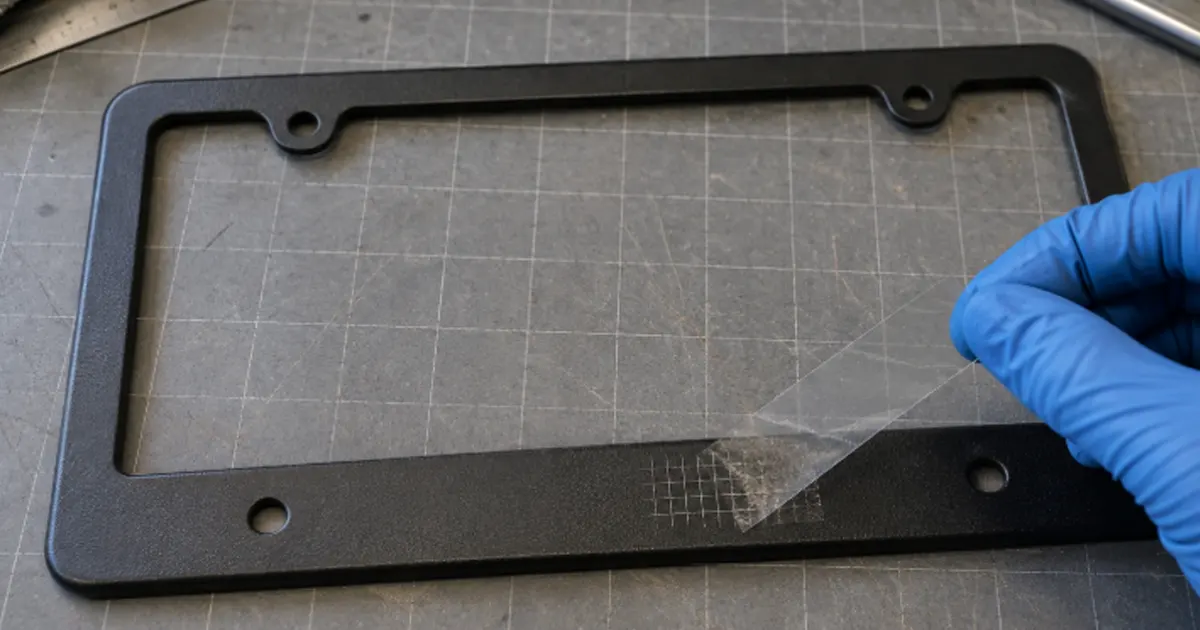
Adhesion is the bond between a coating layer and the surface beneath it, or between layers in a finish stack. ASTM D3359 is a commonly referenced tape-test method for assessing the adhesion of relatively ductile coatings on metallic substrates. It uses cuts through the coating and pressure-sensitive tape, then rates the removed area using the method’s defined approach.
ASTM D3359 includes an X-cut method and a cross-cut method. In the current edition, Method A is primarily intended for coatings thicker than 125 μm (5 mils), while Method B is primarily intended for coatings below 125 μm. Tape type, cut spacing, conditioning, peel angle, peel rate, and operator consistency can also affect the result, so a report should identify the actual method instead of saying only “tape test.”
That is useful evidence, but it is not an absolute measurement of bond force and it does not settle every durability question. A tape-test result does not replace abrasion, cleaner exposure, corrosion, weathering, or installation testing. It tells you one important part of the story.
Read the test as a complete sentence
“Adhesion passed” is incomplete. Read the result as: “This identified coating stack on this identified substrate was evaluated by this method, at this condition, against this acceptance criterion.” If one of those pieces is missing, you cannot reliably compare the result with another frame or reproduce the evaluation.
| Report field | Why it matters |
|---|---|
| Base part | Metal type, plastic grade, texture, and surface preparation influence the bond |
| Finish stack | Primer, color coat, topcoat, print, metallic layer, and cure sequence may all matter |
| Coating thickness | The chosen adhesion method and cut spacing must suit the stated coating system |
| Test method and revision | Shows how cuts, tape, timing, and rating were controlled |
| Sample condition | Fresh, aged, wet, weathered, cleaned, or otherwise conditioned specimens answer different questions |
| Failure location | Separates coating-to-substrate failure from separation between finish layers or localized edge damage |
| Acceptance criterion | Defines what visible removal or rating is acceptable for the stated use |
The substrate comes before the coating name
Coatings do not adhere to a generic label such as “metal” or “plastic.” They adhere to the actual surface presented to them. On metal, that may depend on cleaning, conversion treatment, surface roughness, oxidation state, and the time between preparation and coating. On molded plastic, it may depend on the resin, pigment, mold-release control, texture, aging, and any pretreatment.
ASTM D3359 is specifically focused on metallic substrates. If your license plate frame is plastic, do not casually copy a metal-frame tape-test result into the plastic program. Select a method and sample preparation that fit the actual material, and make the report say so. Keep the material and finish discussion separate when you are reviewing plastic frame options before testing begins.
Test the places that normally fail first
A flat central rail may pass while a functional area fails. Include realistic features wherever possible: mounting holes, formed edges, deep recesses, sharp corners, clip areas, and zones where a plate, screw, washer, or holder contacts the finish. These locations are often where coating stretch, thin coverage, stress, or damage becomes visible.
For printed frames, test both the printed area and the surrounding base finish. The ink-to-coating bond is a separate interface from the coating-to-substrate bond. A logo can stay visually intact while the base finish lifts beneath it, or the base finish can remain stable while ink edges wear. Treat the finished decorated part as one stack.
Fresh adhesion is not the final question
A new coating can pass an adhesion check and later change after heat, moisture, ultraviolet light, cleaner exposure, or corrosion-related stress. When outdoor appearance matters, decide whether adhesion should be evaluated only as manufactured or again after another exposure test. The answer depends on the frame construction and expected use, not on a generic quality checklist.
For example, a printed or coated frame may need an adhesion review after weathering, while a metallic decorative surface may need a corrosion-related check as well. Use UV-printed frame options, silk-screen frame options, and the chrome-plated frame options as distinct process directions. Each still needs evaluation on the exact model and finish being discussed.
How to review a tape-test result without overclaiming it
| Good reading habit | Why it prevents mistakes |
|---|---|
| Compare the same product revision | Prevents a result from being borrowed from a different resin, coating, or geometry |
| Check before-and-after photos | Shows whether removal is localized, broad, cosmetic, or structurally significant |
| Record the test condition | Separates an as-made result from one after heat, moisture, weathering, or chemical exposure |
| Define the acceptance criterion first | Prevents “pass” from being redefined after the result appears |
| Keep one clearly identified reference sample | Provides a physical reference for finish, color, and visible adhesion expectations |
Use a small, product-specific test plan
You do not need a long generic test list to evaluate every frame. Start with the failure risk created by the actual product. A painted metal frame with a printed logo may need adhesion, installation, abrasion, and weathering checks. A chrome-look plastic frame may need a different focus on surface preparation, decorative layer condition, and flexing zones. A basic molded-color frame may need no coating adhesion claim at all.
For a custom construction, record the base material, finish sequence, decoration, intended exposure, test method, sample condition, and acceptance criterion. This keeps the result attached to a specific frame instead of turning it into a vague claim about every coating or model.
FAQ
Is a tape test enough to prove a coating is durable?
No. It indicates adhesion under the stated method. Durability can also depend on abrasion, chemicals, ultraviolet exposure, corrosion, temperature, hardware contact, and the actual installation.
Can coating adhesion be tested on plastic license plate frames?
Yes, but the selected method must fit the plastic construction and finish system. Do not assume that a metal-substrate test method applies without adjustment or supporting evidence.
Why can a printed logo fail when the base coating passes?
The ink and the base coating create separate interfaces. Surface preparation, ink chemistry, cure, and the printed design can change the result. Evaluate the finished decorated frame, not only the base part.