ABS is often the better starting point for a rigid, appearance-led license plate frame with detailed molding, painting, printing, or plating. PP is often the better starting point for a lighter frame that needs controlled flexibility, integral clips, or a cost-efficient molded structure. These are design tendencies, not a universal ranking.
An ABS frame made from a general indoor grade is not automatically suitable outdoors. A PP frame without the right grade, stabilizers, surface preparation, or wall design can also fail. Specify the production grade, additives, color system, geometry, decoration, and validation plan before deciding which material fits your program.
ABS vs PP at a Glance
| Decision Factor | ABS Starting Point | PP Starting Point |
|---|---|---|
| Typical design direction | Rigid appearance part with defined edges and cosmetic surface | Light, flexible structure with clips, tabs, or impact tolerance |
| Polymer structure | Amorphous ABS family | Semi-crystalline polypropylene family |
| Surface decoration | Often easier to paint, plate, print, or bond, subject to grade and process | Often needs controlled pretreatment or an adhesion-promoting system |
| Dimensional behavior | Can suit appearance and dimensional control, but grade and process matter | Shrinkage and warpage require close mold and process control |
| Flexing | Usually selected for a more rigid feel | Often selected where flex or integral hinges and clips are useful |
| Outdoor use | Requires an exterior-suitable grade or validated protective system | Requires the correct UV-stabilized grade, pigment package, and test evidence |
| Property variation | Impact-modified, heat-resistant, plating, UV, filled, and blended grades differ | Homopolymer, impact copolymer, filled, reinforced, modified, and UV grades differ |
The Resin Acronym Is Only the First Decision
ABS combines acrylonitrile, butadiene, and styrene components, and suppliers tune the balance for flow, impact, heat, surface quality, plating, or other needs. PP can be a homopolymer, random copolymer, impact copolymer, or a filled and modified compound. SABIC’s own product families show many grades under each acronym, with different stated property profiles and applications.
That variation is why a drawing that says ABS or PP is incomplete. Record the resin manufacturer and grade, regional supply source, color or masterbatch, additives, filler or reinforcement, allowed regrind, and the change-control rule. If an alternative grade is proposed, compare the affected properties and revalidate the part.
Choose the Structure Before You Compare Datasheets
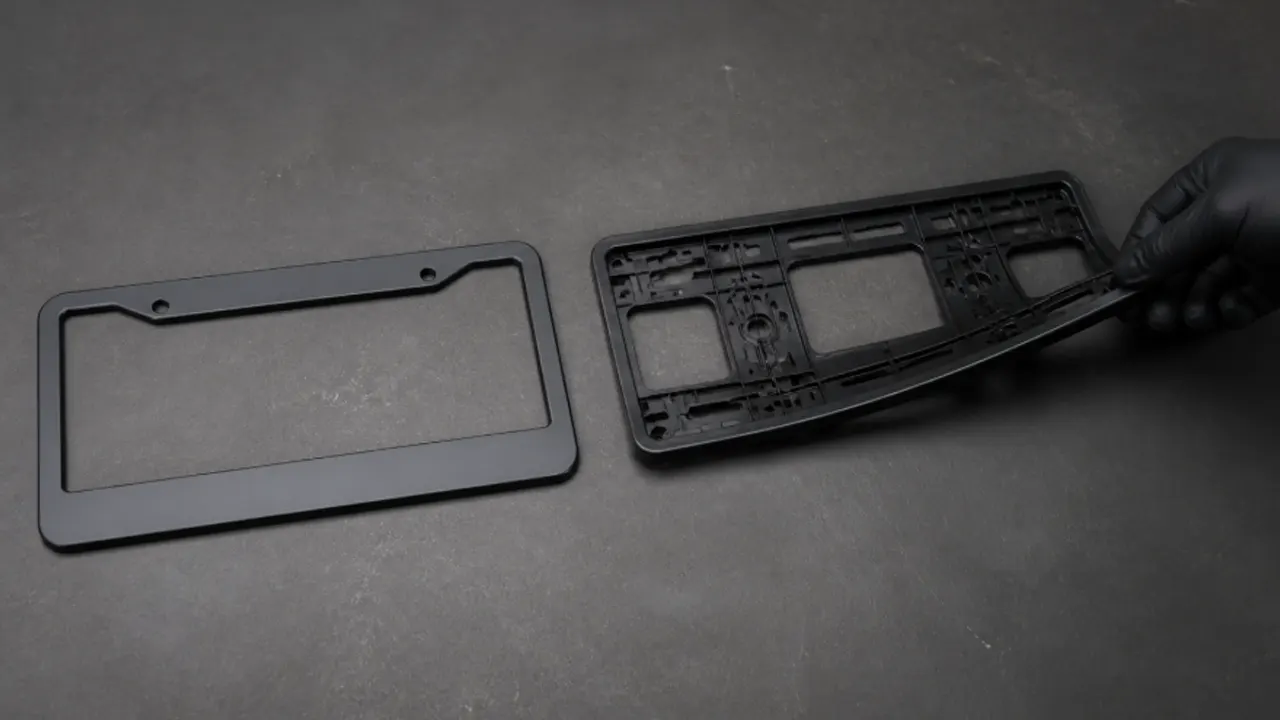
A thin full-surround frame, a wide-bottom dealer frame, and a European holder with a locking strip do not ask the material to do the same job. Define the outer envelope, plate opening, wall sections, ribs, bosses, hooks, clips, screw loads, drainage, and vehicle contact points first. Then compare grades that can fill the tool and meet those functions.
ABS may give a crisp, rigid appearance in one design, while PP may provide safer deflection in a clip-on feature. If the frame needs both, a two-part design may use different resins for the base and the branded strip. Do not force a single material across parts with conflicting requirements merely to simplify the bill of materials.
Rigidity, Impact, and Temperature Need Test Conditions
Statements such as ABS is stronger or PP is tougher are incomplete. Tensile and flexural data do not predict every installed failure. Impact values change with test method, specimen, notch, temperature, grade, thickness, and processing. A license plate frame also sees screw pressure, vibration, car-wash contact, sunlight, heat, cold, and occasional bending.
Set performance around the part. Useful checks may include installation at the specified fastener condition, low- and high-temperature fit, clip cycles, impact at vulnerable corners, dimensional recovery, and inspection after environmental exposure. Record the method and pass/fail limit so a supplier cannot substitute a favorable datasheet number for a finished-part result.
Printing, Painting, and Plating Can Decide the Material
ABS is commonly available in grades developed for cosmetic surfaces, painting, or chrome plating. That does not mean every ABS grade accepts every finish. Plating-grade chemistry, molding quality, surface cleanliness, and process control still matter.
PP has relatively low surface energy, so printing, painting, or bonding often needs flame, corona, plasma, chemical pretreatment, or a matched primer and ink system. The required route depends on the specific PP grade, additives, molding history, and decoration. Ask the supplier to name the pretreatment, target control, ink or coating, cure, and adhesion test on the actual molded part.
For either material, inspect gate vestige, sink, weld lines, flow marks, gloss, color, surface contamination, and the printable area. Decoration should not hide a molding defect that will reappear as the part ages or flexes.
Outdoor Color and Property Retention Must Be Engineered
Black pigment can improve light screening in some systems, but black is not a complete outdoor specification. UV stabilizers, antioxidants, pigment type and loading, resin grade, part thickness, decoration, exposure angle, climate, and cleaning all contribute. A generic UV-resistant claim is not enough.
Define what you will measure after exposure: color change, gloss, chalking, cracking, impact retention, clip function, dimensional change, or adhesion. Name the accelerated or natural weathering method, specimen or finished part, cycle, and acceptance limit. If the program relies on a coating or printed layer for protection, test the complete stack.
Molding and Tooling Considerations
ABS and PP use different shrinkage allowances and respond differently to ribs, gates, cooling, orientation, and uneven walls. Switching resin after a tool is cut can change dimensions, flatness, clip force, appearance, and cycle conditions. A supplier may be able to tune processing, but a material change should never be treated as a paperwork-only substitution.
During design review, ask where the part will gate, how weld lines cross loaded features, which dimensions are critical, how warpage will be restrained, and how the tool will vent and cool. Approve the production-intent material during sampling, not a convenient trial resin.
Specification Checklist for ABS or PP Frames
| Specification Area | What to Record |
|---|---|
| Material | Resin supplier, exact grade, formulation type, filler or modifier, and permitted substitute |
| Color | Masterbatch, physical standard, lighting, gloss, and tolerance |
| Regrind | Whether allowed, maximum percentage, source, and control method |
| Geometry | Critical dimensions, wall and rib sections, clips, bosses, and fit interface |
| Decoration | Pretreatment, primer, ink or coating, cure, print area, and adhesion method |
| Environment | Temperature range, weathering method, evaluated properties, and pass/fail limits |
| Change control | Approval needed for resin, color, additive, tool, process, or decoration changes |
Xingchang’s plastic license plate frame page shows ABS and PP product directions. Use the custom license plate frame development process to connect the material choice with geometry, branding, samples, and inspection.
Frequently Asked Questions
Is ABS better than PP for license plate frames?
ABS is often a useful starting point for rigid cosmetic parts and decorated surfaces. PP is often useful for lighter, more flexible structures and clips. The better choice is the grade and geometry that pass your defined fit, appearance, environmental, and decoration requirements.
Which material is more impact resistant?
There is no reliable answer without grades and test conditions. Impact-modified ABS, PP impact copolymers, filled compounds, temperature, thickness, notches, and molding history can change the result.
Which material is easier to print?
ABS is often more straightforward to decorate, while PP commonly needs controlled pretreatment or a matched primer. In both cases, approve adhesion and appearance on the production molded part.
Can PP be chrome plated?
Special systems may exist, but conventional decorative plating is more commonly associated with plating-grade ABS. If a chrome-like PP frame is proposed, ask whether the finish is plating, vacuum metallization, paint, foil, or another process and validate that exact stack.
Does black ABS or PP automatically resist UV?
No. Color alone does not define the resin grade, stabilizer package, pigment quality, property retention, or decoration durability. Require test evidence against your acceptance limits.
Can a factory switch from ABS to PP in the same mold?
Not without engineering review. Shrinkage, warpage, gate behavior, clip force, dimensions, surface quality, and decoration can change. A substitution should trigger sampling and affected tests.
Should recycled content be allowed?
That is a program decision. If allowed, define source, percentage, contamination controls, color and property limits, testing, and traceability. Do not accept an unspecified regrind allowance.