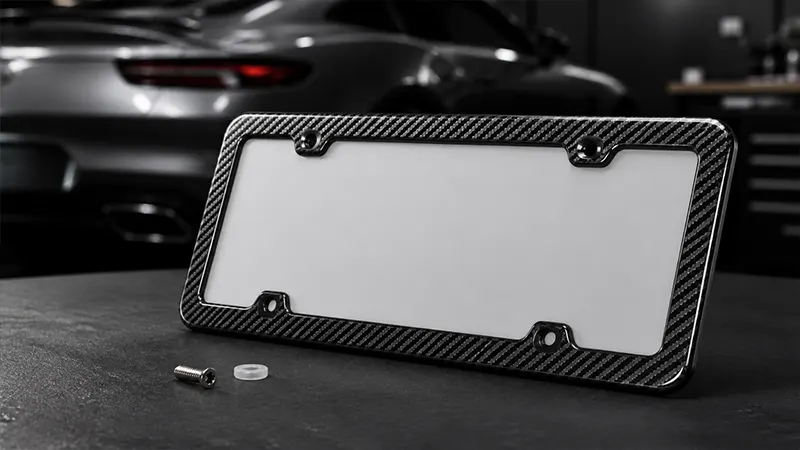
The best carbon fiber license plate frame is not the one with the loudest “real carbon” claim. It is the one that clearly identifies its construction, keeps the weave and finish consistent, supports the screw areas, seals every trimmed edge, resists UV exposure, fits the plate and vehicle without stress, and leaves all required plate information visible. If the product is ABS or metal with a carbon pattern, it should say so plainly.
First Decide What “Carbon Fiber” Means
Listings commonly group several different products under the same keyword. They can look similar in a small photo but behave differently during installation and weather exposure.
| Construction | What it actually is | What you should verify |
|---|---|---|
| Full carbon composite | Reinforcing carbon fibers in a cured resin matrix form the frame body | Laminate support, cure quality, hole reinforcement, edge sealing, clear coat |
| Carbon skin over a core | Carbon reinforcement or decorative carbon layer bonded to metal, plastic, or another core | Core material, bond line, edge transitions, corrosion isolation, labeling |
| Carbon-pattern plastic | ABS or another plastic with molded, printed, hydrographic, or film decoration | Resin, UV package, pattern adhesion, scratch resistance, edge wrapping |
| Carbon-pattern metal | Metal frame with printed film, coating, or patterned insert | Base alloy, pretreatment, decoration adhesion, cut-edge protection |
A carbon-look frame is not necessarily a bad product. It can be affordable, rigid, and visually appropriate. The problem is presenting it as a full composite. Accurate construction language lets you compare weight, stiffness, impact behavior, finish life, and price honestly.
What Makes a Real Carbon Frame Good?
A sensible laminate around holes and corners
Carbon reinforcement is strong in designed fiber directions, but a thin drilled edge can split, crush, or delaminate when a screw head concentrates load. Look for adequate bearing area, smooth holes, washers or reinforced seats, and instructions that warn against overtightening. A decorative weave on the face does not reveal how the mounting zones are built.
Sealed trimmed edges
Cut composite edges expose fiber ends and resin interfaces. They should be trimmed cleanly, smoothed, and sealed. Ragged edges are uncomfortable to handle and give moisture, cleaning chemicals, and repeated vibration a route into defects. Inspect the inside opening, outer profile, and holes—not only the glossy face.
A finish designed for outdoor UV
The resin and clear coat control gloss, color, depth, scratch behavior, and weathering. Carbon reinforcement itself does not guarantee that the surface will remain clear and black. Ask what coating system is used and what accelerated or outdoor exposure supports the claim. “UV protected” without a method, duration, specimen, and acceptance criterion is marketing language rather than comparable data.
Controlled weave appearance
For a visible woven face, check fiber alignment across the top and bottom bars, symmetry at corners, distortion around holes, dry-looking areas, bubbles, print-through, and foreign particles under the clear coat. Decide whether cosmetic variation is acceptable and approve a physical master sample under controlled lighting.
Fit Matters More Than a Few Grams of Weight
A standard North American passenger plate is commonly described as 12 × 6 inches, but the frame must also clear embossed characters, state names, slogans, registration tabs, and vehicle features. Measure the visible opening and outside envelope. Check the camera, plate lamp, hatch handle, sensors, and bumper recess.
Do not force a composite frame over mismatched holes. Bending it into alignment stores stress at corners and holes. Choose the correct two-hole or four-hole pattern and verify screw thread and depth. Our size guide and mounting-hole comparison cover those measurements.
Choose a Slim, Legally Safer Opening
The border should not cover letters, numbers, the issuing jurisdiction, registration tabs, colors, or other required identification. It should not impair recognition by authorized electronic devices. A large bottom logo may look attractive in a product render but become a legal risk on plates with low characters or slogans.
Use the actual target plates when approving the opening. If you sell across several states, test the most restrictive plate layouts in the market rather than assuming one sample represents all. Current local law controls the installed use; see our license plate frame legality guide before choosing a wide border or cover.
Gloss, Matte, and Colored Finishes
A gloss clear coat makes the weave look deeper and more reflective, but it can show swirl marks and water spots. A matte finish reduces reflections and creates a quieter appearance, but inconsistent gloss is easier to notice and aggressive polishing can create shiny patches. A tinted or colored clear coat changes the visual depth and needs color standards.
Ask how the finish should be cleaned. Use water, pH-neutral automotive shampoo, and soft microfiber as the safe default. Avoid abrasive compounds, harsh solvents, and strong wheel cleaners unless the coating supplier permits them. Dry the screw recesses and lower edge after washing.
Hardware and Installation
A premium frame can still fail with unsuitable screws. The hardware must match the vehicle thread, give enough engagement, seat flat, and stop before contacting hidden components. Use washers or designed bearing surfaces so the screw head does not crush the laminate. Soft pads can control lower-edge vibration, but they should not block drainage or make the plate unstable.
- Clean the plate and mounting surface.
- Place the plate and frame together without bending either part.
- Start every screw by hand before tightening any one screw fully.
- Tighten evenly with a hand screwdriver until secure.
- Stop if the frame bows, cracks, creaks, or pulls sideways.
- Confirm plate information, lamps, camera, handle, and sensors remain clear.
- Recheck the assembly after the first drives and washes.
Seven Questions to Ask Before You Buy
- Is it full carbon composite, carbon over a core, or carbon-pattern decoration? The description should identify every main layer.
- What supports the screw holes? Look for bearing area, washers, reinforcement, and clear installation limits.
- Are the trimmed edges sealed? Inspect the opening, outer edge, holes, and rear face.
- How is the finish validated? Ask for the coating system and relevant weathering criteria, not only “UV resistant.”
- What are the exact opening, outside, and hole dimensions? “Universal” is not a drawing.
- Does the border leave the full plate readable? Check your specific jurisdiction and plate design.
- What is included? Confirm screws, washers, caps, pads, instructions, warranty, and replacement policy.
Red Flags
- The page alternates between “100% carbon fiber,” “carbon style,” and “ABS” without explaining the construction.
- Only the front beauty shot is shown; edges, holes, rear face, and installed opening are missing.
- Dimensions are absent or inconsistent across diagrams and text.
- The frame is bent aggressively in promotional images as proof of both flexibility and rigidity.
- Outdoor, UV, scratch, and weather claims have no method or acceptance criterion.
- Installation instructions encourage a power drill or provide no warning about overtightening.
- A wide decorative bar overlaps plate information in the seller’s own photographs.
Is Real Carbon Fiber Always Worth It?
Real carbon fiber is worth considering when authentic weave, material story, low mass, and a premium finish are part of the buying decision. For a license plate frame, the performance benefit of saving a small amount of mass is usually less important than appearance and craftsmanship. If you only want the visual theme, a well-made carbon-pattern plastic or metal frame may provide better value and more forgiving installation.
Choose based on honest construction, fit, finish life, and service conditions. Our broader best material guide compares carbon options with stainless steel, aluminum, zinc alloy, silicone, and plastic.
What Commercial Buyers Should Specify
For a custom carbon program, state whether you require full composite, a carbon layer over a named core, or a carbon-look decoration. Add the plate format, opening and outside dimensions, mounting pattern, laminate or substrate, weave direction, cosmetic zone, edge finish, coating system, gloss range, artwork, hardware, packaging, test plan, quantity, and acceptance sample.
If you are sourcing a carbon-style program, require the supplier to identify whether each model is stainless steel, aluminum, zinc alloy, rigid plastic, carbon over a core, or full carbon composite. Never market a plastic carbon-pattern product as real carbon fiber. For a new construction, send the required material, target evidence, dimensions, quantity, and finish through the project inquiry form for feasibility review.
Frequently Asked Questions
How can you tell if a license plate frame is real carbon fiber?
Start with the construction statement and inspect edges, holes, rear face, weight, and weave under changing light. Visual clues alone are not definitive because high-quality prints can be convincing. Ask the supplier to identify the material layers in writing.
Does carbon fiber rust?
The carbon reinforcement does not form red iron rust. Metal cores, inserts, screws, washers, and the plate can corrode, while the composite can still suffer coating failure, delamination, edge damage, or galvanic interaction with metals.
Can a carbon fiber frame crack during installation?
Yes. Forced alignment, unsupported screw heads, impact, poor trimming, and overtightening can crack or delaminate thin areas. Align the holes freely and tighten by hand.
Is gloss or matte carbon fiber better?
Neither is universally better. Gloss emphasizes weave depth but shows fine scratches; matte reduces reflection but can develop polished spots if cleaned aggressively. Choose the look and care routine you prefer.
Are carbon fiber license plate frames legal?
The material does not decide legality. The installed frame must leave required information visible and must not impair recognition. Check current official rules where the vehicle is used.