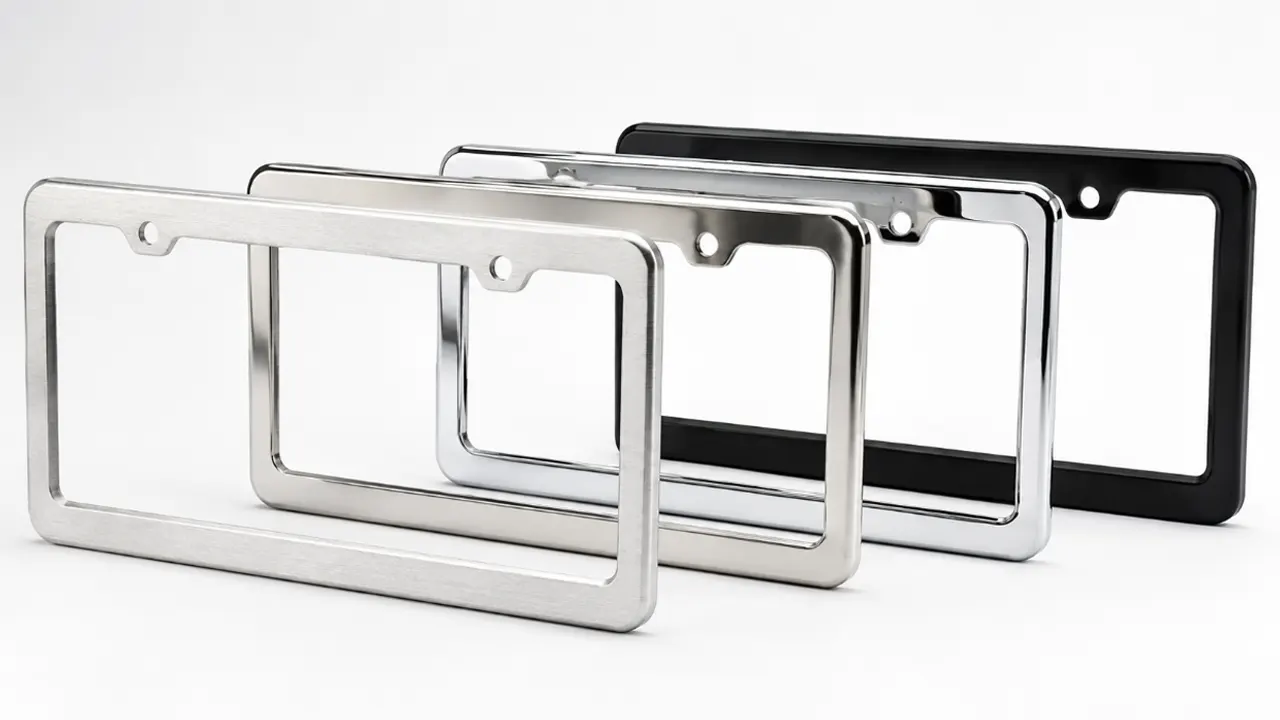
There is no single best license plate frame material. Choose aluminum when low weight and color or printed decoration lead the decision. Choose stainless steel for a slim, rigid frame with a polished or brushed metal appearance. Choose zinc alloy for raised lettering and detailed die-cast shapes. Choose plastic for economical, high-volume molded frames with integrated features.
The material name is only the starting point. Thickness, formed geometry, finish, cut edges, hardware, drainage, vehicle contact, climate, cleaning chemicals, and packaging often decide whether the finished frame performs well. Compare production-ready constructions rather than labels such as “metal,” “chrome,” or “rust-proof.”
Quick Answer by Application
| Material | Best starting use | Specify before approval |
|---|---|---|
| Aluminum | Lightweight retail frames, colored finishes, printed graphics | Alloy, temper, thickness, formed section, finish, sealing, edge coverage, and hardware |
| Stainless steel | Slim premium frames, polished or brushed metal appearance | Grade, thickness, rigidity, surface direction, edge condition, passivation or cleaning, and scratch protection |
| Zinc alloy | Raised logos, sculpted shapes, detailed decorative programs | Alloy, casting defects, polishing, finish stack, trapped-solution control, corrosion criteria, weight, and packaging |
| Plastic | Economical molded frames, integrated tabs or cap seats, high-volume promotions | Exact resin, recycled-content limits, UV and temperature needs, wall and boss design, warpage, color, finish, and screw load |
Use the table to shortlist a construction, not to release an order. Approval should cover the exact material, geometry, finish, fasteners, artwork, package, and test criteria used in production.
Aluminum: Best for Low Weight and Decorative Flexibility
The Aluminum Association reports a typical aluminum-sheet density of 2.66–2.84 g/cm³ and an elastic modulus of 69–73 GPa. Worldstainless lists common stainless families at about 7.7–7.8 g/cm³ and roughly 210–220 GPa. At the same geometry, aluminum is much lighter, while stainless is substantially stiffer. Finished frames rarely use identical thicknesses and formed sections, so compare unit weight and installed rigidity on actual samples.
Aluminum can support anodized, painted, powder-coated, or printed finishes. Each route needs its own specification. An anodized frame should identify alloy and temper, surface preparation, anodic type or class, color, sealing, and acceptable variation. A painted or powder-coated frame needs pretreatment, coating, gloss and color limits, edge coverage, adhesion criteria, and packaging protection.
Common aluminum failures. The quotation says only “aluminum”; a thin flat border flexes; punched edges receive poor finish coverage; the production coating differs from the approved sample; or stainless hardware contacts damaged aluminum in wet, salty service. Lock the material and assembly before you compare price.
Start with the available aluminum license plate frame constructions, then qualify the complete finish and hardware system for your program.
Stainless Steel: Best for Slim Stiffness and a Bare-Metal Look
Stainless steel’s higher elastic modulus helps a narrow section resist deflection, but stiffness is not the same as strength or durability. Grade, thickness, formed shape, unsupported span, and work hardening all affect the result. A thin, flat stainless frame can still bend or vibrate if the geometry is poorly designed.
Stainless steels contain at least 10.5% chromium and rely on a thin passive surface film for corrosion resistance. Grade selection and surface condition remain important. Embedded iron, unsuitable cleaning, deposits, crevices, damaged areas, and chloride exposure can lead to staining or localized corrosion. The word “stainless” is not a corrosion test.
Common stainless failures. The purchase order omits the grade; a mirror finish has no scratch limit or protective film; brushed direction varies between lots; edges remain sharp or burred; or an accelerated test result is presented as a direct prediction of outdoor years.
Review stainless steel license plate frame options, then specify grade, thickness, geometry, surface direction, edge quality, cleaning control, and cosmetic packaging.
Zinc Alloy: Best for Detailed Die-Cast Shapes
Zinc die casting can combine raised logos, recessed backgrounds, ribs, bosses, cap features, and complex contours in one part. International Zinc Association guidance notes that material and forming options must be evaluated together; zinc castings can also accept passivation, organic coatings, or electroplating.
The visible finish is central to a decorative zinc frame. A description such as “zinc alloy with chrome” does not identify the casting quality, polishing, cleaning, underlayers, decorative layer, sealing, rear-face coverage, or acceptance criteria. Approve the part after the full production finish is applied, not as a raw casting.
Common zinc-alloy failures. Porosity, parting lines, ejector marks, or polishing variation remain visible after finishing; process solution is trapped in blind features; corners or rear faces expose the substrate; or product weight and scratch protection are omitted from the landed-cost calculation.
Plastic: Best for Economy and Integrated Molded Features
Plastic frames do not form metal rust and can integrate ribs, retention tabs, cap seats, branding areas, and soft-contact geometry into the molded part. Molded color can also reduce dependence on a separate decorative coating. These advantages make plastic a practical starting point for high-volume promotional or cost-controlled programs.
“Plastic” is not a material specification. Resin family, grade, recycled content, fillers, pigments, UV stabilizers, wall thickness, ribbing, shrinkage, and processing conditions can change stiffness, impact response, color stability, and warpage. Do not publish or approve ABS, PP, or another resin name unless the production material is identified and controlled.
Common plastic failures. Screw bosses crack or whiten from local stress; the border creeps or warps after hot storage; pigment or unqualified resin fades outdoors; molded surfaces scratch in transit; or a metallic-looking coating is marketed as “chrome” without identifying the plastic substrate and finish system.
Use the plastic license plate frame category as a starting point, then define resin, geometry, color, exposure, screw-load, warpage, finish, and packaging requirements.
Chrome, Black, Anodized, and Carbon-Fiber Look Are Not Materials
Retail descriptions often mix substrate and appearance. That creates sourcing errors because the same visual term can describe several constructions.
| Listing term | What you still need to ask |
|---|---|
| Chrome | What is the substrate, preparation, finish stack, coverage, adhesion requirement, and corrosion acceptance? |
| Black metal | Which metal and grade or alloy? What coating, gloss, color tolerance, edge coverage, and UV requirement apply? |
| Anodized | Which aluminum alloy and temper, anodic type or class, color, sealing, mechanical finish, and exposure requirement? |
| Stainless | Which grade, thickness, polish or brush direction, surface-cleaning control, edge finish, and package protection? |
| Carbon-fiber look | Is it a real composite, film, print, hydrographic layer, molded texture, or paint effect? |
Keep “carbon-fiber pattern” separate from true carbon-fiber composite. The appearance does not prove the substrate, weight, stiffness, or manufacturing method.
Durability Depends on the Assembly and Environment
Coastal air, winter road salt, frequent washing, trapped moisture, and cleaning chemicals can change the ranking. Review the exact alloy, grade or resin together with finish, fasteners, washers, vehicle contact, drainage, and cleaning exposure. Test the assembled frame with production hardware rather than a bare material coupon.
ASTM B117 provides a controlled salt-spray environment for relative corrosion information. The active 2026 edition states that stand-alone salt-spray results seldom correlate with natural-environment performance and do not prescribe a specimen, duration, or interpretation for a specific product. A “500-hour” claim is therefore not the same as a five-year vehicle-life claim. Your test plan must define the sample, preparation, damage condition, duration, inspection points, evaluation area, and pass/fail criteria.
Dissimilar-metal contact also matters. NASA explains that two dissimilar metals connected in the presence of an electrolyte can form a galvanic couple; its corrosion guidance specifically shows stainless-steel fasteners accelerating aluminum corrosion in exposure. Isolation, intact coatings, drainage, and compatible hardware can reduce the risk, but the correct control depends on the assembly.
How to Choose the Material for Your Program
- Confirm fit before material. Check plate format, visible area, outer size, opening, hole layout, bumper recess, light, camera, sensors, and mounting hardware for every target market.
- Name the primary buying outcome. Decide whether low weight, slim stiffness, raised decorative detail, integrated molded features, finish appearance, or unit cost has priority.
- Identify the likely failure modes. Include obstruction, bending, rattle, sharp edges, scratching, finish damage, corrosion, UV change, boss cracking, warpage, and packaging damage where relevant.
- Compare production-representative samples. Use the proposed material, thickness, geometry, finish, hardware, artwork, and packaging. A raw substrate sample cannot validate the finished product.
- Release against written criteria. Put material identity, dimensions, cosmetic limits, test methods, inspection level, packaging, and change-control requirements on the approved specification.
What to Include in Your RFQ
- Target country, plate format, vehicle types, mounting points, and use environment
- Dimensioned drawing with outer size, clear opening, border width, holes, corners, thickness, formed section, and tolerances
- Requested material options: aluminum alloy and temper, stainless grade, zinc alloy, or exact plastic resin
- Surface preparation, finish stack, color, gloss, artwork, edge coverage, and cosmetic limits
- Hardware bill of materials, caps, washers, pads, isolation method, drainage, and installation sequence
- Required corrosion, adhesion, abrasion, UV, temperature, vibration, wash, fit, and packaging tests with acceptance criteria
- Unit-weight target, expected quantity, tooling assumptions, individual packaging, carton limits, destination, and inspection plan
Use the custom license plate frame service to compare production-ready constructions against one drawing. A useful quote should show what the material, finish, hardware, packaging, and testing assumptions include.
Frequently Asked Questions
What is the most durable license plate frame material?
No material is universally most durable. Define the expected failures—bending, impact, corrosion, coating loss, UV change, scratching, fastener movement, or warpage—then qualify the finished assembly under relevant conditions.
Is aluminum or stainless steel better?
Aluminum is the better starting point for low weight and color-led decoration. Stainless steel is the better starting point for slim stiffness and a polished or brushed metal appearance. Grade or alloy, thickness, geometry, finish, hardware, and exposure decide the final result.
Are metal license plate frames better than plastic?
Not automatically. Metal can provide a particular stiffness, weight, or surface appearance. Plastic can integrate functional features at low mass and cost. A qualified plastic frame can outperform a poorly specified metal frame in its intended program, and the reverse is also true.
Does stainless steel mean rust-proof?
No. Stainless steel can stain or suffer localized corrosion when the grade, surface condition, fabrication, deposits, crevices, or chloride exposure are unsuitable. Use a named grade and assembled-product evidence instead of “stainless” as the acceptance standard.
Is a heavier frame higher quality?
Weight can create a substantial feel, but it does not prove fit, stiffness, corrosion resistance, finish quality, hardware retention, or legal visibility. Treat weight as one design attribute.
Which material is best for a custom logo?
Aluminum suits printed and color-led graphics, stainless steel suits etched or polished metal effects, zinc alloy suits raised cast detail, and plastic suits molded features or economical color. Approve the logo on production-representative material, geometry, finish, and packaging.
Technical Sources
- The Aluminum Association — Environmental Product Declaration for Aluminum Sheet: aluminum-sheet density and elastic-modulus ranges.
- worldstainless — Tables of Technical Properties: stainless-family density and elastic-modulus data.
- worldstainless — What Are Stainless Steels?: stainless composition, grade families, passive film, and corrosion boundaries.
- International Zinc Association — Designing Zinc Die-Cast Components: material, casting, and finishing considerations.
- ASTM International — ASTM B117-26: purpose and limits of stand-alone salt-spray testing.
- NASA Kennedy Space Center — Forms of Corrosion: galvanic-corrosion mechanism and controls.
Compare the available license plate frame product categories, or contact Xingchang with your target plate format, material, finish, mounting, packaging, and order requirements.