The best custom license plate ideas are easy to understand in a glance, personal enough to mean something, and simple enough to survive a strict character limit. Start with one clear theme—your name, a hobby, the car, a private joke, or a business—and shorten it without turning it into a puzzle. Then prepare several backup versions because availability and approval are never guaranteed.
The frame comes second. It should support the plate rather than compete with it. A restrained frame can finish the look, add a short message, or carry branding that would never fit on the official plate. Too much text, weak contrast, or a wide border can make even a clever plate feel cluttered.
First, Decide What You Are Customizing
“Custom license plate” can describe three different things. Knowing which one you want prevents a good idea from ending up on the wrong product.
| Option | What You Customize | Main Limitation |
|---|---|---|
| Official personalized plate | The registration characters chosen through your state motor vehicle agency | Character count, availability, format, fees, and approval depend on the jurisdiction and plate design |
| Decorative or novelty plate | Colors, artwork, wording, and layout on a non-registration plate | It does not replace a required government-issued plate on a public road |
| Custom license plate frame | The border, finish, printed or engraved message, logo, and decorative details around the plate | It must not hide required plate information, and its fit depends on the plate and mounting area |
Most people searching for ideas mean an official personalized or vanity plate. That is the focus here. If your real goal is to style the border, these frame ideas keep the plate readable while adding personality.
What Makes a Good Custom License Plate?
It reads quickly. A driver behind you should not need to decode four number substitutions and an unusual abbreviation. One familiar shortening can be clever. Three usually look like noise.
It has one meaning. A plate works better when it communicates one name, interest, joke, or mood. Combining your profession, pet, hometown, and model year in the same character string weakens all four ideas.
It sounds clear when spoken. Say the characters aloud. If two people read them in different ways, the idea may need another version. Pay special attention to O and 0, I and 1, S and 5, B and 8, and letter pairs that create an unintended word.
It still fits you later. A private joke from this month may feel tired in two years. Names, enduring hobbies, meaningful places, and a car’s long-term identity usually age better than a short-lived trend.
It respects privacy and context. Avoid full birth dates, access codes, complete addresses, or wording that reveals more than you would put on a public sign. Also imagine the plate at work, at school pickup, and in a crowded parking lot—not only at a car meet.
A useful final test is simple: show the idea to someone for two seconds, hide it, and ask what they saw. If they remember the intended word or message, it is doing its job.
Start With a Theme, Not a Random Character String
You will get better ideas by collecting raw material before shortening anything. Write the full words first. Compression comes later.
| Theme | Start With | Useful Pattern | Watch Out For |
|---|---|---|---|
| Name or identity | First name, nickname, initials, family name | [NICKNAME], [INITIALS] + one meaningful digit | Full birth dates or private identifiers |
| Hobby or lifestyle | Trail, music, books, cooking, travel, pets | Short noun, action word, or familiar community term | Abbreviations only insiders can decode |
| Vehicle character | EV, classic car, truck, road trip, off-road use | Vehicle trait + personal word | Claims that do not match the car or copied model branding |
| Humor | A clean pun, mild understatement, or word split | One readable twist | Forced number swaps or a second unintended reading |
| Minimalist | Initials, a short verb, a place abbreviation | Two to five clear characters | A combination so vague that it means nothing to you |
| Business or club | Short trade name, initials, team identity, event name | Recognizable abbreviation | Unlicensed names, logos, or professional claims |
Personalized Name Plate Ideas
A name-based plate does not have to reproduce your full name. Try a nickname, two initials, a family nickname, or a first name paired with one non-sensitive number. If the obvious spelling is unavailable, change the structure before replacing every vowel with a digit. Reversing the word order, using a familiar nickname, or adding an initial usually reads more naturally.
For a family car, a shared surname abbreviation can work better than one person’s full name. For a gift, confirm that the recipient actually wants the wording displayed publicly. A plate is more personal than a mug; surprise is not always the best design brief.
Car-Themed License Plate Ideas
Build the theme around how the vehicle is used rather than reaching immediately for a manufacturer name. A classic cruiser might suggest restoration, Sunday drives, or a decade. An EV can lean toward quiet motion, charging, efficiency, or road trips. A truck can reference hauling, work, camping, or trails. An off-road build can draw from terrain, route finding, or the owner’s favorite type of trip.
The car should provide context, not dictate every character. A plate based on your own story will remain distinctive even if you change vehicles later.
Funny License Plate Ideas
The strongest jokes are short enough to land without explanation. Try a familiar phrase with one word removed, a sound-based pun, or an understated comment that contrasts with the vehicle. Read it forwards, backwards, and with common letter-number substitutions before submitting it. A harmless idea can acquire an unintended meaning when spaces disappear.
Do not rely on profanity hidden behind numbers or symbols. Motor vehicle agencies review personalized combinations, and approval standards vary. Even if a phrase is accepted, you will still see it every day and so will everyone you meet in traffic.
Minimalist Plate Ideas
Minimalist plates work because they leave room for recognition. Initials, a short place reference, one strong noun, or a compact two-word abbreviation can feel more intentional than a plate filled to its character limit. Pair that restraint with a neutral border. A slimline frame keeps the visual weight low and leaves more of the plate design visible.
Gift, Club, and Community Ideas
For birthdays, graduations, weddings, or car-enthusiast gifts, start with a shared memory rather than the event date. A hobby, nickname, road-trip reference, or short phrase often feels more lasting. Clubs and enthusiast groups can use an approved abbreviation or member pattern, but every member should understand how the identity is meant to appear.
A commemorative frame may be safer than an official personalized plate when the wording is temporary. The frame can mark an event or season without tying the registration characters to a moment that may pass.
Turn One Idea Into Several Strong Plate Options
- Write the full meaning. Start with the sentence you want the plate to communicate, even if it is much too long. “Weekend trail runner” gives you more useful material than staring at seven empty character boxes.
- Keep the most recognizable sound or word. Remove articles and filler first. Shorten only after you know which part carries the idea.
- Use substitutions sparingly. One familiar swap may solve a length problem. Several swaps make the reader do arithmetic.
- Check every possible reading. Add the spaces back in different places, read the string aloud, and ask another person what it says without giving a hint.
- Prepare three to five backups. Change the word order, use a synonym, add an initial, or choose a different compression. Do not make your second choice a barely readable version of the first.
- Check the official ordering tool. Character limits, allowed symbols, plate-design restrictions, availability, fees, and final approval depend on the issuing agency. A preview is not the same as approval.
This method produces ideas that still belong to you. A long list from the internet can provide a spark, but copying a popular combination also makes it more likely to be taken—and less likely to feel personal.
Choose Colors That Support the Plate
You may not control the background of an official plate, so begin with what the state design already gives you. The frame can either echo one accent or create a quiet contrast. Avoid adding several new colors around a plate that already contains a detailed graphic.
| Combination | Visual Effect | Best Used When |
|---|---|---|
| Black + silver | Clean, mechanical, and neutral | The vehicle has dark trim, silver wheels, or metallic details |
| White + black | High contrast and simple | The official plate has a light field and the car has black trim |
| Brushed metal | Subtle texture without strong color | You want a technical or understated finish |
| One red or blue accent | Connects the frame to a body, badge, or interior detail | The accent is repeated elsewhere on the vehicle |
| Chrome-like finish | Bright highlight and traditional accessory look | The vehicle already uses polished or bright trim |
| Rhinestone or pink accent | Decorative and intentionally noticeable | The plate itself is simple enough to carry a stronger border |
| Carbon-fiber look | Sport-inspired pattern | You want the appearance of the pattern; do not assume it is real carbon fiber |
Photograph the rear of the vehicle straight on before choosing. A frame sample that looks balanced on a white background can feel very different against a dark bumper, a recessed plate pocket, or a graphic-heavy state plate.
Custom License Plate Frame Ideas
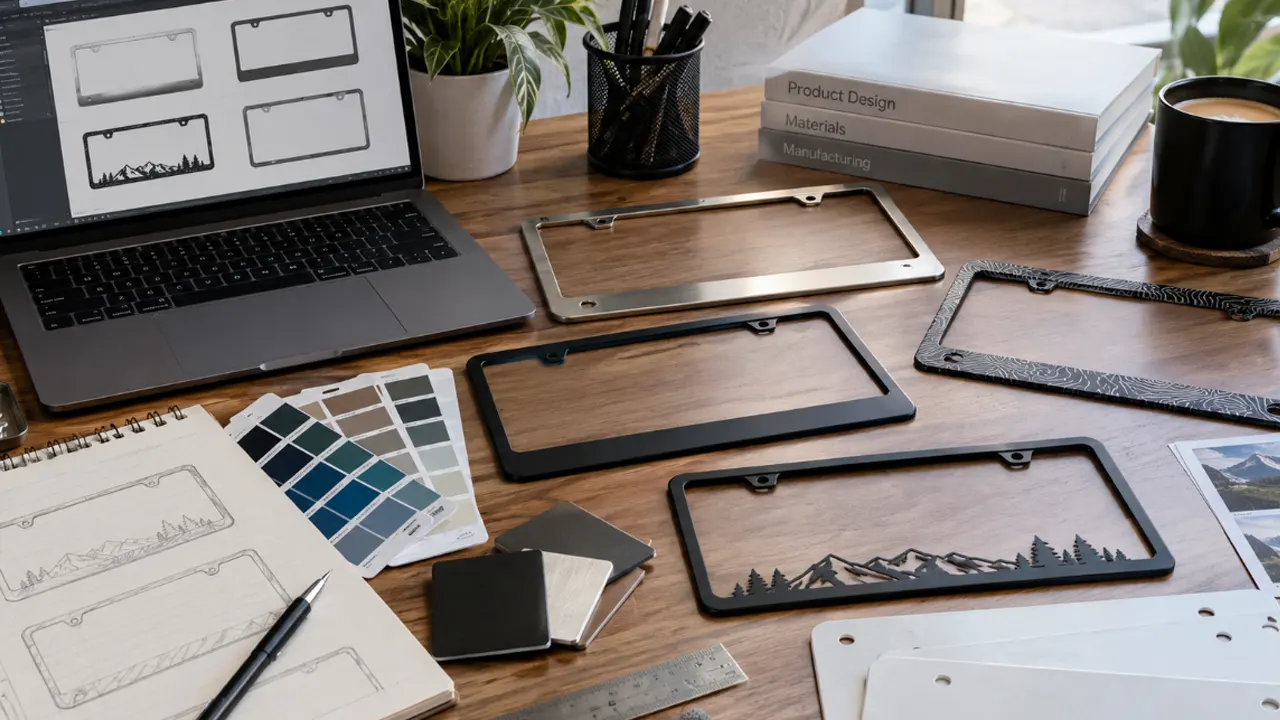
A frame gives you more room to express the idea without making the registration characters harder to decode. The right decoration method depends on the amount of detail, the desired texture, the base material, and how much visual attention the frame should attract.
| Frame Style | Works Well For | Design Caution |
|---|---|---|
| Engraved | Names, dates, short phrases, restrained monochrome branding | Fine text and shallow contrast may disappear at normal viewing distance |
| Printed | Color logos, gradients, small graphic elements, campaign artwork | Artwork must be sized for the actual rail, not a large screen proof |
| Raised letter | Bold dealer names, short brand wording, dimensional emphasis | Long messages become crowded quickly |
| Slimline | Minimalist styling and plates with information near the edges | Less rail area is available for text or logos |
| Rhinestone | Gift designs and decorative personal styling | Keep stones and settings clear of the plate’s required visible area |
| Dealer | Dealership name, group identity, short URL, or service message | Prioritize one readable message instead of stacking contact details |
| Metal | Brushed, polished, engraved, or understated premium looks | Material, edge treatment, and finish are model-specific |
| Colored plastic | Bold color, molded detail, promotional or casual designs | Confirm the exact resin and finish rather than assuming all plastic behaves alike |
For a quiet personal message, engraved frame styling keeps the design controlled. Detailed color artwork is better suited to a process such as UV printing on a compatible frame, while raised lettering gives short text a more dimensional presence. A decorative build can use a rhinestone frame, but the plate must remain the clearest object in the composition.
Should the Frame Match the Plate?
It should coordinate, not necessarily match. Repeating one color or finish is usually enough. If the plate has a dark background, a dark frame can create a unified block; a brushed or polished edge creates more separation. If the plate has several colors, a neutral black, silver, or body-color frame keeps the result from becoming busy.
Check three relationships:
- Plate to frame: Are the characters and official graphics still dominant?
- Frame to vehicle: Does the finish relate to the body color, trim, wheels, or badges?
- Message to style: Does the wording fit the visual tone? A minimalist plate paired with several fonts and decorative motifs sends mixed signals.
When in doubt, simplify the frame. The personalized characters already do most of the talking.
Place Text and Logos Where They Stay Readable
Logo placement is limited by the rail width, mounting holes, plate recess, and the information printed near the plate edges. A layout that works on a blank rectangle may fail on the real plate.
| Placement | Best Use | Check Before Approval |
|---|---|---|
| Top center | Small emblem or very short name | State name, camera view, screw position, and available rail height |
| Bottom center | Dealer name, short phrase, or URL | Registration wording and stickers near the lower edge |
| Split top and bottom | Short identity plus one supporting line | Whether two messages make the frame feel crowded |
| Outer corners | Small original icons or restrained motifs | Mounting holes, corner radius, and the visible plate opening |
| Full-width rail | One short dealership or club name | Actual artwork scale and legibility on the finished rail |
Do not assume that a frame sold for one market or plate format will fit another. Compare the plate dimensions, mounting points, frame opening, border width, and the vehicle recess. The full license plate frame customization process begins with those fit checks before artwork is finalized.
Business, Dealer, and Club Plate Ideas
An official personalized plate has very little room for marketing. A short business name or recognizable abbreviation may work, but a phone number, website, slogan, and service list will not. Put the main identity on the plate only if it remains natural; move supporting information to the frame.
For dealerships, one clear dealer or group name on the bottom rail is usually more useful than several tiny lines. A short URL can work if it stays readable at actual size. Service departments, used-car programs, events, or seasonal campaigns may need different frame artwork even when the base structure remains similar. The examples in dealer frame formats and branding layouts show where that extra message can live without turning the registration characters into an advertisement.
Clubs and communities can use a common frame with a small member-specific plate idea. Define the group abbreviation, approved logo, colors, and placement once so different vehicles still look connected. Use only names and artwork you have the right to reproduce. A word, phrase, symbol, or design may function as a trademark when it identifies the source of goods or services, so familiarity is not the same as permission.
How to Turn an Idea Into a Manufacturable Frame
This step matters only if the concept includes a custom frame, but it is where many attractive mockups meet physical limits.
- Choose the frame structure. Decide whether you need a slim border, full surround, wide bottom rail, clip-on style, or another geometry that matches the target plate and vehicle.
- Select the material. Choose plastic, aluminum, stainless steel, zinc alloy, silicone, or another verified option based on the specific design—not the material name alone.
- Define the finish. Record the intended color, texture, gloss level, plating appearance, brushed direction, or other visible requirement.
- Prepare the artwork. Supply an editable vector file when possible, convert fonts to outlines, include a color reference, and identify any elements that must not be changed.
- Confirm the branding area. Place the art on the actual rail dimensions. Check mounting holes, opening size, edge clearance, and required plate visibility.
- Review a proof or sample. Judge the design at real size and on the intended vehicle. Screen zoom can hide thin strokes and exaggerate tiny details.
- Approve the production reference. Keep the accepted artwork, color target, position, finish, and packaging details together so later runs can be compared with the same reference.
The custom frame options can help you define the available structure and decoration direction, but the exact dimensions, material, finish, and fit still need to be confirmed for the chosen model.
What Should You Avoid?
- Too many substitutions. A plate is not successful if the owner has to explain every character.
- Tiny frame text. If a URL or slogan only works when viewed inches away, it is probably doing too much.
- Poor contrast. Similar text and background values can erase a good idea in normal light.
- Covered official information. Keep the state name, registration characters, stickers, and other required areas visible according to the rules where the vehicle is registered and driven.
- Unlicensed branding. Do not reproduce a third-party logo, team mark, character, or trade name just because it is easy to find online.
- Personal data. Avoid complete dates, addresses, passwords, or anything you would not want photographed and shared.
- A design that only works in a mockup. Check the real plate, real frame opening, screws, bumper recess, and normal viewing distance.
- Assuming availability equals approval. A character combination may appear open and still be subject to review by the issuing agency.
Frequently Asked Questions
How do I come up with a custom license plate idea?
Write down one personal theme and five words connected to it. Circle the word that another person would recognize fastest, shorten it only as much as necessary, and create several variations. A plate based on a specific story usually works better than a generic “cool” word.
How many characters can a personalized plate have?
There is no single U.S. limit. It varies by state, vehicle type, and plate design; spaces or symbols may also be treated differently. Check the current rules for the exact plate design before you refine the idea.
What if my first plate choice is already taken?
Try a synonym, change the word order, use a familiar nickname, or add one meaningful initial. Do not destroy readability just to preserve the exact original phrase. Three to five genuinely different backups are more useful than five nearly identical number substitutions.
Can I put a business name on a license plate frame?
Yes, a business or dealer name is a common frame concept when you have the right to use that branding and the installed frame keeps required plate information visible. Keep the message short enough to read at the actual rail size.
Can a license plate frame include a website?
A short domain can fit well on a wide bottom rail. Remove unnecessary prefixes, avoid stacking it with a phone number and slogan, and test a full-size proof. If the letters become thin or cramped, use the business name alone.
Is engraving better than printing for a custom frame?
Neither is automatically better. Engraving suits restrained text and line work; printing is more flexible for color, gradients, and detailed artwork. The best method depends on the base material, finish, design detail, desired appearance, and verified process limits.
Can dealer frames match a personalized plate?
They can coordinate through one shared color, finish, or type style. Avoid repeating the exact same message on both pieces. Let the plate carry the personal or branded identity and use the frame for a short supporting detail.
Can I use a logo on a custom license plate frame?
You can use an original logo or artwork you are authorized to reproduce. Keep small logo details out of narrow rails, provide a clean vector file, and confirm the final size before production. Permission and technical fit are separate checks; you need both.
What file format should I send for a custom frame?
An editable vector file such as AI, EPS, or SVG is usually the strongest starting point because it can be scaled without losing edge quality. Include outlined fonts, a color reference, and a PDF preview showing the intended arrangement. Confirm the accepted format with the manufacturer handling the specific project.
Should a custom plate and frame use the same color?
Not necessarily. Repeating one accent often looks more deliberate than matching every color. Use contrast when it helps the plate remain dominant, and choose a neutral frame when the official plate already contains detailed artwork.
Make the Idea Work on the Real Vehicle
A memorable plate does not need a complicated code or an elaborate border. Choose one meaning, make it readable, prepare backups, and check the current rules before ordering. If you add a custom frame, judge the plate and frame together at actual size. The finished combination should still look clear from a few car lengths away.