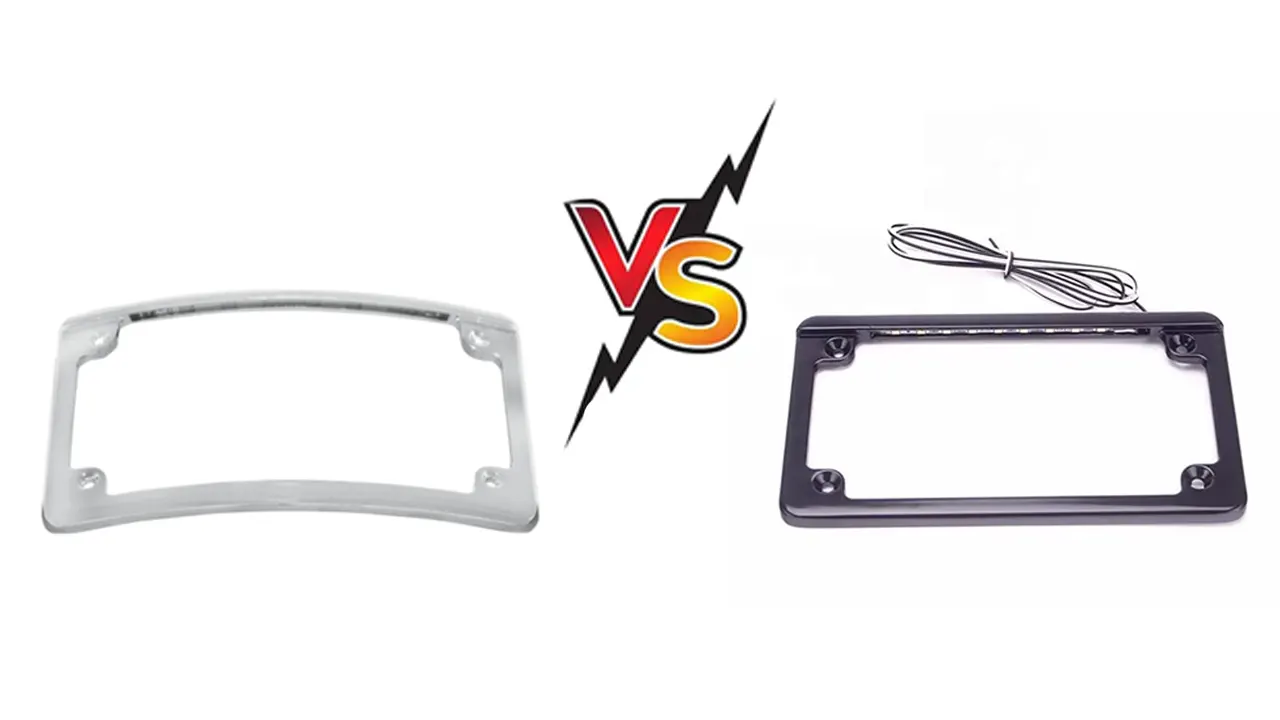
A flat license plate frame is the right default when the vehicle provides a level plate pad or a flat mounting bracket. A curved frame makes sense only when its contour matches a defined fender, bumper, or vehicle-specific carrier. The word “curved” isn’t a fit specification by itself.
For a retail or OEM program, compare the complete stack—vehicle surface, bracket, plate, frame, spacers, and fasteners. A frame can have the correct outside dimensions and still rock, twist, or load the plate because the screw axes and contact points don’t agree.
Flat and curved frames solve different geometry problems
| Decision point | Flat frame | Curved frame |
| Best starting condition | Level plate pad or flat adapter bracket | Known curved carrier, fender, or bumper mount |
| Fit information needed | Outer size, opening, hole layout, recess clearance | All flat-frame data plus curve direction, radius or profile, and stand-off |
| Main risk | Corner gaps on a curved surface | Rocking or stress if the curve does not match |
| Program flexibility | Easier to use across vehicles that share a flat mounting interface | Usually narrower and more vehicle-specific |
| Sample check | Frame sits level without being pulled into shape | Frame follows the carrier without forcing the plate or twisting the fasteners |
A curved frame isn’t automatically more secure or more aerodynamic. Its value is geometric: it can sit closer to a matching contour. Harley-Davidson, for example, describes one curved frame as shaped for the contour of particular rear fenders and limits it to named motorcycle models. That is a useful fit lesson for any buyer—the curve and the mounting system belong together.
Don’t use the screws as a forming tool
If a flat frame leaves visible gaps on a curved mount, tightening the screws harder may seem like the quickest fix. It can also bow the plate, crack a plastic frame, distort a thin metal frame, strip a mounting insert, or leave the assembly under constant spring load.
First identify what is actually curved. Sometimes the painted bumper is curved but the plate bracket presents a flat face. In that case, the frame should match the bracket rather than the bumper behind it. If the mounting points are on different planes, use an approved carrier or spacers designed for that vehicle instead of asking two screws to pull everything flat.
Measure the interface, not only the frame
Start with the license plate frame size guide, then add the dimensions that describe curvature and support:
- plate width, height, corner shape, and embossed areas;
- frame opening and border width, including clearance around registration information;
- hole-center spacing, hole shape, and screw-axis direction;
- distance from the mounting plane to the highest and lowest contact points;
- curve direction and a cross-section or radius where the surface is not flat;
- clearance for cameras, lights, liftgate handles, sensors, and recess edges;
- number and location of pads, clips, or lower supports.
A side-profile photo beside a straightedge is helpful during early discussion, but it does not replace a drawing or physical sample. For a vehicle-specific frame, ask the supplier to identify the datum surface used for the curve. Otherwise two parties can quote the same “radius” from different reference points.
Choose by sales program
Multi-vehicle aftermarket range
A flat frame paired with a verified flat bracket usually gives you cleaner SKU control. Group vehicles by plate format, hole layout, recess, and obstruction risk. Don’t market one frame as universal merely because it surrounds a common US plate size.
Motorcycle or vehicle-specific accessory
A curved design can look more integrated when the rear fender or layback mount has a stable, known profile. Treat fitment as model- and year-specific until the installation has been checked on every listed application.
Custom OEM program
Freeze the mounting stack before tooling: vehicle reference surface, bracket revision, plate location, frame material, thickness, curve, fasteners, and any isolators. The customization guide explains the artwork and sample inputs that should travel with that geometry.
Approve the sample under real mounting conditions
Bench inspection won’t reveal every fit problem. Install a production-equivalent sample on the intended vehicle or approved fixture and check:
- All screws start by hand without pulling the frame sideways.
- The frame contacts only the intended pads or bracket surfaces.
- The plate remains supported and is not visibly bowed.
- The frame does not rock when light pressure is applied at its corners.
- The opening leaves required plate information visible for the target jurisdiction.
- The assembly clears adjacent trim and still allows the trunk, tailgate, or fender-mounted components to operate.
If your program spans several vehicles, record results by model and year. One successful installation proves that application, not the whole market.
What to send with a flat or curved frame RFQ
Send the target market, plate drawing, vehicle or bracket reference, hole layout, side profile, preferred material and finish, annual quantity, packaging format, and fitment list. For a curved frame, add a 2D section or 3D file that defines the contour. You can share these details through the project inquiry page for a feasibility and sampling discussion.
Frequently asked questions
Can a flat license plate frame be bent to fit a curved bumper?
Only if the frame, plate, bracket, and vehicle instructions permit it. Forcing an unknown frame into a curve can leave residual stress or damage the mounting points. A compatible adapter is usually the safer way to create a flat interface.
Is every curved license plate frame the same radius?
No. Curvature may run horizontally, vertically, or through a compound surface, and different products use different profiles. Ask for the actual curve definition and fitment list.
Does a curved frame need special packaging?
Often, yes. The pack should support the formed profile so stacking pressure does not flatten or twist it. Approve packaging with production-equivalent parts and the intended shipping carton.