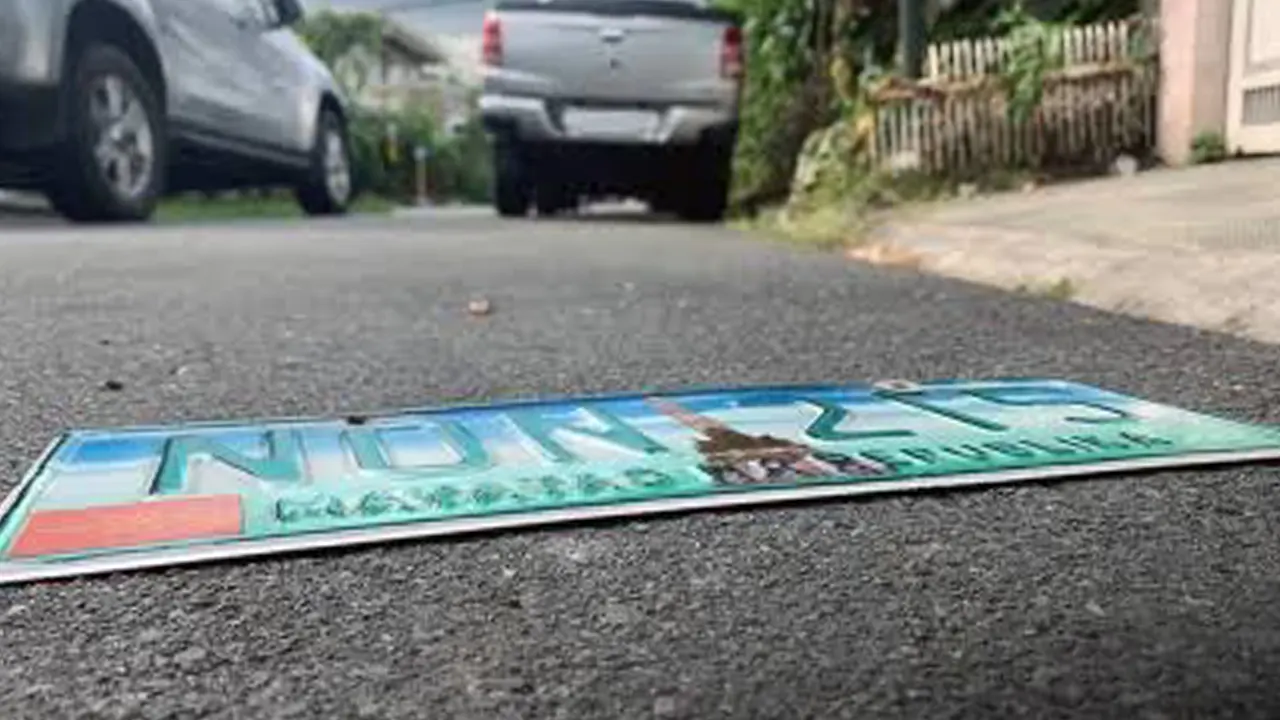
If you lost a license plate, move the vehicle to a safe location, confirm which plate is missing, photograph the empty mounting area, and contact the motor-vehicle agency that issued the registration. Ask whether you need a police report, whether you may drive before replacement, what to do with any remaining plate, and whether the plate number will change. Do not make a cardboard substitute or attach a decorative copy.
A plate that fell off is different from one you know was stolen, but you may not be able to tell immediately. Loose screws, broken plastic anchors, torn plate holes, road debris, and a damaged bracket can all cause a loss. Tool marks, missing security screws, body damage, or suspicious activity may point to theft. Document what you see before repairing it.
Do this first: Photograph the front and rear of the vehicle, record the plate number from your registration or insurance records, inspect the route only when safe, and contact the issuing agency promptly. A plate found by someone else can still be misused.
The First Hour: A Safe Order of Actions
- Stop somewhere safe. Do not walk along a freeway shoulder or step into traffic to search.
- Check both plate positions. Note whether the front, rear, or only issued plate is gone.
- Photograph the vehicle. Capture the empty bracket, remaining screws, torn holes, scratches, and the other plate if present.
- Find the plate number. Look at the registration card, insurance policy, renewal notice, toll account, parking account, or a previous vehicle photograph.
- Check nearby ground and recent stops. Look around the driveway, car wash, parking space, and loading area without putting yourself at risk.
- Contact the issuing agency. Use its current lost-plate or replacement procedure rather than a generic form from another state.
- Ask about police reporting. Requirements depend on the state, number of missing plates, and whether theft is suspected.
- Follow temporary-driving instructions. Do not assume a receipt, remaining front plate, or handwritten sign is enough.
Write down the date and approximate time you noticed the loss, the last place you remember seeing the plate, and any unusual event such as a minor impact, deep water, off-road trip, or automatic car wash. This timeline can help with the agency report and with later toll or parking disputes.
Lost or Stolen? Look for Evidence, Not Certainty
A plate that is simply absent does not tell you how it disappeared. The mounting area can provide useful clues.
| What you see | What it may suggest | Next step |
|---|---|---|
| Loose screw remains; other hole is enlarged | Fastener loosened and plate flexed away | Photograph, report loss, repair the mounting point |
| Both screws and frame are gone cleanly | Removal is possible, though not proven | Treat as possible theft and ask about police reporting |
| Torn plate fragment under a screw | Fatigue, impact, or severe vibration | Save the fragment and replace damaged support |
| Scratches or pry marks near bracket | Forced removal may have occurred | Do not clean first; document and report |
| Bracket cracked after a car wash or impact | Mechanical loss is plausible | Notify the agency and replace the broken bracket |
If you have evidence of theft, use the steps for a stolen license plate, including law-enforcement reporting and closer monitoring for misuse. If you genuinely do not know, say that. Do not delay the replacement process while trying to prove exactly what happened.
Do You Need a Police Report for a Lost Plate?
There is no single answer for every state. New York’s DMV, for example, instructs owners to obtain police documentation when both plates are lost, stolen, or destroyed, or when the only plate on a one-plate vehicle is missing. Procedures differ when just one plate from a two-plate set is gone. California’s DMV uses its own replacement process and has separate instructions concerning lost or stolen plates and any plate that remains.
Call the non-emergency number or use an official online reporting channel when directed. Use emergency services only for an immediate danger, a theft in progress, collision injuries, or another genuine emergency. Keep the report or incident number and the officer or agency information.
Can You Drive After Losing a License Plate?
Do not assume you can. The answer depends on whether the state issued one or two plates, which plate is missing, and whether the agency offers a temporary permit, receipt, or other authority. A front plate remaining on a vehicle does not automatically replace a required rear plate. Likewise, a vehicle from a two-plate state may not become compliant simply because the rear plate remains.
Ask the issuing agency these questions:
- May I drive the vehicle before the replacement arrives?
- Do I need a temporary operating permit or specific receipt?
- Where and how must the temporary credential be displayed?
- Must I surrender the remaining plate before replacements are issued?
- Will I receive a new plate number or a duplicate of the old one?
- Do personalized, specialty, disability, historic, or motorcycle plates follow a different process?
If the vehicle cannot be driven lawfully, arrange compliant transport or leave it parked where permitted. A handwritten plate number in the window is not an official credential unless the issuing authority specifically authorizes that exact method.
How to Replace a Lost License Plate
The details vary, but the preparation is similar. Gather government identification, the vehicle identification number, current registration, plate number, vehicle year and make, proof of ownership if requested, police documentation if required, and payment for the stated fee.
Use the official state motor-vehicle website or office. Watch for look-alike websites charging extra to provide forms that are available directly from the agency. Confirm whether the application can be completed online, by mail, at a self-service kiosk, or only in person.
If one plate from a pair remains, do not discard it. Many agencies require it to be surrendered when the number is reissued. Removing it early may also leave the vehicle without any displayed plate, so follow the agency’s sequence.
Special Plates May Need a Different Replacement Path
Tell the agency exactly what kind of plate is missing. A standard passenger plate may be replaced through a routine transaction, while a personalized, disability, military, historic, organizational, commercial, dealer, trailer, or specialty plate may have extra forms, eligibility checks, or production time.
For a personalized plate, ask whether the character combination can be reissued or whether the missing number must remain canceled for security. Do not order a decorative copy of the same characters while you wait. It will not carry the registration authority of the original and may complicate a stop or parking review.
If the lost plate displayed a disability symbol or was associated with parking privileges, contact the issuing program as well as the registration office when instructed. The replacement of a plate and the replacement of a placard are not necessarily the same transaction. Protect any related identification number and report suspicious use promptly.
Historic and collector registrations can also have plate-specific restrictions. A vintage plate used under a year-of-manufacture program may be owned differently from a standard modern issue. Bring photographs and approval records, and do not modify or replace it with another old plate until the agency confirms the permitted process.
Keep a Replacement File
Store the application, payment receipt, police or loss report, temporary permit, mailing confirmation, and final registration together. Add photographs of the empty mount and the repaired installation. If the number changes, record the date each toll, parking, and access account was updated.
This file is useful if a citation, toll, or parking notice tied to the missing number arrives weeks later. It also helps another household member explain the situation during a stop. Keep the original documents secure and carry only the temporary credential or copy that the agency tells you to display or retain in the vehicle.
Will You Keep the Same Plate Number?
Possibly, but not always. A state may issue a new configuration so the missing plate can be flagged and no longer linked to the active registration. Personalized and specialty plates can have different duplicate or reissue rules. Ask before promising yourself—or a toll, parking, or insurance account—that the number will stay the same.
When a new number is assigned, update every service that identifies the vehicle by plate:
- Toll-road and bridge accounts
- Municipal and private parking apps
- Residential parking permits
- Workplace, apartment, school, hospital, or airport garages
- Car-wash or fleet memberships
- Roadside-assistance and insurance records where the number appears
Save confirmation screenshots or emails. Remove the missing number from automatic access lists only after preserving any transaction history you may need.
What If You Lost Only the Front Plate?
In a two-plate state, the front plate can still be required even when the rear plate is secure and readable. Report and replace it according to the issuing state’s procedure. Inspect the front bracket closely because impacts, parking curbs, snow, car washes, and loose plastic anchors commonly affect that location.
If the front bracket broke, replace it with a model-appropriate mounting solution. Do not drill new bumper holes casually or use a screw that could strike wiring, sensors, shutters, a heat exchanger, or painted structure. The options described for installing a front plate without new holes can help you identify bracket types, but vehicle fit still needs confirmation.
What If You Lost the Rear or Only Plate?
The rear plate is commonly the primary or only required plate, so contact the agency before driving. Check the plate lamp, wiring, and bracket because the same incident that removed the plate may have left sharp metal, exposed wire, or loose trim.
A rear plate can disappear after fasteners loosen, a carrier cracks, or a low mount contacts a curb or road debris. Repair the cause before installing the replacement. Simply using larger screws in damaged plastic can split the mounting boss and make the next failure more likely.
Lost Motorcycle License Plate
Motorcycle plates experience vibration, spray, and more exposed mounting positions. A tail tidy or side-mount bracket can amplify movement if it is thin, cracked, or poorly supported. Check the full carrier, lamp, wire, fastener holes, and any plate fragment still under a washer.
Tell the agency that it is a motorcycle plate because plate size, registration class, replacement form, and number of plates differ from passenger vehicles. Do not substitute a car-size novelty plate or change orientation while waiting. When reinstalling, measure the actual motorcycle plate and use a carrier that supports it without entering the tire or suspension path.
Lost Registration Sticker but Still Have the Plate
A missing sticker is not the same as a missing plate. It may have peeled, been damaged during cleaning, or been removed. Contact the issuing agency for its replacement decal process and ask whether reporting is required.
Do not print a sticker or move one from another plate. Clean only as directed before applying the official replacement. If the plate surface is peeling or badly damaged where the sticker belongs, ask whether the entire plate should be replaced.
Could the Plate Have Fallen Off?
Yes. Common mechanical causes include loose screws, missing washers, stripped plastic inserts, a cracked bracket, torn plate holes, severe vibration, an impact, or a fastener stack that never clamped the plate evenly.
A plate can also fret around its holes when it moves slightly on every drive. The hole grows, the remaining metal thins, and eventually the plate pulls past the screw head. Large washers can spread load, but they are not a repair for a badly torn plate or broken bracket.
Use a careful fastener diagnosis instead of overtightening. The sequence for keeping license plate screws from loosening explains thread condition, clamping, washers, spacers, and vibration in more detail.
Inspect the Mount Before the Replacement Arrives
- Clean only enough to inspect. Preserve tool marks or damage if theft is possible.
- Check the threaded points. Look for stripped inserts, cracked anchors, and corrosion.
- Check bracket flatness. A bent carrier can preload the new plate and make it vibrate.
- Inspect the plate light. Confirm the housing, lens, wire, and connector remain secure.
- Look behind the bracket. Make sure no screw can contact painted bodywork or hidden components.
- Choose the correct hardware. Match thread, length, head size, washer, spacer, and corrosion resistance to the mounting point.
If the mounting point is part of a damaged bumper, trunk panel, tailgate, motorcycle fender, or electrical assembly, have it repaired properly. The new plate should not be used to clamp broken trim together.
How to Prevent Another Loss
- Use all intended mounting points when the vehicle and bracket provide them.
- Replace stripped anchors and cracked brackets instead of using more torque.
- Use washers or spacers where they keep the plate and frame flat.
- Choose screw length that fully engages the thread without bottoming out.
- Use a suitable locking method only where the vehicle or hardware maker permits it.
- Check the plate after car washes, minor impacts, off-road driving, or long rough trips.
- Listen for a new rattle and investigate it early.
- Keep a clear photograph of the plate and registration details in a secure record.
Tamper-resistant screws can slow casual removal, but they do not make a plate impossible to lose or steal. Keep the matching driver bit somewhere accessible at home, and inspect the joint periodically.
Can a License Plate Frame Prevent Loss?
A properly fitted frame can support plate edges and distribute some load, but it cannot compensate for loose fasteners, torn holes, a broken bracket, or incorrect installation. A heavy frame on a flexible carrier can even increase vibration.
Match the frame to the plate size and mounting-hole spacing. Make sure it sits flat and does not force the plate to bow. If the frame touches the vehicle paint, use the correct spacer or backing arrangement rather than tightening until the contact mark disappears.
A frame is also not an anti-theft guarantee. Treat fasteners, bracket, carrier, plate, and frame as one stack. Every layer must be clamped securely without hiding required information.
What If You Find the Plate Later?
Do not immediately put it back on the vehicle. Contact the police agency and motor-vehicle agency involved in the report. The number may have been canceled, entered as missing, or replaced. Reusing it could create a mismatch with the current registration.
If the agency tells you to surrender or destroy the recovered plate, follow its exact instructions. Keep the correspondence or receipt with the replacement record.
Watch for Toll and Parking Activity
A lost plate can be picked up and attached to another vehicle. Review toll, parking, and access accounts for transactions after the loss date. Preserve screenshots, notices, and photographs before disputing a charge.
If a violation arrives, respond before the stated deadline. Provide the loss report, DMV replacement record, photographs, and any evidence showing that the pictured vehicle is not yours. Each operator or court may have its own contest process.
Frequently Asked Questions
What should I do immediately after losing a license plate?
Move to safety, photograph the vehicle and mounting area, record the plate number, check nearby locations only when safe, and contact the issuing motor-vehicle agency.
Should I report a lost plate to the police?
Requirements vary. Some states require police documentation in defined lost-plate situations, while others use an agency declaration. Report promptly when theft is suspected and follow the issuing state’s current instructions.
Can I drive with one plate missing?
Do not assume so. It depends on the plate system, which plate is missing, and whether temporary authority is available. Ask the issuing agency before driving.
Can I make a temporary plate myself?
No. A handwritten or printed copy is not an official plate unless the issuing authority explicitly authorizes a particular temporary credential and display method.
Will the DMV give me the same number?
Not always. Lost plates may be canceled and replaced with a new configuration. Personalized and specialty plates can follow separate rules.
What happens to the remaining plate?
The agency may require surrender of the remaining plate when replacing a two-plate set. Keep it secure until you receive instructions.
What if the plate fell off because the screws were loose?
Complete the loss and replacement process first, then repair the threads, anchors, bracket, and fastener stack before installing the new plate.
What if someone returns my old plate?
Contact the agencies involved before using it. It may no longer be valid even if it appears undamaged.
The Bottom Line
A lost license plate calls for two parallel actions: protect the registration record and find the mechanical reason the plate disappeared. Document the vehicle, contact the issuing agency, complete any required police report, follow temporary-driving instructions, and keep the remaining plate until told what to do with it.
Before the replacement goes on, repair loose threads, torn holes, broken brackets, lighting damage, and uneven spacers. A sound installation keeps the new plate readable and greatly reduces the chance of repeating the same loss.
After installation, photograph the new number, check it again after the first week of driving, and add the fasteners to your normal vehicle inspection routine.
Technical Sources
- California DMV — Replacement License Plates and Stickers
- New York DMV — Lost, Stolen or Destroyed Plates
Procedures reviewed September 21, 2026. Reporting, fees, temporary permits, surrender requirements, and plate-number treatment vary by state and can change. Follow the current instructions from the agency that issued your registration.