
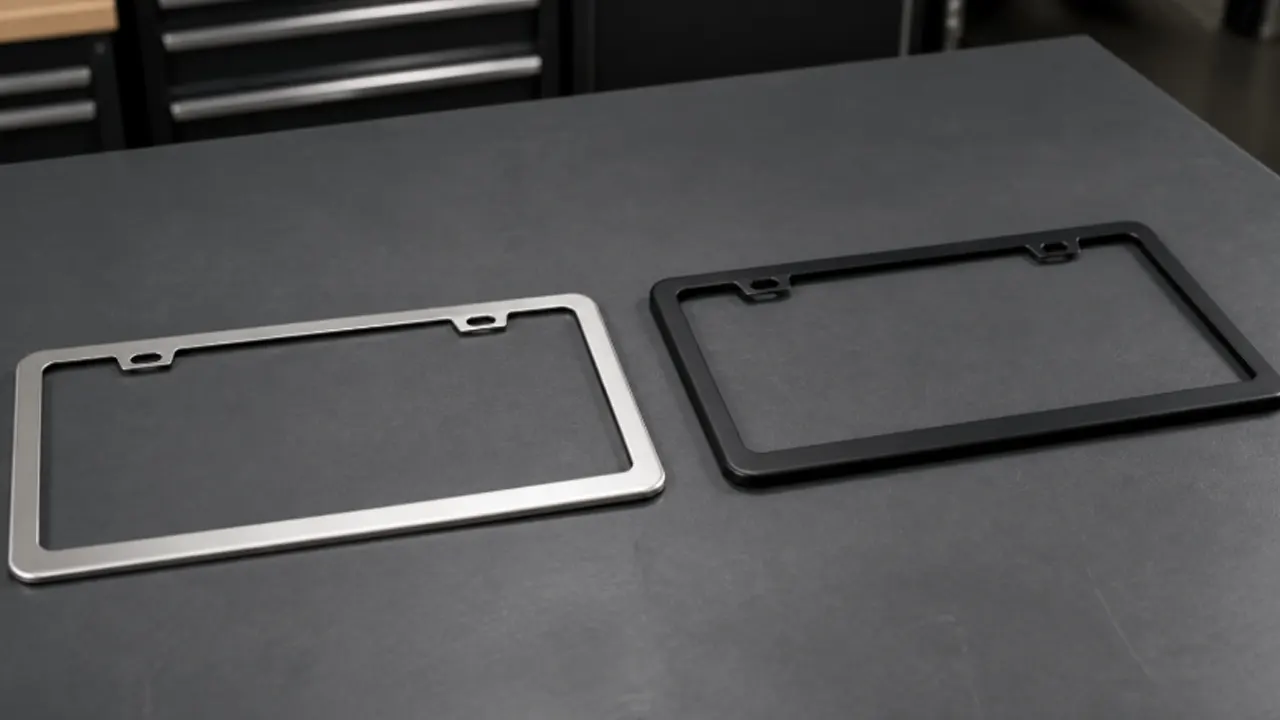
Stainless steel is the better starting point when your product needs an unmistakable metal surface, a thin rigid profile, and a polished, brushed, coated, engraved, or applied-branding finish. Plastic is the better starting point when the frame needs molded clips, ribs, raised lettering, complex geometry, low part mass, or a repeat platform for high-volume color and branding programs.
Do not approve either from the material name alone. Stainless steel performance changes with grade, thickness, forming, edge treatment, finish, fasteners, and environment. Plastic performance changes with resin grade, modifiers, wall section, molding, pigments, UV package, and decoration. The finished assembly—not the label—determines fit, appearance, and failure risk.
Side-by-Side Buying Comparison
| Decision Factor | Stainless Steel | Plastic |
|---|---|---|
| Market position | Premium metal look and feel | Broad range from cost-focused dealer frame to appearance-grade molded product |
| Structure | Thin sheet, formed section, stamped panel, or layered assembly | Molded walls, ribs, tabs, bosses, clips, and integrated logo panels |
| Surface choices | Polished, brushed, satin, coated, printed, etched, or applied detail | Molded color or texture, paint, plating, hot stamp, print, or raised detail |
| Environmental risk | Grade-dependent corrosion, staining, pitting, crevice conditions, and fastener interaction | UV-driven color or property change, creep, warpage, cracking, and decoration loss |
| Impact response | May dent or permanently bend depending on section | May flex, crack, or recover depending on resin and geometry |
| Tooling | Stamping, forming, polishing, coating, and assembly tools vary with design | Injection mold can combine many functions in one repeat part |
| Packaging concern | Surface scratches, dents, edge contact, and fingerprints | Warpage, scuffing, pressure marks, and decorated-surface contact |
Define Stainless Steel Before You Price It
Stainless steel is a family of alloys, not one grade. A supplier may offer 201, 304, 316, or another grade, and surfaces can look similar after polishing. Grade affects corrosion margin, forming, cost, and sourcing control. If your project will face coastal air, road salt, frequent washing, or water traps, the grade and assembly details deserve explicit review.
Worldstainless explains that stainless behavior comes from the alloy’s chromium-rich passive surface, not from a decorative coating. That surface can still be compromised by contamination or an unsuitable environment. Avoid claims such as rust-proof for every condition. Specify the grade, thickness, finish designation or physical master, direction of grain where relevant, edge condition, hardware material, and cleaning expectations.
Define the Plastic With the Same Discipline
Generic plastic is not a purchasable engineering specification. ABS may support rigid geometry and high-quality decorated surfaces. PP may support a lighter, more flexible structure or living clips. PC, PS, blends, fillers, impact modifiers, pigments, and stabilizers create other property sets. Even within one resin family, two grades can have different stiffness, impact behavior, heat response, shrinkage, and weathering.
Name the production resin grade and any permitted alternative. State the color system, UV-stabilization requirement, filler or modifier, allowed regrind, surface texture, and decoration process. If plating or painting is required, confirm that the grade and molding process suit it. If integral clips are important, test them after the environmental conditions the product will see.
Rigidity, Denting, and Cracking Are Design Outcomes
A formed stainless frame can feel rigid with a thin section, but an unsupported border may still deform. Once bent, it may hold the new shape. A plastic frame can be designed to flex during assembly and recover, yet stress concentrations, cold conditions, or over-tightened fasteners can cause cracking. These are not arguments for one material; they are reasons to validate the geometry.
Inspect mounting holes, inside corners, branding panels, lower tabs, and any narrow bridge around the plate opening. Use actual vehicle hardware or the intended bracket in the fit trial. State fastener torque or installation method. A material comparison without the fastening load misses one of the most common sources of damage.
Appearance and Packaging Need Separate Specifications
Stainless steel exposes handling defects quickly. Mirror finishes show fine scratches, fingerprints, waviness, and polishing inconsistency. Brushed finishes can hide some marks but reveal grain-direction changes and patchy repair. Protective film, separators, and nonabrasive bags may be necessary, but the film must remove cleanly after the expected storage period.
Plastic avoids metal denting and grain mismatch, but molded surfaces can show flow lines, sink, weld lines, gloss variation, gate marks, color shift, or decoration defects. Stacking pressure and heat can warp a thin part. Define the cosmetic inspection distance, lighting, critical surfaces, allowed defect size, and packaging orientation for either material.
Compare the Total Program Cost
Plastic frequently becomes efficient after an injection mold is proven, especially when clips, branding areas, ribs, and color are integrated. Stainless steel can avoid a complex mold for a simpler formed frame, yet polishing, coating, badges, assembly, protective film, and scratch-safe packaging add recurring operations. Tooling ownership, maintenance, change parts, and design revisions also affect the comparison.
Request a cost breakdown at your expected order pattern. A single large annual run, many small releases, multiple finishes, and frequent logo changes create different answers. Include inspection and packaging in the quote; a finish that needs individual protection is not comparable to an unpackaged molded part.
Use a Risk-Based Approval Table
| Requirement | Stainless Steel Evidence | Plastic Evidence |
|---|---|---|
| Material identity | Grade declaration and agreed verification method | Resin grade, supplier data, color and additive record |
| Fit | Drawing and installed sample with actual hardware | Drawing and installed sample, including clip function |
| Appearance | Finish master, grain direction, gloss or reflectivity, defect limit | Texture, color, gloss, molding and decoration defect limits |
| Environment | Corrosion or exposure test tied to grade and assembly | Weathering, heat, impact, and dimensional checks tied to grade |
| Handling | Scratch, dent, edge, film, and packaging trial | Scuff, warp, stack-load, and packaging trial |
How to Choose
Choose stainless steel when a true metal surface and slim premium construction justify tighter finish and packaging controls. Choose plastic when the product depends on molded functions, integrated branding, color variety, or a repeat injection-molded platform. If the market brief simply says durable, translate that word into measurable fit, appearance, environmental, and handling requirements before selecting.
Review Xingchang’s stainless steel license plate frame options and plastic license plate frame options. If stainless is shortlisted, the 201 vs 304 stainless steel comparison shows why grade belongs in the purchase specification.
What to Send With an RFQ
Provide plate and vehicle dimensions, visible opening, hole pattern, frame section, material grade, finish or molded surface, logo method, color reference, quantity by SKU, target environment, packaging, and inspection requirements. State whether you are comparing existing frames or funding new tooling. A fair comparison needs the same fit, appearance, test, and pack-out targets.
Frequently Asked Questions
Is stainless steel always more durable than plastic?
No. Stainless steel may offer a strong corrosion-resistant metal structure, but grade, section, edges, finish, hardware, and environment matter. A properly designed plastic frame may tolerate flexing better than a thin metal one. Durability must be defined by the relevant failure mode.
Can stainless steel license plate frames rust?
They can stain or corrode in unsuitable conditions. Grade, chloride exposure, contamination, crevices, surface finish, cleaning, and dissimilar-metal contact affect the risk.
Which material is better for raised dealer lettering?
Plastic can mold the frame and raised lettering as an integrated part. Stainless frames can use stamped, applied, printed, etched, or badge-style branding. Compare the desired depth, colors, tooling, and repairability.
Which frame is less likely to scratch vehicle paint?
Material alone does not decide that. Movement, sharp edges, trapped grit, uneven tightening, plate support, and missing spacers create contact damage. Verify the rear geometry and installed clearance.
Is plastic automatically cheaper?
No. Tooling, resin, plating or paint, colors, secondary operations, quality controls, volume, and packaging determine cost. Compare complete program quotes.
Which material is easier to recycle?
Recyclability depends on material identification, mixed components, coatings, local collection, and the actual recycling stream. Do not make a finished-product claim from the base material alone.