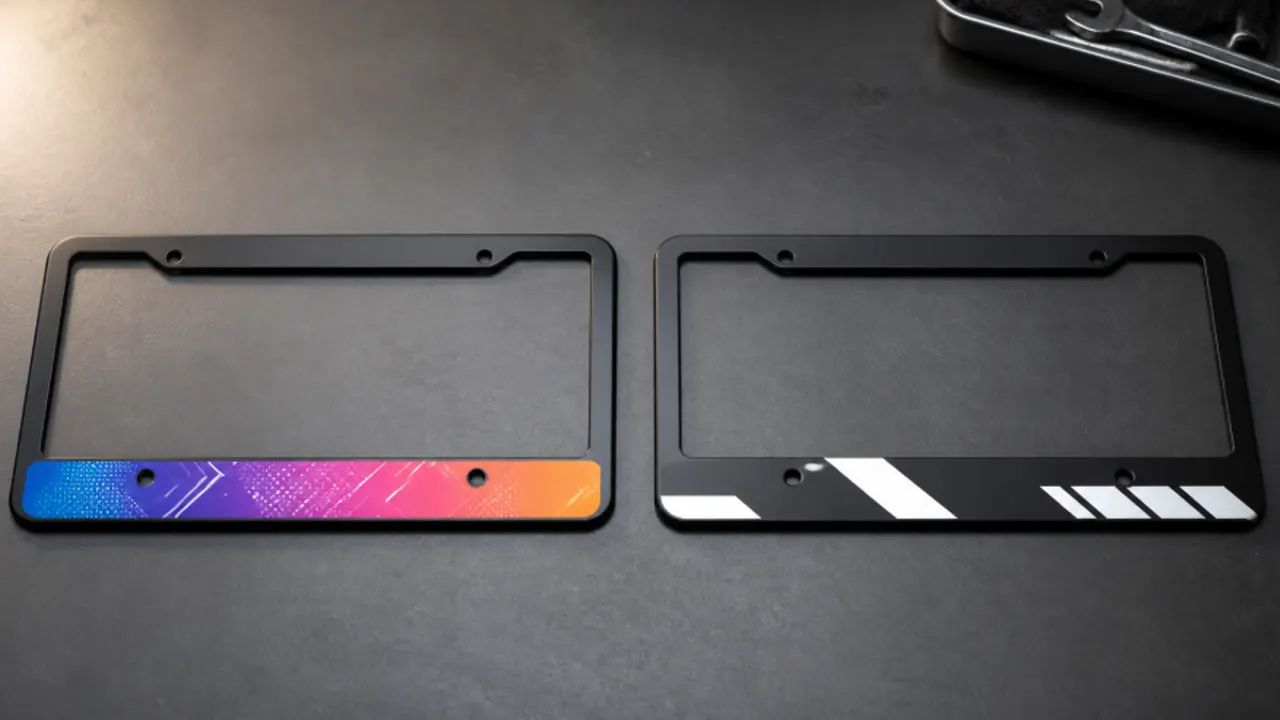
UV printing is usually the better starting point when your license plate frame artwork uses gradients, fine detail, photographs, or many colors. Screen printing is usually stronger for simple spot-color graphics that will repeat across a stable production program. Neither process is automatically more durable outdoors. Ink chemistry, frame material, surface preparation, cure, film build, clear protection, and the approved test method determine whether the decoration survives.
For a buyer, the useful question is not which process wins in general. It is which process can reproduce your artwork on the selected frame, at your order pattern, with evidence that the print will stay attached and retain an acceptable appearance.
Quick Comparison
| Decision Factor | UV Printing | Screen Printing |
|---|---|---|
| Artwork | Detailed, multicolor, gradients, variable graphics | Bold text, line art, spot-color logos |
| Color setup | Digital file and color-management setup | Separate screen and registration control for each color |
| Design changes | Easier to change between approved files | New or revised screens may be required |
| Production fit | Useful for multiple designs and shorter changeable runs | Efficient for stable artwork repeated in volume |
| Color control | Depends on profiling, white ink, substrate color, and viewing conditions | Direct spot-color formulation can suit tightly controlled brand colors |
| Durability | System-specific; requires adhesion, cure, and weathering evidence | System-specific; requires the same evidence |
| Typical risk | Weak adhesion, insufficient white base, banding, or edge chipping | Registration shift, pinholes, inconsistent deposit, or incomplete cure |
How the Two Processes Build the Image
A UV flatbed printer jets small droplets of ink and cures them with ultraviolet energy. It can place process colors, white ink, and sometimes clear layers from a digital file. That digital path makes complex artwork and frequent design changes practical, but the result still depends on the printer, ink set, primer, print mode, frame height variation, and cure settings.
Screen printing pushes ink through a patterned mesh onto the frame. A separate screen is normally prepared for each spot color, and multiple colors must register to one another. Mesh, stencil, squeegee, ink viscosity, deposit thickness, flash or final cure, and part fixturing all affect the result. Screen printing can produce bold, opaque graphics, yet curved or uneven branding panels may narrow the usable print area.
Choose UV Printing When Artwork Complexity Drives the Program
UV printing earns its place when the visual brief cannot be reduced to a few solid colors. A flag, illustrated mascot, gradient, photographic pattern, or collection of seasonal graphics is easier to manage from digital production files than from many physical screens. It can also make sense when you need several approved designs in one purchase program and the basic frame stays the same.
Check the white-ink strategy before approval. Color printed directly onto a black frame can become dull or transparent unless the system places an adequate white layer below it. On a bright metal surface, reflected light can also change the apparent color. Ask the supplier to show the artwork under the actual frame color and finish, not on a generic white test panel.
Fine detail needs its own limit sample. Thin strokes, small reversed text, sharp corners, and ink near an edge may look clean in a digital proof but fail on the physical frame. Set minimum line width and text size from a production sample rather than from the printer’s nominal resolution.
Choose Screen Printing for Stable Spot-Color Artwork
Screen printing fits dealership names, URLs, phone numbers, slogans, and simple logos that repeat without frequent revision. When the brand specification calls for a named spot color, the ink can be mixed and approved against a physical color standard. The economics improve when screen preparation and setup are spread across a longer run, but the crossover quantity depends on the artwork, number of colors, frame geometry, ink system, and supplier workflow.
Each added color increases setup and registration work. If two colors must meet precisely, define an acceptable registration tolerance and inspect the same boundary on production samples. A screen-printed frame can also carry halftones, but a photographic effect is not a reason by itself to choose the process. Confirm what the supplier can hold on the actual surface.
Outdoor Durability Is an Ink-System Question
Calling an ink UV-cured does not prove that it is UV-resistant outdoors. The first term describes how the ink hardens; the second concerns how the finished color and film respond to weathering. Screen inks may also be UV-cured, solvent-dried, or use another chemistry. Process names alone cannot support a service-life claim.
Adhesion can change between ABS, PP, coated metal, anodized aluminum, polished stainless steel, and painted surfaces. Mold release, silicone contamination, fingerprints, low surface energy, polishing residue, or a mismatched primer can cause early peeling even when the ink itself is suitable. Mimaki’s technical guidance, for example, treats primer as a way to improve UV-ink adhesion on difficult substrates. Nazdar’s screen-ink data likewise ties performance to cure, film thickness, color formulation, substrate, mounting angle, location, and abrasion.
For your program, approve a named system: frame substrate and finish, cleaning or pretreatment, primer where used, ink series, color formula, print sequence, cure settings, and any clear layer. If the supplier changes one of these after approval, require a documented review instead of assuming equivalence.
Build a Sample Plan Around Failure Modes
| Check | What to Approve | Why It Matters |
|---|---|---|
| Artwork reproduction | Fine lines, reversed text, gradients, and edge definition | Confirms the physical process can hold the design |
| Color | Physical master, lighting, substrate, and tolerance | Prevents digital-screen approval from becoming the color standard |
| Adhesion | Defined cross-cut or tape method after full cure | Finds weak surface preparation or ink mismatch |
| Abrasion | Agreed rub medium, load, cycles, and pass/fail appearance | Represents cleaning and handling risk |
| Weathering | Test method, exposure, evaluated properties, and acceptance limit | Replaces vague outdoor-life claims with evidence |
| Lot consistency | Color, position, registration, and defects across sampled units | Connects the golden sample to mass production |
What to Put in the RFQ
Send the frame drawing or model, substrate and finish, printable area, artwork files, brand-color references, expected quantities by design, packaging method, target market, and intended outdoor environment. State whether exact color, small text, abrasion, or rapid design changes are the priority. A supplier can then quote the process around a defined job instead of a keyword.
Ask for the production proof on the actual frame. For UV printing, confirm the white layer, primer, print mode, and edge clearance. For screen printing, confirm the number of colors, screen count, print order, registration tolerance, and whether the approved ink deposit is measurable. For either process, keep the approved sample and inspection criteria with the purchase specification.
You can review Xingchang’s UV-printed license plate frame options and silk-screen license plate frame options before preparing an RFQ. If the frame structure, material, and artwork are still open, start with the license plate frame customization process.
Frequently Asked Questions
Is UV printing more durable than screen printing?
Not by process name alone. A well-matched, correctly cured ink system can outperform a poorly prepared one in either process. Compare test evidence for the exact substrate, finish, ink, pretreatment, and clear layer you will buy.
Which process is better for a full-color logo?
UV printing is usually the practical starting point for gradients, many colors, photographic elements, or several design versions. Approve white ink, color, and fine detail on the actual frame surface.
Which process is better for dealership frames?
Screen printing often suits stable dealer names, URLs, and one- or two-color logos repeated in volume. UV printing may fit dealer groups that need many locations, campaign graphics, or more complex artwork. Quantity alone does not decide the method.
Can screen printing reproduce a Pantone color?
A spot ink can be formulated to a physical color target, but the observed result still changes with substrate color, opacity, gloss, film thickness, and lighting. Approve a physical master and a tolerance.
Do PP frames need pretreatment before printing?
They may. PP grade, additives, molding conditions, age, contamination, and ink chemistry affect adhesion. Require the supplier to define the surface-preparation route and verify it on the molded production material.
Should a clear coat be mandatory?
Only when the validated ink system and your performance target require one. A clear layer changes gloss, color, edge behavior, repairability, and cost, so it should be named and tested rather than added as a vague durability upgrade.