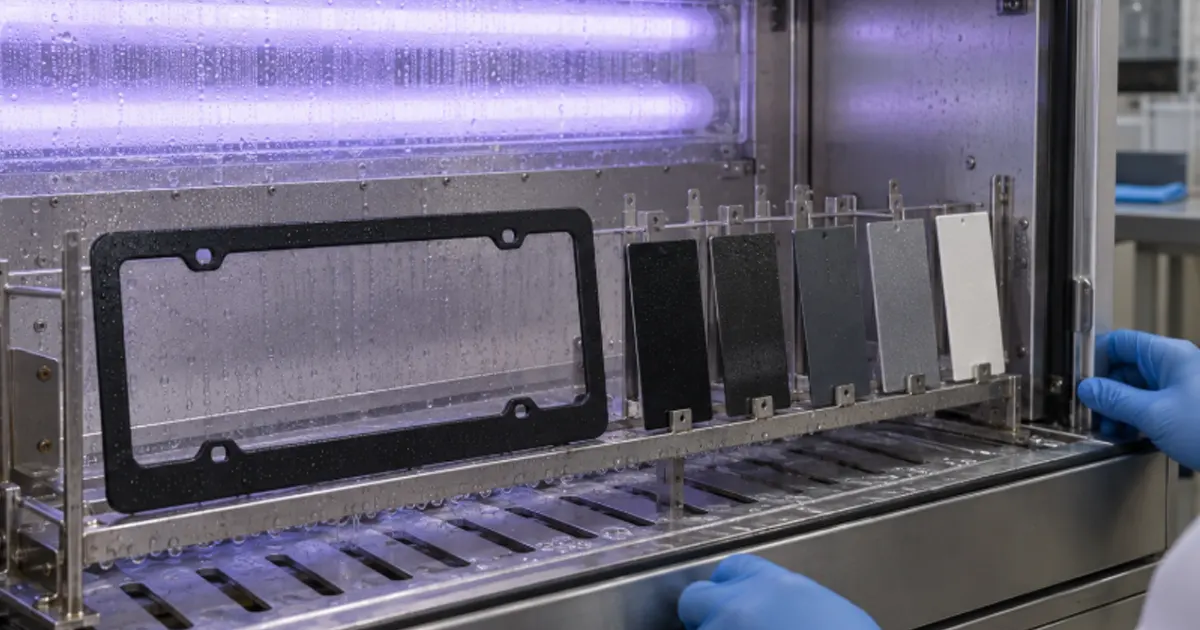
Outdoor exposure can change a license plate frame long before the base part fails. A black frame may lose visual depth, a colored logo may shift, a clear or metallic surface may haze, and a coating can become less stable at edges. A UV weathering test helps you compare those changes under stated laboratory conditions. It does not turn a lab exposure time into a guaranteed number of years on every vehicle.
First, separate UV weathering from UV printing
UV weathering refers to light exposure used to evaluate how materials and finishes change. UV printing is a decoration process that uses ultraviolet light to cure inks. They can meet on the same product, but they are not the same thing. A UV-printed logo may need weathering evaluation, while a non-printed powder-coated or molded-color frame may need it too.
For digital-logo options, UV-printed frames show the decoration route. The weathering test then asks whether the finished surface remains acceptable over time.
What a UV weathering test can show
ASTM G154 describes procedures for operating fluorescent ultraviolet exposure equipment. The method gives a laboratory way to expose suitable materials under defined light, temperature, moisture, and cycle conditions. For license plate frames, the useful question is usually not “Did it pass UV?” It is “What changed on this finished frame under this stated exposure, and was that change acceptable?”
| Appearance or function to review | Why it matters on a frame |
|---|---|
| Color change | A frame, logo, or accent may no longer match the approved appearance master |
| Gloss change | Gloss black, metallic, chrome-look, and coated surfaces can read differently after exposure |
| Chalking or surface dulling | Can change the tactile feel and make the part look aged even if it remains intact |
| Cracking, checking, or brittleness | May appear at thin rails, clips, corners, or stressed mounting areas |
| Print or coating condition | Edges, large ink areas, and high-contact zones may react differently from the base surface |
| Adhesion after exposure | Shows whether a coating or print still remains attached under the agreed evaluation method |
Why a flat panel is not enough
A flat panel can be useful for comparing color or coating process control. It is not a complete substitute for a finished license plate frame. Frames have mounting holes, narrow borders, decorative recesses, molded ribs, formed edges, and areas that may flex during installation. Those features can concentrate stress or make small visual changes more obvious.
For a finished accessory, include a complete frame that represents the material, color, coating or print, geometry, and hardware conditions you want to evaluate. If the test uses only a flat material plaque, treat the result accordingly. It can compare that material or finish, but it does not automatically describe every edge, hole, recess, or stressed area on the complete frame.
Do not compare hours without comparing conditions
Two reports can state the same exposure duration and still be poor comparators. The light source, cycle, moisture phase, temperature, sample orientation, specimen preparation, measurement method, and acceptance criteria all affect what the result means. ASTM G154 is an operating practice, not a product-specific promise of how many hours a frame must withstand or how to translate those hours to outdoor service.
When you see a “UV tested” claim, look for the acceptance criterion. A useful result names the sample, method, exposure conditions, duration, properties evaluated, and permitted change. Without that information, the phrase says very little about how the frame actually changed.
Read the report in this order
| Check | What to look for |
|---|---|
| 1. Sample identity | Base material, color, finish, print, part revision, and any attached components |
| 2. Exposure method | Named practice or procedure and the laboratory cycle used |
| 3. Exposure period | Recorded duration without converting it directly into service life |
| 4. Evaluation method | Visual standard, color measurement, gloss measurement, adhesion check, or another stated assessment |
| 5. Acceptance criteria | What change was permitted, where it was measured, and who approved it |
| 6. Before-and-after evidence | Photos or measurements that let you judge the cosmetic result, not only a pass label |
Match the test to the construction
A molded-color plastic frame, a painted metal frame, a chrome-look plastic frame, and a printed aluminum frame may all need weathering review, but they do not carry the same risks. For plastic, look at resin, pigment, texture, stabilizer package, and stress areas. For coated or decorated metal, look at the finish stack, cut or formed edges, printed zones, and hardware contact.
The current plastic frame options and aluminum frame options help separate the material paths. They do not replace testing on the exact finish and geometry being evaluated.
Use weathering evidence honestly
Use the result to compare like-for-like constructions and define how much visual change is acceptable. Pair it with the risks the frame will actually see. An outdoor frame may also need cleaning-chemical exposure, abrasion checks, installation trials, coating adhesion review, and corrosion testing where metal or a decorative metallic surface is involved.
Keep the evaluation focused. Select the failure modes that could change the frame’s appearance, fit, or everyday use instead of treating one UV exposure number as a complete durability verdict.
FAQ
Does a UV weathering test prove a license plate frame will not fade outdoors?
No. It provides comparative laboratory evidence under stated exposure conditions. Natural outdoor performance also depends on geography, orientation, heat, moisture, road contamination, cleaning, and the exact construction.
Should a black license plate frame be weathering tested?
It can be useful when visual retention matters, especially for gloss, texture, printed artwork, coated finishes, or plastic colors. Define what visual change is acceptable before testing.
Can a frame pass UV weathering but fail in normal use?
Yes. Weathering is only one exposure. A frame may still have problems with abrasion, cleaners, hardware contact, corrosion, vibration, or installation damage. Use the result as one part of the qualification plan.