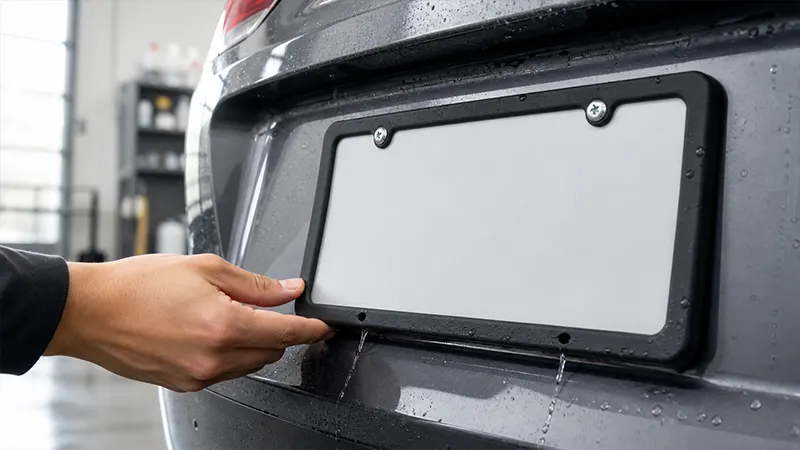
Yes, silicone license plate frames are good when you want a quiet, soft surround that covers the plate edge and reduces direct contact with the vehicle. They are not automatically maintenance-free or universally legal. A good design must fit the plate without sagging, leave all required information visible, drain at the installed low points, resist tearing around the holes, and allow you to remove trapped grit during cleaning.
The Pros and Cons in One Table
| Area | Advantage | Limitation to manage |
|---|---|---|
| Noise | Soft material can isolate the plate edge and reduce tapping or buzzing | It cannot fix a loose vehicle bracket, trim panel, camera, or wrong screws |
| Paint contact | Cushions hard edges and covers the plate perimeter | Sand trapped behind the frame can still abrade the paint |
| Corrosion | The silicone body cannot form red iron rust | Steel hardware, the plate edge, and vehicle mount can still corrode |
| Weather | Flexible construction tolerates normal movement and temperature changes | Poor drainage can retain dirty water and road salt |
| Appearance | Creates a clean, understated border without bright metal | Loose corners, stretched holes, lint, and surface staining can look untidy |
| Installation | The plate usually slips into a surrounding channel | A tight or poorly shaped channel can bunch, tear, or cover plate details |
| Branding | Supports subtle molded, colored, or printed details | Less suitable than rigid metal for deep relief and crisp premium decoration |
Why Silicone Frames Can Reduce Rattle
A rear plate often uses only two upper screws. The unsupported lower edge can tap the trunk lid, hatch, bracket, or a rigid frame. Silicone places a compliant layer around the plate and can absorb small movements before they become audible contact. It can also prevent a bare plate edge from buzzing inside a hard frame.
That advantage only applies when the source is the plate assembly. Hold the plate firmly while reproducing the noise. If the rattle continues, inspect interior hatch trim, a loose bracket, wiring, a camera housing, or another body component. If it stops, remove the plate and check for polished contact marks, loose fasteners, warped parts, and missing isolation. Our rattle diagnosis guide walks through that process.
Do Silicone Frames Protect Car Paint?
They reduce direct contact between sharp metal edges and paint, which is useful around shallow recesses. The soft material also makes accidental contact less severe while you position the plate. But silicone does not create a sealed clean room. Dust, sand, road film, and dried salt can work behind the assembly. If the frame moves, those particles can mark the finish.
Remove the frame periodically, rinse away loose grit before wiping, clean the plate and painted recess, and dry the parts before reassembly. Do not rely on a thick layer of random foam tape. Poorly placed foam can hold water, prevent secure screw seating, or create new pressure points.
Can a Silicone License Plate Frame Rust?
The silicone body cannot rust because it is not an iron-based metal. The word “rust-proof,” however, is often applied too broadly. Your assembly still contains a state-issued metal plate, screws, washers, threaded inserts, and a vehicle bracket. Those parts may corrode if their coating is damaged or water and salt remain trapped.
Check whether the hardware material is identified, whether drainage remains open after installation, and whether the channel holds water along the plate edge. For a broader explanation of material and assembly corrosion, see our rust-proof license plate frame guide.
Drainage Is the Detail That Separates Good and Bad Designs
Water enters from rain, washing, condensation, and road spray. A wraparound channel should give it a path out at the lowest installed points. Drain features located at the top, covered by the bumper, or collapsed by stretching do not help. More holes are not automatically better; their positions and open area must work with the plate and vehicle orientation.
After installation, pour a small amount of clean water along the upper edge and confirm it leaves the lower channel rather than collecting behind the plate. This simple check does not replace durability testing, but it can reveal a blocked path immediately.
Fit, Hole Strength, and Screw Seating
A silicone frame should grip the plate edge evenly without excessive stretch. Corners should remain flat, the face should not curl into the visible field, and the mounting holes should align without pulling the frame sideways. Too much stretch thins the material around holes and corners; too little retention lets the frame sag.
The screw head needs a supported seat. If it bears on a soft unsupported ring, tightening can deform or tear the material before the plate is secure. Use washers or reinforced areas when the design calls for them, match screw length and thread to the vehicle, and tighten evenly by hand. Stop when the plate is secure; a power driver can strip the mount or cut into the silicone.
Legal Visibility Still Applies
Silicone is not exempt from plate-display rules. A thick lip can cover a state name, registration tab, character, or color field. A distorted channel can also intrude after months of use. Check the installed frame, not only the empty product. Make sure the plate is upright, clearly legible, properly illuminated, and recognizable visually and by authorized electronic systems.
Rules differ by jurisdiction and can change. Use current official sources for the state where the vehicle is registered and operated. Our legal overview explains why a slim unobstructed opening is the safest design direction.
How Long Does a Silicone Frame Last?
Service life depends on the silicone formulation, pigments, fillers, wall thickness, tear design, UV exposure, temperature, chemicals, installation stress, and cleaning. A generic “silicone” description does not establish outdoor performance. For a commercial specification, ask for the actual material grade or controlled formulation, target hardness, color tolerance, relevant temperature range, UV or weathering validation, and tear or pull-through acceptance around the mounting areas.
Inspect the frame when you wash the vehicle. Replace it if the corners no longer grip the plate, the holes are splitting, the lip covers required information, the surface has become sticky or brittle, or the assembly will not stay secure.
Cleaning a Silicone License Plate Frame
- Rinse the assembly to remove loose grit.
- Remove the screws while supporting the plate so it does not fall against the paint.
- Take the plate out of the channel without pulling one corner excessively.
- Wash the silicone, plate, hardware, and vehicle recess with mild automotive shampoo and water.
- Use a soft brush only where needed; avoid abrasive pads and harsh solvents.
- Rinse thoroughly and dry the channel, holes, plate edges, and mounting area.
- Reinstall with open drains at the bottom and verify all plate information remains visible.
Who Should Choose Silicone?
A silicone frame is a strong choice for a daily driver with a two-screw rear plate, a shallow painted recess, or an existing plate-edge rattle. It also suits buyers who prefer a simple matte border and do not need deep decorative relief.
Choose a rigid metal frame instead when your priority is a polished or brushed finish, detailed cast branding, a crisp thin border, or an emblem program. The silicone vs metal comparison separates those use cases in more detail.
For an OEM, dealer, or retail program, evaluate a production-intent sample with the real plate, hardware, and vehicle bracket. You can share the plate format, target markets, color, branding, quantity, packaging, and validation needs through our project inquiry form.
Frequently Asked Questions
Are silicone license plate frames legal?
They can be legal when they do not cover or impair any required plate information and the plate remains securely mounted and readable. The installed geometry and local law matter more than the material name.
Do silicone frames melt in hot weather?
A properly specified outdoor silicone formulation should be selected for the expected temperature range, but you should not assume every product uses the same formulation. Ask for material and weathering data when heat exposure is critical.
Do silicone frames stop all plate noise?
No. They can isolate plate and frame contact, but noise from the bracket, trunk trim, camera, wiring, or body panels needs a different repair.
Will silicone damage paint?
The soft body is less likely to scratch than a sharp metal edge, but grit trapped behind it can mark paint. Clean the contact area periodically and make sure the assembly does not move.
Are silicone frames good for front plates?
They can be, provided the vehicle bracket supports them, the drains face correctly, the frame clears sensors and airflow, and every required plate element remains visible. Check front and rear positions separately.