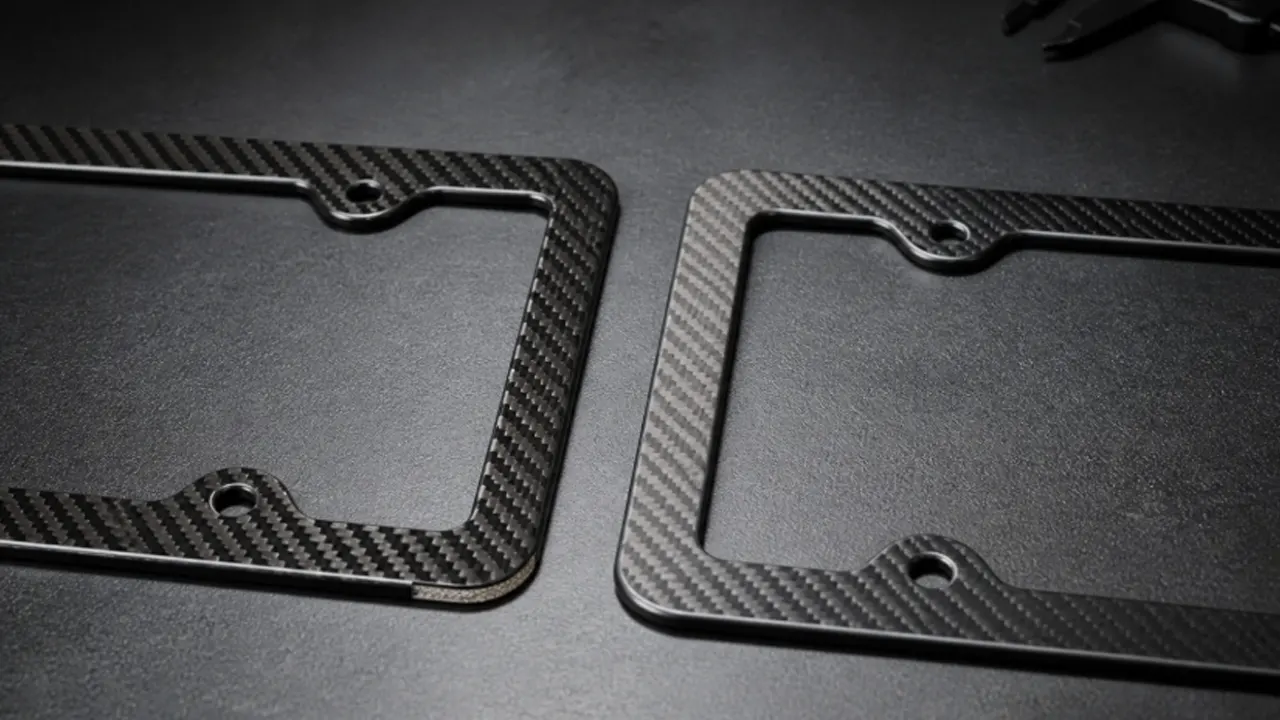
A real carbon fiber license plate frame contains carbon fiber reinforcement in a resin matrix. A carbon fiber look frame uses a printed, molded, painted, wrapped, or hydro-dipped pattern over another material such as plastic or metal. Both can create a sporty appearance, but they are different products and should be specified, priced, and marketed differently.
For a small decorative frame, genuine carbon fiber is not automatically the better commercial choice. Your decision depends on what you are promising: authentic material, low weight, visual consistency, impact tolerance, customization, target price, or a reliable finish across a large order.
What “Real Carbon Fiber” Should Mean
Carbon fiber itself is a reinforcement made from many fine carbon filaments. A usable part is normally a composite: carbon fibers or woven carbon fabric are combined with a thermoset or thermoplastic resin and cured into a laminate. Toray’s terminology defines a carbon-fiber-reinforced polymer as carbon fiber serving as the primary reinforcement within a polymer matrix.
That definition matters because the visible weave alone does not tell you how the frame is built. A frame may be a molded carbon laminate, a hybrid laminate, or another substrate with a thin genuine carbon veneer. All three may contain actual carbon fiber, but they do not have the same construction or performance. Your product description should state which one you are buying.
What a Carbon Fiber Look Frame Is
A carbon-look frame reproduces the appearance of woven carbon without relying on carbon reinforcement for the part’s structure. Common constructions include:
- A carbon pattern molded into an injection-molded plastic surface
- A printed film or hydrographic pattern applied to plastic or metal
- An adhesive vinyl wrap with a woven texture
- A painted or UV-printed pattern under a clear protective layer
“Carbon look” is not a defect when it is described honestly. It can give you repeatable graphics, a lower target price, easier color changes, and a substrate that is better suited to high-volume molding or decorative branding. The problem begins when a cosmetic pattern is sold as a structural carbon-fiber composite.
Real Carbon Fiber vs Carbon Fiber Look: Practical Comparison
| Decision factor | Real carbon fiber construction | Carbon fiber look construction |
|---|---|---|
| Material identity | Contains carbon reinforcement within a resin system; construction may be full laminate, hybrid, or veneer. | Uses another substrate and a cosmetic carbon pattern. |
| Appearance | Can show genuine weave depth and natural variation, but appearance depends on fabric, layup, resin, and clear finish. | Can be highly consistent; pattern quality depends on the printing, molding, film, and topcoat process. |
| Weight and stiffness | May provide high stiffness at low mass when the laminate is engineered correctly. | Follows the properties of the plastic or metal substrate; the pattern adds little structural value. |
| Impact and overtightening | Thin laminates and drilled areas can crack or delaminate if geometry and installation are poor. | Behavior depends on the substrate; some plastics flex, while thin metal may bend. |
| Weathering | The resin and clear finish control much of the visible UV, gloss, and surface aging. | The film, ink, adhesion, and clear layer control fading, peeling, and wear. |
| Batch consistency | Weave alignment and cosmetic surface can vary with cutting, layup, molding, and finishing. | A controlled print or molded texture can be easier to repeat across high volume. |
| Customization | Logos and colors usually require additional processes or carefully planned inlays and finishing. | Printed patterns and molded substrates can support broad graphic and color options. |
| Cost structure | Includes reinforcement, resin, layup or molding, trimming, finishing, and higher cosmetic inspection demands. | Often supports a lower unit cost, but tooling, film setup, printing, coating, and reject rates still matter. |
| Proof required | Bill of materials, construction description, reverse-side and edge evidence, approved sample, and batch controls. | Named substrate, decoration method, topcoat specification, adhesion and weathering expectations. |
How to Tell the Difference Without Guessing
A product photo is not enough to verify genuine carbon fiber. Modern prints can reproduce weave, gloss, and apparent depth convincingly, while a genuine carbon laminate may be painted on the reverse or finished in a way that hides the fibers.
Read the construction wording. “Carbon style,” “carbon pattern,” “carbon texture,” and “carbon fiber look” usually describe appearance. “Genuine carbon fiber” is more specific, but you should still ask whether the frame is a full laminate, a hybrid, or a carbon veneer over another core.
Inspect edges, holes, and the reverse side. These areas may reveal a molded plastic body, metal substrate, adhesive film, coating stack, or laminate plies. Do not rely on a single edge photo if the product has painted or capped edges.
Tilt the sample under one light source. Genuine woven reinforcement can show changing depth as the viewing angle moves. A flat repeating print may stay visually uniform. Treat this as a clue, not a certificate; textured films and clear coats can imitate depth.
Compare the pattern around curves and cutouts. Real fabric may distort as it conforms to geometry, while a printed pattern may stretch, repeat, or break at a seam. Skilled composite work can look very regular, and high-quality printing can look irregular, so visual inspection remains inconclusive.
Ask for objective supplier evidence. The most useful answer is not “look at the weave.” It is a material declaration, process description, approved physical sample, and permission to inspect a cut section or retained production sample when the order value justifies it.
The Clear Finish Often Decides What the Customer Sees
Buyers tend to compare carbon fiber with plastic, but the first weathering failure may occur in the outer finish. On a genuine carbon composite, resin-rich areas, pores, edge sealing, sanding, and clear-coat quality affect gloss and appearance. On a carbon-look frame, ink adhesion, film adhesion, topcoat coverage, and UV stability affect whether the pattern fades, lifts, or becomes patchy.
A glossy sample can look excellent on approval day and still be poorly defined for production. Record the accepted gloss range, color tone, weave or pattern orientation, allowable visual defects, edge appearance, and backside finish. Photographing one “golden sample” helps, but a written cosmetic standard makes inspection less subjective.
Failure Modes to Check Before a Bulk Order
Cracking around screw holes. A narrow section, sharp hole edge, countersink, or high installation torque can concentrate stress. Test the actual screw, washer, and frame stack rather than the frame alone.
Delamination or edge lifting. A laminate or veneer can separate if the bond, cure, trimming, or sealing is poor. Film and hydrographic layers can also lift when the surface preparation or clear layer fails.
Yellowing, chalking, or gloss loss. These are finish-system questions. Ask what resin or topcoat is being used and how the supplier validates outdoor appearance. Do not translate a generic “UV resistant” statement into a lifetime claim.
Pattern mismatch between units. Genuine fabric can vary in weave alignment; printed patterns can vary in registration or placement. Define whether random variation is acceptable or whether the pattern must align to a fixed reference on every frame.
Rubbing damage in packaging. A high-gloss surface can show fine scratches before installation. Evaluate separators, protective film, bag material, hardware placement, and carton movement with the finished frame, not an unfinished blank.
Which Construction Fits Your Sales Channel?
Choose genuine carbon fiber when material authenticity is central to the product. A premium automotive brand may accept higher cost and more detailed cosmetic inspection because the real weave is part of the value proposition. Your listing must still say whether the part is full carbon, hybrid, or veneered.
Choose a carbon fiber look when the visual theme matters more than structural performance. This can suit promotional, dealership, gift, and price-sensitive retail programs. A well-made carbon-look frame is easier to sell honestly than a vague “carbon” product that invites disputes.
Consider a hybrid only when you can explain it clearly. A metal or plastic core with a genuine carbon veneer may offer authentic surface material with different structural and cost behavior from a full laminate. Call it a carbon-veneered or carbon-skinned construction if that is what it is.
If you are still comparing broad material families, our license plate frame material guide covers metal, plastic, silicone, and carbon-pattern options from a practical selection perspective.
A Buyer’s Approval Checklist
- State the base construction, not just “carbon.”
- Identify whether carbon is structural reinforcement, a veneer, or a cosmetic pattern.
- Confirm the resin, topcoat, film, ink, or molding process relevant to the finish.
- Approve the frame drawing, opening, hole layout, edge radius, and screw-head clearance.
- Define weave or pattern orientation and acceptable cosmetic variation.
- Test the assembled frame with the intended plate, screws, washers, and vehicle bracket.
- Check scratch protection and hardware separation in production packaging.
- Keep a signed master sample and a written inspection standard for repeat orders.
You can review the current carbon fiber license plate frame buying guide for fit, opening, and finish considerations. For any model, confirm the stated construction before using “genuine carbon fiber” in product copy; a carbon-fiber pattern is a different specification.
Frequently Asked Questions
Is carbon fiber look the same as fake carbon fiber?
It is a cosmetic imitation of the carbon weave, but “fake” is unnecessarily misleading when the product is labeled clearly. “Carbon fiber look,” “carbon pattern,” or the named decoration process tells the buyer what the product actually is.
Does a genuine carbon fiber frame have to show weave on the back?
No. The reverse may have a different ply, a core, paint, or another finishing layer. A visible backside weave can support the claim, but it does not fully describe the laminate construction.
Can a carbon-look frame be made from metal?
Yes. A metal frame can receive a printed film, hydrographic pattern, coating, or other decorative layer. The listing should name both the substrate and the decoration method.
Is real carbon fiber always more durable?
No. Durability depends on laminate design, resin, cure, edge finishing, clear coat, geometry, installation torque, and exposure. A poorly made carbon laminate can fail sooner than a well-designed plastic or metal frame.
Can weight prove that a frame is genuine carbon fiber?
Weight alone cannot prove material identity. Frame thickness, hidden cores, metal inserts, resin content, hardware, and geometry all affect mass.
What should an importer request before using “real carbon fiber” in a listing?
Request a construction statement, bill of materials or material declaration, process description, physical sample, photos of edges and reverse surfaces, and a written batch-inspection method. Match the published wording to that evidence.
Specify the Construction You Intend to Sell
The safest buying language is also the clearest customer language. Define the substrate, reinforcement or pattern process, finish, frame geometry, hardware, artwork, quantity, packaging, and destination market. If you need a high-volume patterned design, use our custom license plate frame page to prepare your requirements, then send the project details for review.