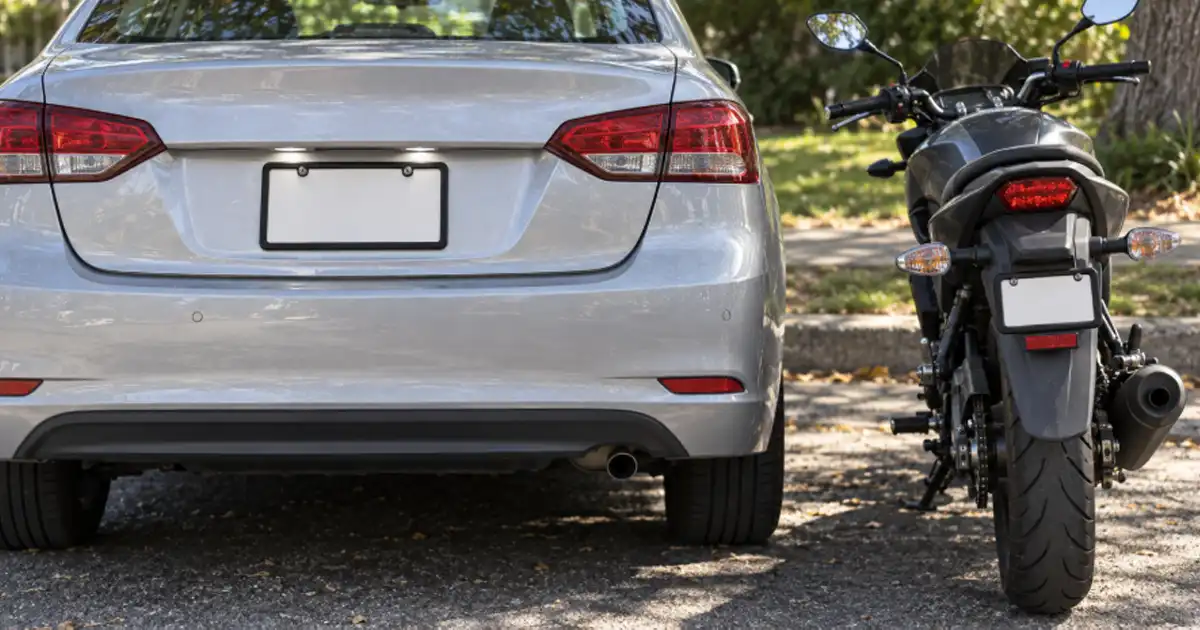
A car frame and a motorcycle frame can both look like a simple border around a plate. In production, they solve different packaging problems. A passenger-car frame usually has more bumper area and a larger plate envelope to work with. A motorcycle frame has less space, sits closer to lights, fenders, racks, or exhaust-related hardware, and is more exposed to movement and rear-wheel spray.
For a distributor or branded-accessory program, the useful question is not “Which one looks better?” It is “Which plate format, fixing pattern, clearance envelope, and display rules does this program actually need to accommodate?” Get those inputs first and the material, border, logo treatment, and hardware choice become much easier to control.
The short buying answer
| Decision point | Passenger-car frame | Motorcycle frame |
|---|---|---|
| Plate envelope | Common U.S. passenger programs start with a 12 × 6 in. plate reference, then confirm the issuing plate. | Plate formats are often smaller and are not safely assumed from the word “motorcycle.” |
| Mounting | Two top holes are common, but the vehicle or front bracket can be the limiting interface. | Rear-fender bracket geometry, angle, and nearby equipment often decide the usable fixing layout. |
| Clearance | Check bumper curvature, cameras, parking sensors, and the plate recess. | Check lights, reflectors, tire travel, luggage hardware, and the rear-fender profile. |
| Branding area | A wider top or bottom bar may be possible, subject to plate-information visibility. | Space is tighter; a slim logo area may be more realistic than a large dealer message. |
| Sample review | Review the complete stack: vehicle surface, plate, frame, hardware, and any bracket. | Review the installed angle and moving/adjacent parts, not only a flat bench assembly. |
Plate dimensions come before the frame outline
For a U.S. passenger-car program, 12 × 6 in. is a useful starting point, not permission to skip measurement. AAMVA’s current License Plate Standard includes that passenger-plate size and describes bolt-hole placement in its specialty-plate reference material. The plate supplied in your destination state, its embossing, registration features, and the vehicle-side mounting location still need to be checked on the actual program sample.
Motorcycle dimensions deserve a separate review. Ohio’s current license-plate specification is a helpful illustration of why: it specifies a 7 × 4 in. motorcycle plate with 5.75 in. horizontal and 2.75 in. vertical center-to-center hole spacing, while its standard plate reference is 12 × 6 in. with 7 in. horizontal and 4.75 in. vertical spacing. That is an Ohio specification, not a promise for every motorcycle plate in the United States. Treat it as a reason to request the real plate drawing, not as a universal motorcycle template.
If you need a broader starting point, compare the supplied plate with the working dimensions on our license plate frame size guide. For a motorcycle-specific product route, the motorcycle license plate frames category and our motorcycle frame size notes help keep the discussion focused on the smaller format rather than a passenger-car assumption.
Mounting geometry is usually the real difference
A frame can match the plate and still be wrong for the vehicle. On a passenger car, the plate may mount directly to a bumper, a dealer bracket, or a front adapter. The holes visible in the bumper are not automatically the same as the holes in the plate. On a motorcycle, the plate carrier may be angled, narrow, or offset, so the available fastener path and the space behind the plate matter as much as the hole centers.
Ask the buyer to separate three interfaces in the brief: plate-to-frame, frame-to-vehicle or carrier, and any intermediate bracket. That simple distinction prevents a common error: drilling or slotting a decorative frame to solve a vehicle-bracket mismatch without checking whether the plate is still retained cleanly.
Hole count also changes the assembly. A two-hole design may suit a given plate and installation, while a four-hole frame can improve positional control only when the plate and vehicle stack actually accept all four points. The choice should be based on the program drawing and sample installation. Our comparison of 2-hole and 4-hole license plate frames is a useful next check when the buyer is deciding between those layouts.
Do not let the frame hide the information the plate must show
A tall branding bar can turn a clean-looking frame into a field problem if it covers a jurisdiction name, validation area, plate characters, or another required feature. The exact display rule belongs to the destination jurisdiction, so it should be verified locally before release. From a product-design standpoint, the safer sequence is to place the actual issued plate behind the proposed frame artwork, then review every edge of the opening at normal viewing distance.
This is especially important for motorcycle programs. A smaller plate leaves less unused surface around the characters. A frame that is visually balanced on a passenger plate may look heavy—or cover critical information—once scaled down.
What to put in a car or motorcycle frame RFQ
| Send this item | Why it changes the result |
|---|---|
| Destination market and plate photo | It establishes the working plate format and flags local visibility review. |
| Plate drawing or measured sample | It confirms width, height, hole centers, hole shape, and the protected information area. |
| Vehicle-side photo and mounting-surface measurement | It reveals curvature, obstruction, clearance, and whether a bracket is involved. |
| Required logo and border layout | It determines whether a slim, wide-bottom, top-bar, or other visual construction is practical. |
| Hardware expectation | It identifies whether the program needs screws, caps, washers, spacers, retaining tabs, or a separate holder. |
| Sample acceptance points | It makes fit, opening visibility, finish appearance, and installed stability reviewable before volume release. |
Sample the installed assembly, not only the loose frame
A good sample review has two parts. First, confirm the frame against the plate on a flat surface: the plate inserts cleanly, the opening does not hide important information, and the branding reads as intended. Then install that same sample on the target vehicle or carrier. Check access to the fasteners, clearance around adjacent components, and whether the frame remains properly seated after normal handling.
For a mixed vehicle range, do not label the result “universal” after one successful installation. Record which plate and mounting surface were tested, which hardware stack was used, and which variants remain unverified. That record gives your sales team a much better answer than a broad fit claim.
When your program is U.S. passenger focused, start with our U.S. license plate frame options. When the brief includes a distinctive logo, finish, or opening layout, the custom license plate frames page shows the information worth preparing before a quotation.
FAQ
Can a car license plate frame fit a motorcycle?
Only if the actual plate dimensions, hole pattern, carrier geometry, clearance, and visibility review all match. The vehicle category alone is not enough evidence of fit.
Are motorcycle license plate frames always smaller?
Many motorcycle programs use smaller plate formats, but dimensions vary by issuing authority and destination market. Work from the actual plate or an approved drawing.
Should I use two holes or four holes?
Use the hole layout supported by the plate and the target mounting assembly. More holes are not automatically better if the extra positions do not align or create unwanted stress in the stack.
What is the fastest way to get an accurate quotation?
Send a plate photo or drawing, market, vehicle-side mounting photo, desired frame artwork, and expected order program. If any point is uncertain, say so; it is better to resolve it in sampling than after a production tool is released.