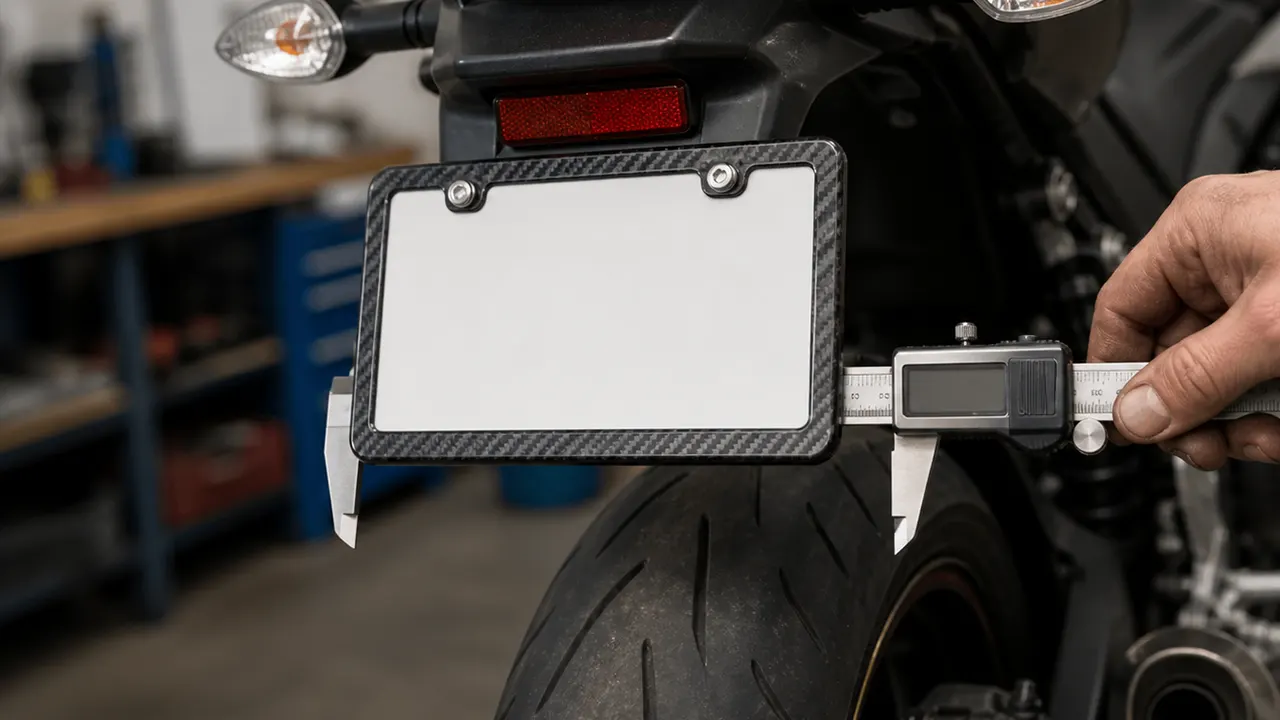
There is no single motorcycle license plate frame size that fits every U.S. state-issued motorcycle plate. A 7 × 4 inch plate and a frame with hole centers around 5.75 inches horizontally by 2.75 inches vertically are common aftermarket references, but they are not a universal legal standard. Measure your actual plate, holes or slots, bracket, lamp clearance, and required visible information before choosing a frame.
The Measurements You Need
| Measurement | How to measure it | Why it matters |
|---|---|---|
| Plate width and height | Measure the metal plate edge to edge | Confirms the frame can accept the plate body |
| Hole centers | Measure center to center, horizontally and vertically | Prevents forced alignment and cracked frames |
| Hole or slot size | Record diameter, slot length, and slot direction | Determines screw, washer, and adjustment range |
| Required visible field | Mark characters, jurisdiction name, tabs, and other official information | Prevents the border from obscuring the plate |
| Available outer envelope | Measure space around the plate on the motorcycle | Checks tire, fender, exhaust, lamp, indicator, and body clearance |
| Bracket thickness and shape | Measure the support behind the plate and any bends | Affects screw length, frame seating, and vibration |
| Mounting orientation | Record horizontal or vertical position and frame direction | Controls drains, artwork, and legal readability |
Why “Universal Motorcycle Size” Is Risky
Passenger-car plates in North America commonly use a standardized 12 × 6 inch format, but motorcycle plates have remained more variable. States can use different plate dimensions, corner radii, hole patterns, tab positions, and layouts. Older plates, specialty plates, mopeds, trailers, and non-U.S. registrations add more variation.
A seller may call a frame universal because it fits a popular 7 × 4 inch pattern or includes elongated slots. That claim describes the seller’s intended market, not every plate issued. A frame can accept the holes and still cover a character or tab, or fit the plate while contacting the tire or exhaust.
Common 7 × 4 Inch Aftermarket Reference
Many U.S.-market motorcycle frames are built around a nominal 7-inch-wide by 4-inch-high plate, with common product listings using approximately 5.75-inch horizontal and 2.75-inch vertical hole-center spacing. Treat those numbers as a comparison reference only. Place a ruler or caliper on your plate and bracket before ordering.
Do not round a measurement to make the product seem compatible. A small mismatch can force a rigid metal or composite frame into stress. Silicone may stretch over it, but the stretched lip can distort, tear, or cover plate details.
Frame Opening vs Overall Size
The plate size tells you what must fit inside or behind the frame. The opening tells you what remains visible. The outside size tells you whether the assembly clears the motorcycle. All three dimensions matter.
- Plate size: edge-to-edge size of the state-issued plate.
- Frame opening: clear window after the frame is installed.
- Frame outside size: total width and height including bars, corners, and emblems.
- Depth: thickness of the frame, plate, bracket, spacers, washers, and caps.
A wide message bar may fit outside the plate but cover the jurisdiction name or sit too close to the tire. Approve the frame on the actual plate and motorcycle, not only from a dimension labeled “fits 7 × 4.”
Two-Hole and Four-Hole Motorcycle Frames
A two-hole frame can fit a bracket with two upper or side mounts, but the unsupported edge needs enough stiffness or isolation to resist vibration. A four-hole frame distributes load when all four bracket points exist and align. Elongated slots add adjustment but need washers large enough to seat properly without entering the opening.
Never drill the state-issued plate merely to match a frame. Do not drill the motorcycle bracket, fender, or bodywork until you have checked the manufacturer’s instructions and the area behind it. A different frame or adapter is usually the safer answer.
Check Tire, Suspension, Exhaust, and Lighting Clearance
A motorcycle plate moves relative to the tire and body as the suspension travels. The static gap in a showroom is not the minimum operating clearance. Check the vehicle manufacturer’s bracket location and full suspension envelope. Side mounts, tail tidies, and angled brackets can create special legal and mechanical risks.
Confirm that the frame does not touch the tire, chain, belt, swingarm, exhaust, luggage, indicators, reflector, or rear bodywork. The plate must remain illuminated where required, and the lamp must light the plate rather than being covered by the top bar.
Vibration and Fastener Selection
Motorcycles expose the plate assembly to engine vibration, road input, and airflow. Use the correct thread, screw length, washer, and any locking method specified by the vehicle or bracket manufacturer. A thread-locking product is not automatically safe for every plastic, painted surface, or service procedure; use it only where approved.
Start screws by hand and tighten evenly. Do not use excessive torque to pull a frame over mismatched holes. After installation, press the corners, check lamp clearance, and verify the plate cannot contact the tire or exhaust. Reinspect after the first ride and periodically thereafter.
Material Choice for Motorcycle Frames
Stainless steel suits slim rigid borders and polished or brushed finishes. Inspect edges and verify the frame is not excessively heavy for a flexible bracket.
Aluminum offers low mass and colored finish options. Control cut-edge protection and hardware compatibility.
Zinc alloy supports raised graphics and cast detail but can add mass. Check bracket stiffness, casting quality, and plating coverage.
Plastic is light and can integrate ribs and recesses. Resin, UV stabilization, wall thickness, and screw-hole support determine durability.
Silicone covers the plate edge and can reduce contact noise. Check fit, drains, lip position, and tear resistance around the holes.
Carbon composite can be light and visually distinctive, but hole support, trimmed edges, clear coat, and careful hand installation matter.
See the license plate frame material guide for a full comparison.
Legal Fit Is More Than Dimensions
A correctly sized frame can still be unlawful if it covers or impairs required information, is mounted at an improper angle, is not securely fastened, lacks required illumination, or is placed somewhere other than the designated position. Motorcycle rules vary by jurisdiction and vehicle class.
Check the current official motor-vehicle code or DMV guidance where the motorcycle is registered and operated. Do not rely on an aftermarket “street legal” label. Our license plate frame legality overview explains the visibility principle, but state rules remain controlling.
Motorcycle Frame Fit Checklist
- Actual plate width, height, corner radius, and thickness recorded
- Horizontal and vertical hole centers measured from the real plate
- Hole or slot size and washer seating checked
- Frame opening leaves all official information visible
- Outside frame clears tire through suspension travel
- Frame clears exhaust heat, chain or belt, indicators, and bodywork
- Plate lamp and reflector remain functional and visible
- Correct screws engage without bottoming out
- Frame does not rattle, bow, or load the plate unevenly
- Installed angle and position comply with current local rules
Never publish a size or “universal fit” claim until the finished frame dimensions, opening, hole spacing, and slot range have been measured and approved against the intended plates and brackets. For a new design, send the target state plates, bracket drawing, available envelope, material, artwork, quantity, and packaging through the project inquiry form.
Frequently Asked Questions
What is the standard U.S. motorcycle license plate size?
There is no single size used by every state. A 7 × 4 inch format is common in aftermarket products, but you must measure the state-issued plate and check official requirements.
What is common motorcycle license plate hole spacing?
Many 7 × 4 inch aftermarket frames advertise about 5.75 inches horizontally and 2.75 inches vertically between hole centers. Treat that as a product convention, not a nationwide standard.
Can I drill new holes in my motorcycle license plate?
Do not alter the state-issued plate to fit an accessory. Choose a compatible frame or approved adapter and follow the issuing authority’s rules.
Can a car license plate frame fit a motorcycle?
Usually not. A North American passenger-car frame is built around a much larger 12 × 6 inch plate. Motorcycle plate dimensions and holes differ.
Are side-mounted motorcycle plate frames legal?
Rules for location, angle, height, visibility, and illumination vary. Check the current official law for your jurisdiction and vehicle class before using a side mount.