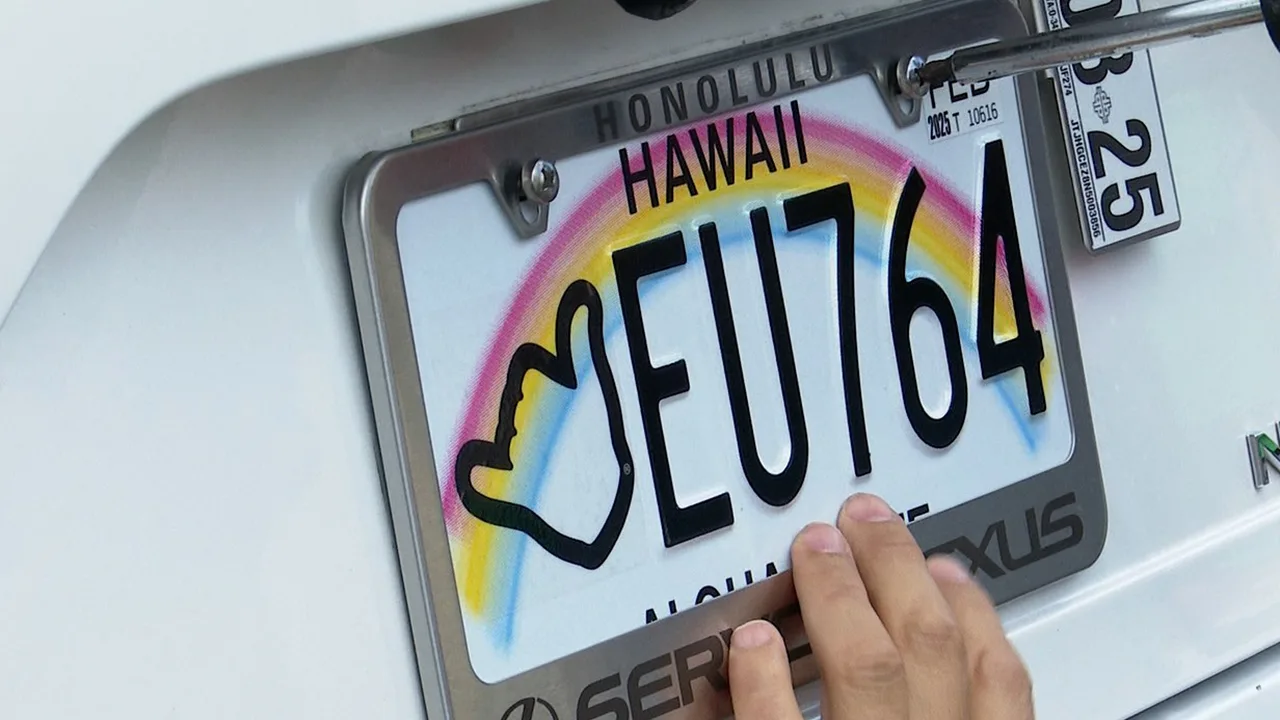
Hawaii law prohibits a cover or shield installed over a license plate. A conventional open edge frame is not necessarily the same product, but it still should not cover characters, registration stickers, the state name, or otherwise interfere with the plate’s visibility. If an accessory places material over the plate face or functions like a shield, calling it a “frame” does not avoid the rule.
There is also an important date ahead: Act 12 of 2026 takes effect on January 1, 2027. It strengthens the plate-cover rule, ties the absence of a cover or shield to the safety inspection, broadens enforcement, and raises the minimum fine.
The rule that applies now, in September 2026
Hawaii’s 2025 Act 124 prohibits using a cover or shield installed over a license plate, regardless of transparency, when it falls within the statutory definition. The legislation was aimed at devices and materials that alter or interfere with the plate’s appearance or legibility. The stated fine range is $500 to $1,000.
In practical terms, smoked shields, clear plastic covers placed over the face, films, and devices designed to interfere with reading the plate are poor choices. The fact that you can read a new clear cover while standing next to the car does not make it exempt.
What changes on January 1, 2027?
| Issue | Through December 31, 2026 | Beginning January 1, 2027 |
| Cover or shield | Prohibited under the 2025 law | Remains prohibited under the revised rule |
| Intent | Relevant to part of the 2025 definition | Act 12 removes the intent element from the definition |
| Safety inspection | Current inspection rules apply | Inspection is conditioned on having no cover or shield installed over the plate |
| Enforcement | Current enforcement framework | Act 12 expands enforcement authority to specified state and county personnel |
| Fine | $500 to $1,000 under the 2025 act | At least USD 1,000 per offense |
The future date matters. Act 12 was signed in May 2026, but its operative changes do not begin until January 1, 2027. Do not describe the higher minimum fine or inspection condition as if it already applied in September 2026.
Is an ordinary license plate frame legal in Hawaii?
A narrow open frame that stays around the outside edge is different from a transparent or tinted sheet covering the face. Hawaii’s recent legislation repeatedly targets a “cover or shield.” It does not say that every decorative edge frame is prohibited simply because it surrounds a plate.
Still, the product name is not decisive. An edge accessory can create a problem if it:
- extends over the registration number or letters;
- covers a validation sticker, state name, or other required information;
- includes a clear, tinted, reflective, or retractable panel over the face;
- changes how the plate looks to a person or camera; or
- prevents the plate from being securely and properly mounted.
If you want the conservative setup, use an open slim frame with no shield, film, lens, or plate-changing feature.
Frame versus cover: check the construction
Retail listings often use “frame,” “cover,” “protector,” and “shield” loosely. Ignore the marketing label and examine the construction:
- Open edge frame: surrounds the perimeter while leaving the plate face exposed.
- Cover or shield: places a layer over all or part of the plate face.
- Hybrid product: combines an edge border with a clear or tinted front panel.
A hybrid product may be advertised as a frame but still function as a prohibited cover. The visual examples in our frame-versus-cover comparison can help you identify the difference before installation.
Where Hawaii plates must be displayed
Hawaii Revised Statutes § 249-7 generally requires the assigned plates to be securely fastened at the locations provided by the vehicle manufacturer or, if no location is provided, on the front and rear bumpers. The plates and registration emblems need to be displayed as required for the vehicle.
A frame should support that mounting position, not move the plate behind a dark window, tilt it away from view, or turn a secure attachment into a loose one. Both front and rear installations deserve the same unobstructed fit.
A Hawaii installation check
- Remove any face panel. Clear and tinted shields are not the low-risk option under Hawaii’s rule.
- Expose every official item. Keep letters, numbers, state wording, and registration emblems visible.
- Use the intended mount. Secure the plate at the manufacturer-provided location or other lawful position.
- Inspect the frame corners. Decorative corners often overlap stickers even when the center opening looks wide.
- Prepare for 2027 now. If the accessory could be treated as a cover or shield, removing it before the new inspection and penalty provisions take effect avoids a last-minute problem.
Frequently asked questions
Are clear plate covers legal in Hawaii?
Hawaii prohibits covers and shields; transparency does not make an installed cover acceptable. The 2027 revision makes the rule even less dependent on claimed intent.
Does the 2027 law ban every metal or plastic frame?
The legislation targets covers and shields over the plate, not every open perimeter frame by name. A frame should nevertheless leave all official information visible and contain no panel, film, or device over the face.
When does the USD 1,000 minimum fine begin?
Act 12’s changes take effect on January 1, 2027. Through the end of 2026, the penalty language in the 2025 act remains the relevant provision.
Will a plate cover affect Hawaii safety inspection in 2026?
The new statutory inspection condition begins January 1, 2027. Even before then, the underlying cover-or-shield prohibition is already in effect.
Bottom line
Keep the plate face open. A slim perimeter frame that does not obscure information is a fundamentally different setup from a shield placed over the plate, but a hybrid accessory can still fall on the wrong side of Hawaii’s rule. With stricter provisions arriving January 1, 2027, removing covers and shields now is the straightforward choice.
This information distinguishes the law in effect on September 24, 2026 from changes scheduled for January 1, 2027. It is general information, not legal advice.