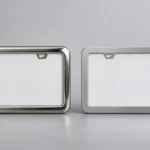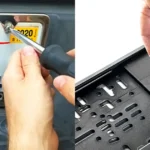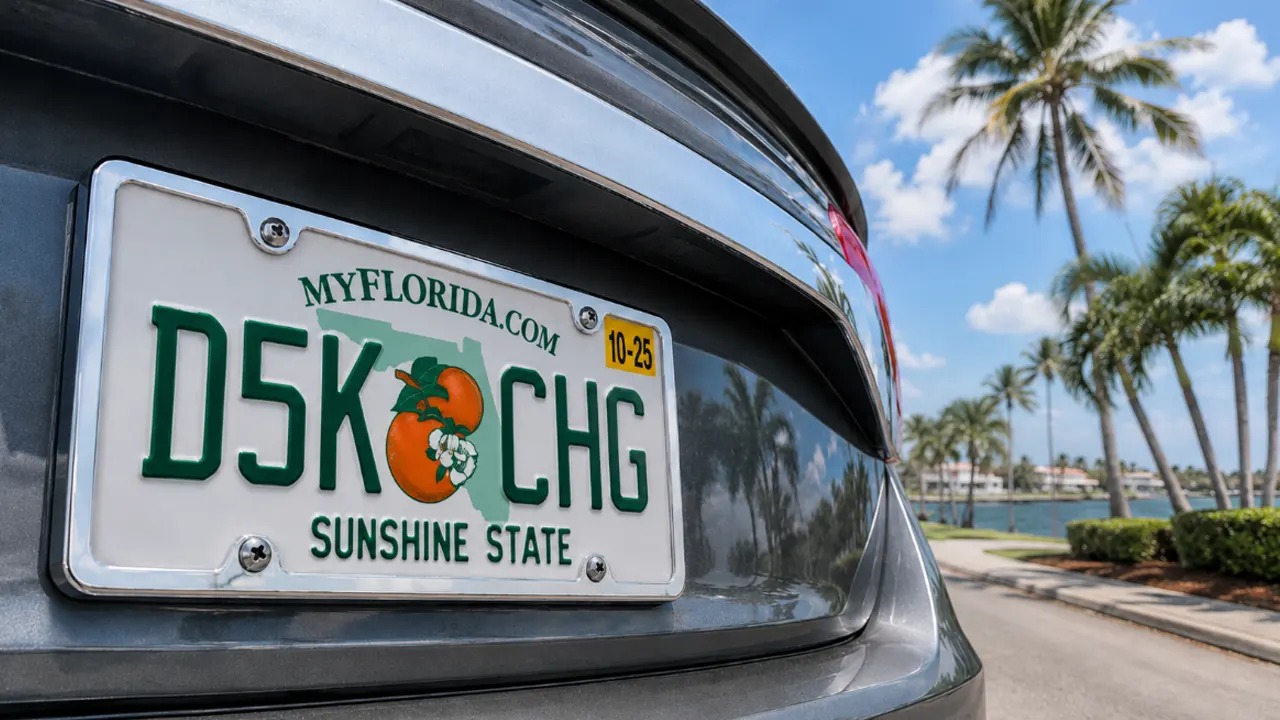
Current answer as of August 17, 2026: Florida does not ban every license plate frame by name, but the law now in force creates serious risk when anything around the plate interferes with the legibility, angular visibility, detectability, or recording of any feature or detail. Keep the plate number, registration decal, “Florida,” all printed words, and every other plate detail fully visible.
Change effective October 1, 2026: Signed Florida Chapter 2026-39 will expressly state that a frame or decorative border is not an offense under sections 320.061 and 320.262 if it does not obscure the license plate number or the validation sticker in the upper-right corner. Do not apply that future exception before its effective date. Florida’s separate display statute, section 316.605, also remains important because it requires all letters, numerals, printing, writing, the registration decal, and the alphanumeric designation to be clear, distinct, and visible.
This article is general information, not legal advice. If you have been stopped, cited, arrested, or accused of selling an obscuring device, speak with a qualified Florida attorney about the exact product and facts.
Florida’s Rule in One Table
| Date | Applicable rule | Practical treatment of frames |
|---|---|---|
| Through September 30, 2025 | The earlier version of section 320.061 treated prohibited obstruction as a noncriminal moving violation. | Obscuring material was prohibited, but the penalty structure was less severe than the law that followed. |
| October 1, 2025–September 30, 2026 | Chapter 2025-36 amended section 320.061 and created section 320.262. | A knowing violation of section 320.061 is a second-degree misdemeanor. Certain devices designed or adapted to obscure, hide, switch, or defeat recording of plate details carry separate criminal penalties. |
| Beginning October 1, 2026 | Chapter 2026-39 narrows key language in sections 320.061 and 320.262 and adds an express frame/border exception. | A frame or decorative border is not an offense under those two sections when it does not obscure the plate number or the upper-right registration decal. Section 316.605’s broader display requirements still need to be considered. |
What the Current Florida Statutes Say
Florida Statute 320.061: alteration and obstruction
The 2025 statute prohibits altering the original appearance of a registration certificate, license plate, temporary plate, or validation sticker. It also prohibits applying or attaching a substance, reflective matter, illuminated device, spray, coating, covering, or other material onto or around a plate when it interferes with the legibility, angular visibility, or detectability of any feature or detail, or interferes with recording any feature or detail.
The statute says a person who knowingly violates it commits a second-degree misdemeanor. Under Florida’s general penalty statutes, that classification can carry up to 60 days of imprisonment and a fine of up to $500. Those are statutory maximums, not a prediction of the result in a particular case.
Florida Statute 320.262: obscuring devices
Section 320.262 targets a manual, electronic, or mechanical device designed or adapted to switch plates, flip a plate out of view, cover or interfere with the primary plate features—including the number or validation sticker—or interfere with recording those features.
Under the current text, purchasing or possessing a qualifying obscuring device is a second-degree misdemeanor. Manufacturing, selling, offering to sell, or distributing one is a first-degree misdemeanor. Using such a device to assist a crime or avoid detection or arrest in connection with a crime is a third-degree felony.
An ordinary decorative frame should not be described automatically as a section 320.262 obscuring device merely because it touches the plate edge. The statutory definition includes a design-or-adaptation purpose. Section 320.061 can still apply separately if the installed frame actually interferes with any plate feature or detail.
Florida Statute 316.605: display and 100-foot visibility
Section 316.605 requires the plate to be securely fastened and prevents swinging. It says all letters, numerals, printing, writing, the registration decal, and the alphanumeric designation must be clear, distinct, and free from obscuring matter so that they remain plainly visible and legible at 100 feet. It also says nothing may be placed on the face of a Florida plate unless permitted by law or government rule.
This section matters both now and after October 1, 2026. The new frame exception says a qualifying frame is not an offense under sections 320.061 and 320.262; it does not delete section 316.605 from Florida law.
What Changes on October 1, 2026?
Florida Chapter 2026-39 was approved by the Governor on April 21, 2026, and becomes effective October 1, 2026. For license plate frames, the enacted text makes two central changes:
- Section 320.061 will focus its obstruction language on the license plate number and validation sticker rather than “any feature or detail.”
- A frame or decorative border will expressly not be an offense under section 320.061 if it does not obscure the alphanumeric designation or plate number and the registration decal or validation sticker in the upper-right corner.
- Section 320.262 will receive matching changes to its obscuring-device definition and a matching frame/border exception.
The amendment resolves a major source of uncertainty around ordinary decorative borders under those two sections. It does not create permission to cover the number or sticker, use a tinted cover, defeat a reader, flip a plate, or ignore other display requirements.
Florida License Plate Frame Law Examples
| Installed condition | Risk as of August 17, 2026 | Position beginning October 1, 2026 |
|---|---|---|
| Slim open frame; no number, sticker, state name, slogan, or other printing is covered | Lower risk because no detail appears obstructed, but check angle, camera recognition, and 100-foot visibility. | Expressly protected under sections 320.061 and 320.262 if the number and upper-right sticker remain visible; section 316.605 still applies. |
| Top bar covers part of “Florida” | Risky because current section 320.061 protects any feature or detail and section 316.605 protects printing and writing. | The new frame exception focuses on number and sticker, but section 316.605 remains. The conservative choice is to keep “Florida” fully visible. |
| Bottom bar covers “Sunshine State,” “In God We Trust,” or other plate wording | Risky under the current “any feature or detail” language and the broader display wording in section 316.605. | Do not assume the new exception makes covered wording harmless; section 316.605 still requires printing and writing to remain clear and visible. |
| Corner overlaps the upper-right registration decal | High risk under sections 320.061, 320.262 where applicable, and 316.605. | Not protected by the new frame exception. |
| Frame or cap covers part of a letter or number | Clearly risky under all relevant obstruction and display provisions. | Not protected by the new frame exception. |
| Clear, tinted, reflective, or glare-producing cover over the plate face | Risky if it changes appearance or interferes with visibility, detectability, or recording; placing material on the face raises an additional section 316.605 issue. | The frame exception does not authorize an obstructing cover or coating. |
| Flip, shutter, switch, or camera-defeating device | Potential obscuring-device offense with enhanced penalties depending on possession, distribution, or criminal use. | Still prohibited; the decorative-frame exception does not protect it. |
These examples are practical risk assessments, not rulings on a particular installation. Millimeters matter. Check the actual Florida plate, frame, fasteners, caps, and viewing angles together.
Does the Law Ban All License Plate Frames in Florida?
No statute says that every frame is illegal simply because it is a frame. The present legal problem is obstruction: current section 320.061 uses broad “any feature or detail” language, while section 316.605 protects all letters, numerals, printing, writing, the decal, and the alphanumeric designation. A slim frame that covers nothing is different from a wide frame that overlaps text or a corner sticker.
Beginning October 1, 2026, the new language will make that distinction clearer under sections 320.061 and 320.262. Even then, the lowest-risk installation will keep every printed element visible, not only the two elements named in the new exception.
How Drivers Can Check a Frame in Five Minutes
- Clean the plate and frame. Dirt and film can create an obstruction even when the frame opening is adequate.
- Inspect the entire number. No edge, screw cap, tab, or decoration should touch the readable portion of a character.
- Expose the upper-right sticker. Leave the complete registration decal visible, including its edges and printed information.
- Read every word. Keep “Florida,” the website line, slogan, county, plate class, and other printing unobstructed as a conservative response to section 316.605.
- Step back and change angles. Confirm that the plate is upright, illuminated, stable, and plainly readable from 100 feet and from typical side angles.
If the frame fails any step, remove it or replace it with a slimmer open design. Do not trim a state-issued plate or move a registration decal to make a frame fit.
What About Out-of-State Vehicles in Florida?
Section 316.605 applies to vehicles driven, stopped, or parked on Florida highways, roads, or streets. It also addresses vehicles not required to be licensed in Florida and recognizes plates issued elsewhere when they substantially comply with the section.
That wording is a reason not to assume that a frame allowed in the registration state will be ignored in Florida. Keep the out-of-state plate’s number, jurisdiction, decals, and other official information visible. If a citation or enforcement question involves conflicts between states, ask a Florida attorney to assess the specific facts.
Requirements for Sellers, Distributors, and Manufacturers
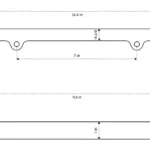
Do not market a frame as “Florida legal” solely because its catalog drawing fits a 12-by-6-inch plate. Florida issues multiple plate designs, and information can sit close to the upper, lower, or corner edges. Test the finished product on representative current plates with the actual screws, caps, artwork, and backing components.
Separate an ordinary open frame from an obscuring device in product design, naming, photography, and advertising. Avoid any claim or feature associated with hiding a number, defeating a toll or enforcement camera, changing the displayed plate, or blocking the upper-right decal. Keep records of the drawing revision, physical overlays, legal-source review date, and packaging instructions.
Use the license plate frame size guide to define the plate opening, then compare suitable constructions in the license plate frame product range. A Florida program should use conservative top, bottom, and corner clearance even after the 2026 amendment takes effect.
Frequently Asked Questions
Are license plate frames illegal in Florida right now?
Not automatically. As of August 17, 2026, a frame creates legal risk when it interferes with any plate feature or detail under section 320.061 or leaves letters, numerals, printing, writing, the decal, or alphanumeric designation unclear under section 316.605. A frame designed or adapted to obscure primary plate features can also raise section 320.262 issues.
Can a Florida frame cover “Sunshine State” or “In God We Trust”?
Do not cover it. Current section 320.061 protects any plate feature or detail, and section 316.605 requires all printing and writing to be clear and visible. After October 1, 2026, the new exception under sections 320.061 and 320.262 will focus on the number and sticker, but section 316.605 will still exist.
Can a frame cover part of “Florida” if the number is readable?
That is risky under the law in force on August 17, 2026, and it can remain problematic under section 316.605 after the October amendment. Use a frame that leaves the full jurisdiction name visible.
Can a frame cover the registration sticker?
No safe reading supports that installation. Both the current law and the October 1, 2026 frame exception specifically protect the validation sticker, and Florida places it in the upper-right corner.
Is a clear license plate cover legal in Florida?
A clear appearance does not make a cover lawful. If it alters the plate, impairs legibility, angle visibility, detection, or recording, or violates the restriction on material placed on the plate face, it creates legal risk. Tint, glare, scratches, condensation, and dirt can worsen that risk.
What is the penalty for an obscured plate in Florida?
The applicable penalty depends on the statute and conduct. A knowing violation of section 320.061 is currently a second-degree misdemeanor. Section 320.262 assigns different offense levels to purchase or possession, manufacture or distribution, and use connected to another crime. Section 316.605 describes a noncriminal nonmoving traffic infraction for violating its display subsection. A lawyer should determine which provision, if any, applies to a specific case.
Safest Design and Installation Rule
Keep the complete plate number, upper-right decal, state name, slogans, website line, county or plate-class text, and every other official marking visible. Use an open frame with conservative clearances and no tinted, reflective, illuminated, flipping, or camera-interference feature. That approach works under the stricter rule in force today and remains sensible after the October 1, 2026 clarification.
For a Florida-targeted private-label or dealership frame, review the custom frame options, then send the final plate layouts, artwork, mounting details, and packaging requirements for a manufacturing review. Obtain legal approval separately before making a compliance claim.