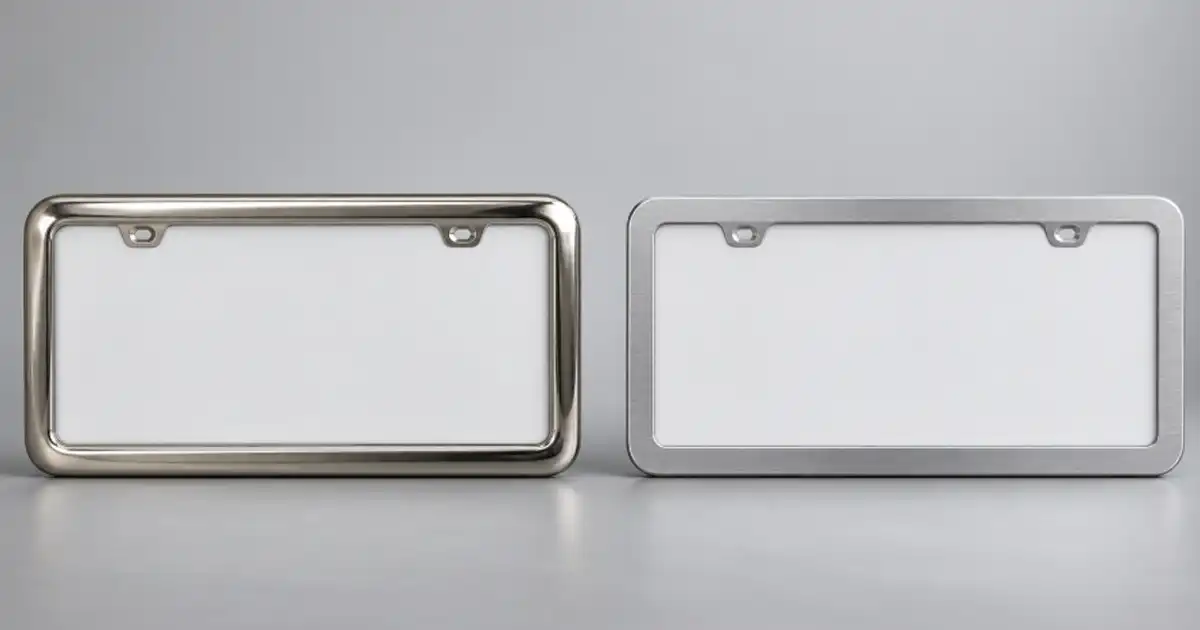
Zinc alloy and aluminum can both produce a premium-looking metal license plate frame. They should not be chosen by appearance alone, and they should not be compared as if each name describes one fixed material, one fixed process, and one fixed cost. The part geometry, production route, surface requirement, target finished mass, hardware, and order program all change the answer.
If you buy for a distributor, dealer, fleet, or private-label program, start with the product you want the customer to hold and install. Do you need a flat, lightweight-looking frame with a simple branded bar? Do you need intricate cast-in relief, sharp local detail, or an integrated decorative form? Do you need a particular finish sample to survive a defined environment? Those questions lead to a better material decision than “Which metal is stronger?”
The decision in one table
| What you need to decide | Zinc-alloy direction | Aluminum direction |
|---|---|---|
| Visible geometry | Worth evaluating when the concept depends on cast-in detail, relief, local contours, or a compact complex shape. | Worth evaluating when the concept favors a flatter profile or a route suited to the approved aluminum construction. |
| Part mass target | Compare the actual finished sample mass; zinc-based cast parts may carry a mass penalty depending on geometry. | Often the first direction to examine when low finished mass is a priority, but wall geometry and hardware still matter. |
| Surface expectation | Specify the exact plating, coating, paint, or other finish system and approval sample. | Specify the exact surface route and finish approval sample; “aluminum” alone is not a finish specification. |
| Tooling and volume | Quote the finished geometry, volume forecast, secondary operations, and quality checks together. | Do the same; the aluminum process should be defined before cost comparisons are treated as meaningful. |
| Fit and hardware | Confirm hole layout, local material around holes, frame opening, and the final hardware stack. | Confirm the same items. Material choice does not replace fitment engineering. |
“Zinc alloy” is not a complete specification
Zinc casting alloys use zinc with smaller amounts of other metals, and published alloy systems differ in composition and intended properties. The International Zinc Association’s alloy-specification material lists several recognized zinc die-casting alloy designations and equivalent standards. A material name on its own therefore does not tell a buyer the exact alloy grade, whether a part is die cast, what post-processing is used, or what finish is present.
That matters because a decorative frame may carry cast-in logo relief, a plated visual surface, threaded or through-hole features, and a specific mounting arrangement. Each element has to be approved as part of the actual design. Ask the supplier to identify the model, material designation where available, process route, finish system, dimensions, and sample acceptance points. Do not convert a generic “zinc alloy” description into an unverified claim about corrosion performance, thickness, or exterior life.
Xingchang’s client product records include U.S. zinc-alloy license plate frame variants, including golf- and label-style product records. Those records confirm that zinc-alloy frame programs are within scope; they do not establish a publishable alloy grade, coating, or performance value for every future design. Your quotation should lock those details to the specific model rather than borrow them from a different frame.
“Aluminum frame” can also mean more than one manufacturing route
An aluminum frame might be made from sheet, an extrusion, a casting, or another approved construction. The route changes the feasible detail, wall behavior, tooling approach, finishing sequence, and cost structure. A comparison that ignores the route can turn into a comparison of two vague labels rather than two manufacturable products.
For a brand program that needs a clean flat border, a simple printed or engraved branding zone, and controlled visible edges, an aluminum direction may be worth developing first. For a program that needs more sculpted form or fine cast-in detail, a zinc-alloy direction may be worth sampling. These are design hypotheses, not universal winners. A frame with a different opening, border width, logo position, or hardware stack can reverse the practical trade-off.
Our aluminum license plate frame range is a useful starting point when you are defining an aluminum product route. If the decision is really between two finished metal products rather than zinc versus aluminum alone, compare it with aluminum versus stainless steel license plate frames before deciding on a brief.
Finished mass: compare samples, not metal names
Material density is relevant, but it is not the whole purchase decision. A zinc design can sometimes use a different wall layout or capture more detail in one part; an aluminum design can use a different construction altogether. That is why a raw density comparison cannot predict the mass of the finished frame in your hand.
Ask for the finished sample mass with the same approximate opening, border, hardware, and finish direction you intend to sell. Then decide whether the result works for packaging, freight, perceived quality, vehicle mounting, and your target price point. Put that sample mass in the approval record rather than promising “lightweight” before there is an approved configuration.
Finish and outdoor use need their own specification
Do not buy either material with a vague request for a “weatherproof” frame. Outdoor appearance depends on the full surface system and the intended environment: base material, surface preparation, coating or plating, edges, local geometry, hardware, cleaning exposure, and where the vehicle operates. A shiny reference sample may not represent a coastal, winter-road, or fleet-use program.
Instead, state the visual target and the validation plan. For example, request approved color/gloss references, specify the parts of the frame that are most visible, identify the target market environment, and agree on the test method, duration, acceptance criteria, and sample revision before relying on a performance claim. For an aluminum program, our comparison of anodized and powder-coated aluminum frames can help you turn “finish” into a more useful discussion.
Total program cost is more useful than a price per kilogram
Raw metal cost is only one line in the program. Tooling, yield, machining or trimming, logo treatment, finishing, hardware, packaging, inspection, freight, and expected volume all affect the commercial result. Two quotes can look far apart because one includes the required surface and assembly work while the other leaves it as an assumption.
Request comparable quotations. Give both options the same plate opening, hole layout, branding artwork, finish target, hardware assumption, packaging level, order forecast, and quality requirements. If one option needs a more complex tool or secondary operation, show it clearly instead of burying it inside the unit price. That comparison gives you a rational commercial choice and a cleaner internal approval.
What to approve before you commit to a material
| Approval item | What it prevents |
|---|---|
| Dimensioned drawing | Confusion about plate opening, border width, mounting holes, local relief, and reference surfaces. |
| Material/process statement | Assuming that a generic metal name guarantees a particular grade or manufacturing route. |
| Finish approval sample | Approving from a screen image or a metal swatch that does not match the finished frame. |
| Installed assembly sample | Discovering hole, hardware, frame-opening, or clearance problems after production work starts. |
| Quality and test plan | Vague durability promises without an agreed method, condition, duration, or acceptance criterion. |
| Comparable quotation basis | Comparing different finishes, hardware, packaging, or production assumptions as if they were the same product. |
When you are ready to develop the design, use the custom license plate frames page to prepare the project inputs, then send the plate and mounting information through our contact page. A physical sample is the right place to settle material direction, finish, and fit—not an unsupported label in a spreadsheet.
FAQ
Is zinc alloy better than aluminum for a license plate frame?
Neither is automatically better. Zinc alloy may suit a geometry that benefits from cast-in detail, while aluminum may suit a product that prioritizes a different construction or lower finished mass. Decide from the approved design, finish, fit, and sample evidence.
Is a zinc-alloy license plate frame heavier?
Zinc-based alloys are denser than aluminum, but the finished frame mass also depends on geometry, wall layout, process, hardware, and finish. Compare actual samples made to the same design intent.
Can I use the same finish specification for both metals?
Do not assume so. Define the surface system for the selected substrate and validate it on a finished production-representative sample. The visual target and exterior-use requirements should be stated separately from the material name.
What information should I provide for a quotation?
Provide the target market, plate dimensions and hole pattern, vehicle-side mounting photo or drawing, desired frame design and logo, finish reference, expected order volume, packaging requirement, and any acceptance/test requirement. That gives the supplier enough information to compare a zinc-alloy and aluminum route fairly.