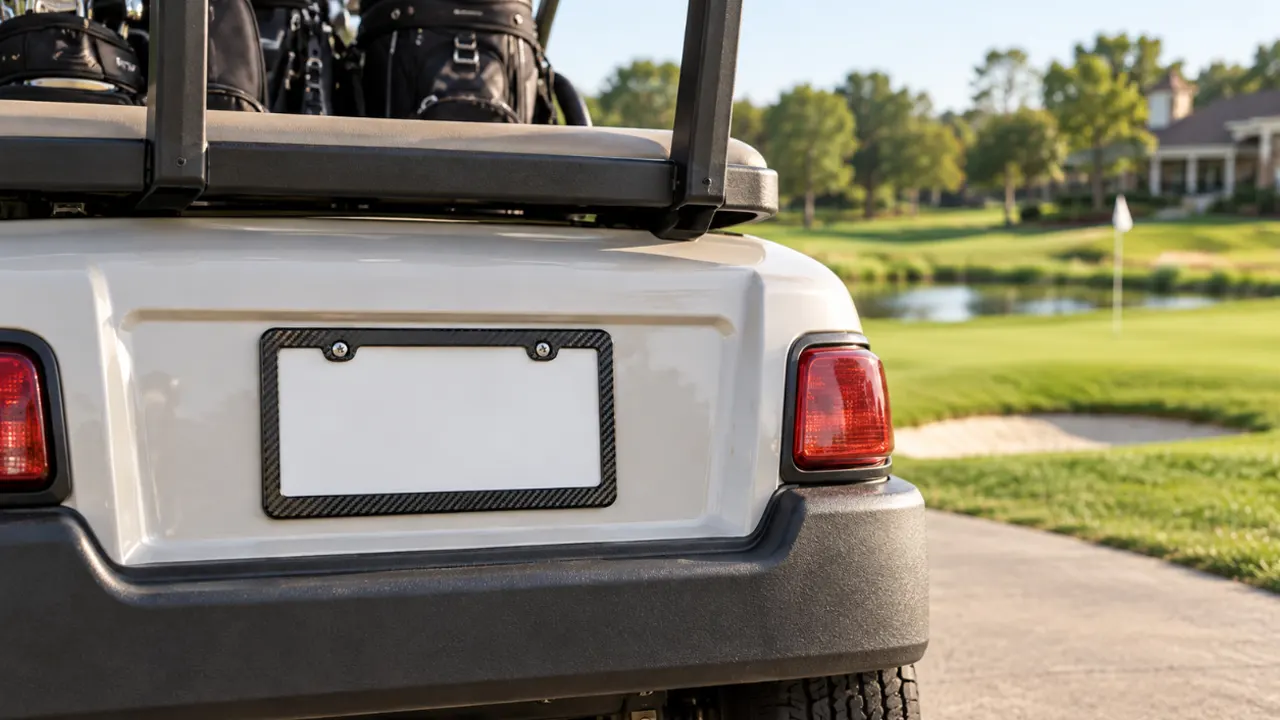
Start with the vehicle’s legal classification, not its appearance. A golf cart, a low-speed vehicle, and a converted cart can have different registration, plate, equipment, and road-use requirements. Once you know what plate was issued, choose a frame that matches its dimensions, leaves all information visible, and fits a supported rear mounting point without interfering with lights, seats, hitches, or cargo.
If the cart has no plate mount, the first purchase is usually a bracket or holder. A decorative frame can border a plate, but it should not be the structural connection to a plastic body panel or rear-seat assembly.
Confirm Whether It Is a Golf Cart or Low-Speed Vehicle
These labels are not interchangeable. In Florida, for example, ordinary golf carts and registered low-speed vehicles are treated differently, and a converted low-speed vehicle has specific title and registration steps. Texas has its own golf-cart plate and authorized-road rules. Local governments may also control where a golf cart can operate.
Check the issuing agency’s current information and the vehicle documents. The answer determines whether you need a plate at all, which plate you receive, where it must be displayed, and whether illumination is required. It also keeps a frame purchase from becoming an accidental attempt to make an unregistered cart look street legal.
Measure the Plate Instead of Guessing Its Format
Golf-cart and specialty plates may be smaller than passenger plates. Measure width, height, hole spacing, and the readable area. Then measure the available space on the cart, including any recess or holder.
Compare the frame’s inner opening with the plate’s state name, serial, stickers, and other required marks. A frame can have the right outside size yet cover a small plate badly. Use the site’s license plate frame size guide for the measurement sequence and verify the final choice against the issued plate.
Choose the Structural Mount Before the Frame
Common golf-cart mounting locations include the rear body panel, a dedicated bumper bracket, the back of a rear-seat kit, or a hitch-area bracket. Each location needs a sound load path. Thin decorative plastic and unsupported seat trim can crack when screws are tightened or when the frame vibrates.
| Mounting area | Main risk | What to verify |
| Plastic rear body | Cracking or pull-through | Approved mounting points and backing support |
| Rear-seat kit | Seat movement or folded footrest interference | Manufacturer bracket provision and full range of motion |
| Hitch area | Accessory or ball-mount collision | Clearance with every hitch component installed |
| Bumper or tubular frame | Need for a clamp or adapter | Tube size, rotation resistance, and protected edges |
A holder supports the plate while a frame borders it. Keeping those roles separate makes the installation easier to diagnose later.
Check Rear Seats, Hitches, and Cargo in Every Position
Rear flip seats are a frequent source of conflict. Test the seat as a seat and as a cargo deck. The plate should not become horizontal, face the ground, or disappear behind a footrest. If the seat kit includes a specified plate bracket, use that mounting logic rather than inventing a spot on the body.
Install the hitch receiver, ball mount, cargo rack, cooler carrier, or safety grab bar you actually use. A plate that is visible on an empty cart can be completely hidden after an accessory is added. Relocating it may also require moving the light, so plan the complete assembly together.
Make Space for the Plate Light
Where illumination is required, check whether the cart already has a dedicated plate lamp or an approved lighted holder. A thick upper border can shadow a lamp mounted close above the plate. A lower light can be vulnerable to curbs or hitch equipment.
Test the installation in darkness. Confirm that the whole plate is readable and that glare from a polished frame is not excessive. Route wiring away from battery terminals, moving seat mechanisms, suspension parts, sharp sheet metal, and hot components. Follow the cart or conversion-kit manufacturer’s electrical instructions.
Choose a Material for the Cart’s Actual Use
Plastic
Plastic is light, available in many colors, and does not add much leverage to a small holder. It is useful when you want a simple border, but inspect it for sun aging and cracks at screw holes. Avoid strong solvents during cleaning.
Aluminum
Aluminum offers a light metal option and can suit a cart with a supported flat mount. It can bend during a parking bump and its finish can scratch when sand gets trapped between frame and plate.
Stainless Steel or Other Finished Metal
A polished or brushed metal frame can match mirrors, wheels, or grab bars, but appearance does not guarantee suitability. Check weight, edge shape, material description, finish, fasteners, and contact with the mounting bracket. On a plastic panel, support and tightening matter more than visual heft.
Keep the Frame Slim and the Plate Readable
Golf-cart plates are often viewed from a lower mounting position and may have limited space around their printed information. A slim border usually gives you more tolerance. Avoid covers or dark shields that add glare or reduce readability; local rules may restrict them.
If you want custom wording, keep it outside the required plate information and do not let decoration compete with the serial. The frame border-width reference shows why an attractive border still has to be judged against the exact plate opening.
Install Carefully on Plastic Bodywork
Do not use screw torque to pull a rigid frame flat against a curved panel. That can distort the plate, crack the frame, or stress the body. Use approved mounting points, a compatible holder, or spacers that create a flat supported stack.
- Turn off the cart and follow manufacturer precautions before working near wiring or batteries.
- Remove the existing plate while supporting the holder.
- Inspect the backing surface, fasteners, light, and wiring.
- Dry-fit the frame and cycle the rear seat and accessories.
- Tighten evenly without crushing plastic parts.
- Test lights and confirm visibility from directly behind the cart.
Selection Checklist
- The vehicle classification and plate requirement are confirmed.
- The frame matches the actual plate and hole spacing.
- The opening leaves every required mark visible.
- A real holder or bracket supports the assembly.
- Rear seat, hitch, cargo, and body-panel clearance are checked.
- Lighting and wiring suit the permitted road use.
- The installation can be inspected and cleaned without dismantling the cart.
Frequently Asked Questions
Do all golf carts need a license plate?
No. Requirements depend on vehicle classification, jurisdiction, and where the cart operates. Confirm with the state or local authority responsible for registration and road authorization.
Can I use a motorcycle frame on a golf-cart plate?
Only when the measured plate, holes, and readable opening match. Similar-looking small plates can use different dimensions and layouts.
Can I attach a frame directly to the plastic body?
Use only an approved or properly supported mounting point. Thin plastic alone may not hold fasteners reliably, and hidden wiring or batteries can make casual drilling unsafe.
Is a lighted frame necessary?
It depends on the applicable equipment rules and existing light. If a compliant holder already illuminates the full plate, a second light may be unnecessary.
What frame style is best for a rear flip seat?
A low-profile frame on the seat kit’s intended plate bracket is usually easier to keep clear. Test the seat in every position before final tightening.