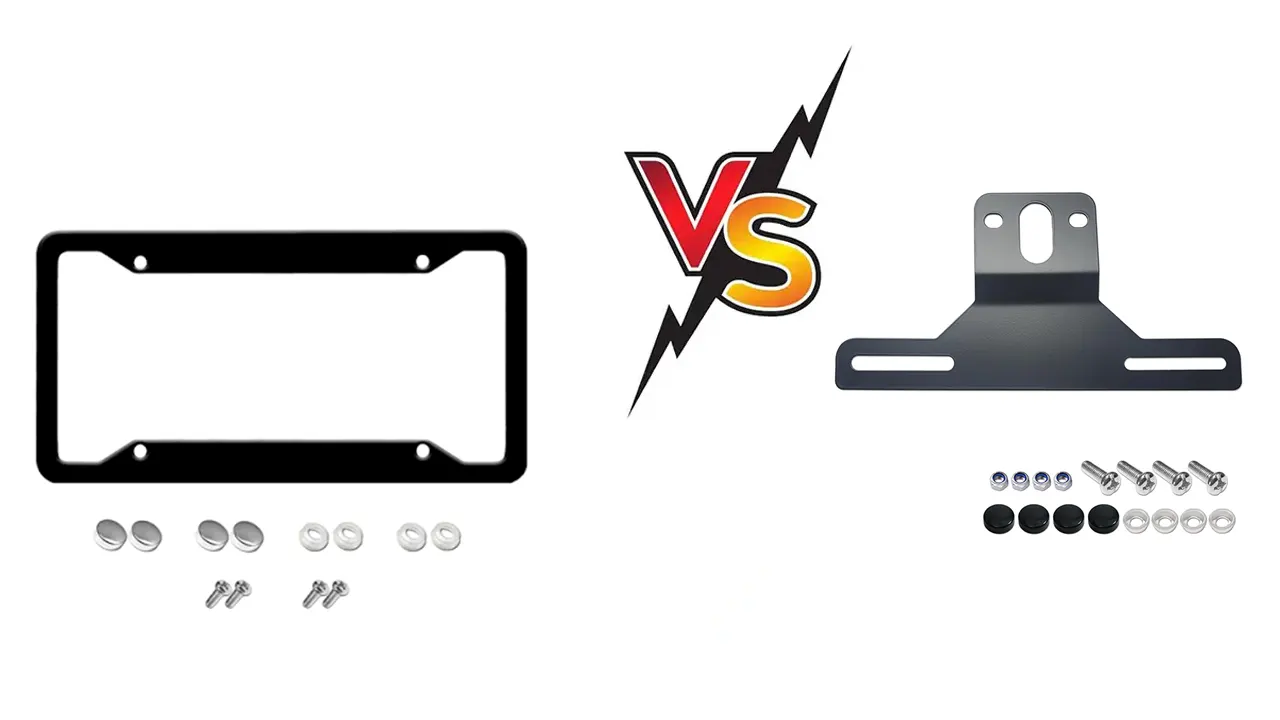
A license plate frame is usually the visible border around the plate. A license plate holder supports, retains, or adapts the plate to the vehicle. Sometimes one product does both jobs, which is why catalogs and RFQs use the terms loosely.
The name matters less than the structure. If you’re buying for an OEM, dealer, or retail program, describe how the part contacts the plate and vehicle. That prevents a decorative frame from being quoted when you actually need a load-bearing bracket—or a bulky holder when all you wanted was a branded border.
The quick difference
| Feature | License plate frame | License plate holder or bracket |
|---|---|---|
| Main job | Surrounds the visible plate edge | Supports, carries, retains, or adapts the plate |
| Typical position | In front of or around the plate | Behind the plate or integrated around it |
| Vehicle interface | Often shares the plate screws | May attach to bumper dimples, grille points, a recess, or a dedicated mount |
| Branding | Common on the visible border | Possible, but often secondary to mounting function |
| Fit risk | Opening, border, hole, and visibility mismatch | Vehicle geometry, anchor, stiffness, and adapter mismatch |
A frame starts with the visible opening
Most decorative frames share the plate’s mounting fasteners and add a finished edge, color, logo, slogan, or surface treatment. Their key dimensions are the outer envelope, visible opening, border width, hole pattern, thickness, and rear contact features.
A frame can also help control a loose plate edge when it includes suitable retention tabs or pads. Still, don’t assume the border is the vehicle’s structural mount. If the bumper has no compatible threaded points or bracket, the frame alone may not solve the installation.
A holder starts with the vehicle interface
A holder—often called a mounting bracket, carrier, backing plate, or plinth—creates the connection between the plate and vehicle. It may adapt a curved bumper, grille, tow point, spare-wheel mount, or market-specific recess to the plate.
OEM service instructions illustrate the distinction well: the bracket is first aligned and fastened to the vehicle, then the plate is fastened to that bracket. The decorative frame, if used, becomes another layer in the stack.
Some products combine both functions
A clip-in European plate holder can carry the plate and surround its edges. A sleeve-style silicone frame wraps around the plate and may reduce edge contact while sharing the mounting screws. A deep plastic assembly may include a back plate, locking strip, and visible branded rail.
When the functions are integrated, use a section drawing or exploded view. Product names won’t tell you whether the plate slides in, clips down, loads from the rear, or is clamped by the vehicle screws.
Choose by the problem you need to solve
| Your problem | Start with | Check next |
|---|---|---|
| Add dealer or brand identity | Decorative frame | Safe artwork zone and plate visibility |
| Vehicle has no flat plate mount | Vehicle-specific holder or bracket | Attachment points, curvature, camera, sensors, and airflow |
| Adapt one market’s recess to another plate | Adapter holder | Both hole patterns and the complete outside envelope |
| Reduce movement or edge contact | Frame or holder with designed retention | Pads, tabs, flatness, screw engagement, and drainage |
| Quick dealer plate insertion | Clip-in holder system | Retention force, access, fatigue, and service procedure |
What changes in the RFQ?
For a frame, send the plate specification, visible-area requirements, outer clearance, material, finish, branding method, and hardware. For a holder, add vehicle CAD or mounting-area dimensions, anchor type, allowable loads, curvature, installation sequence, and nearby equipment.
If the product combines both, ask for three interfaces to be shown clearly: holder to vehicle, plate to holder, and visible frame to plate. Also define which fasteners are supplied and which remain vehicle-specific.
Watch the terminology in listings and drawings
“Universal holder” may mean only that several slots are provided. It does not prove the part fits every bumper or plate. “Frame holder” may be a decorative border, a backing carrier, or a two-piece assembly. Translate the name into geometry before comparing price.
- Request front, rear, side, and section views.
- Mark the plate-loading direction and retention method.
- Identify vehicle-side anchors separately from plate-side holes.
- Confirm whether drilling or an adapter is expected.
- Check the complete hardware stack and installed projection.
You can review available frame categories in the license plate frame product range. If your application needs an integrated carrier or new mounting structure, start with the custom frame development inputs.
Frequently asked questions
Is a license plate holder the same as a bracket?
Often, yes. Both terms commonly describe the component that attaches to the vehicle and carries the plate. Check the drawing because sellers use the names inconsistently.
Can a frame be installed without a holder?
Yes, when the vehicle already provides compatible plate mounting points and the frame shares those fasteners. If the vehicle lacks a suitable interface, you may need a bracket.
Does a holder sit in front of the plate?
Usually it sits behind or around the plate, but clip-in systems can surround the plate as well. The loading and retention method are more reliable identifiers than the product name.
Which part is better for custom branding?
A visible frame usually offers the clearer branding surface. A holder can carry branding too, especially on a lower rail, but mounting and retention must come first.
Describe the interfaces and the right name will follow
If you send only “license plate holder,” a supplier still has to guess. Share the target plate, vehicle mounting area, photos or CAD, installation sequence, hardware, material, finish, branding, and expected quantity. Once those interfaces are clear, it becomes obvious whether you need a frame, a holder, a bracket, or a combined assembly.