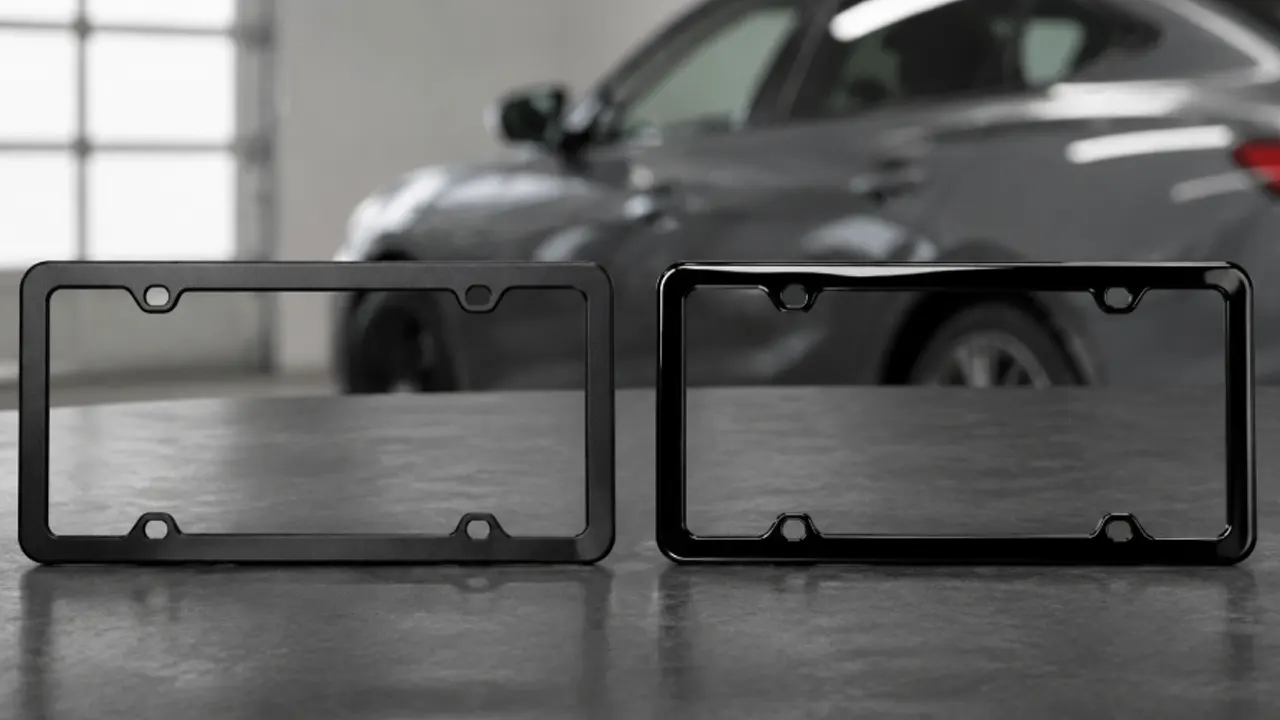
Choose matte when your product brief calls for restrained reflections, an understated appearance, and a surface that is less likely to spotlight every light handling mark. Choose gloss when color depth, a polished visual effect, and strong shelf photography matter more. Neither choice is automatically tougher or easier to maintain.
The word “finish” also needs more detail. Matte molded plastic, matte powder coating, satin brushed metal, and a matte clear coat can look similar in a catalog but behave differently in production. Gloss molded plastic, polished metal, a glossy coating, and a clear layer over print are equally different systems. Your specification should identify the substrate and the complete finishing route before it sets a sheen target.
Matte and gloss change what the customer sees
| Decision factor | Matte finish | Gloss finish |
|---|---|---|
| Light response | Diffuses reflections and reduces sharp highlights | Produces clear highlights and stronger reflections |
| Color impression | Often appears softer or slightly lighter under the same lighting | Often makes dark colors and saturated artwork look deeper |
| Visible defects | Can reveal rub marks, polished patches, uneven texture, or trapped soil | Can reveal dust, fine scratches, waviness, orange peel, and fingerprints |
| Brand character | Technical, understated, contemporary, or OEM-like | Bright, decorative, premium, or display-oriented |
| Photography | Easier to light without hard reflections | Can look rich but needs controlled reflections |
| Inspection | Control texture and unwanted shiny spots | Control gloss, image clarity, haze, and surface distortion |
A black matte frame and a black gloss frame should not be approved from a color code alone. The way each surface reflects light changes its apparent darkness. Put both samples beside the intended vehicle trim or packaging artwork under diffuse daylight and directional light. If a buyer only approves a phone photo, the production surface can be technically “black” yet still look wrong in person.
Specify the finish system before the gloss level
Start with the base material and the process used to create the surface. A molded plastic texture is created by the tool surface and resin flow. A painted or powder-coated frame adds a film over the substrate. A polished metal frame depends on mechanical finishing. Printed frames may add ink, primer, and a protective layer. Each route creates different risks at corners, holes, edges, logo panels, and contact points.
Ask your supplier to describe the complete stack in plain terms: substrate, surface preparation, color layer, decoration, clear layer if used, and curing method. Do not accept “matte black” or “high gloss” as the whole specification. If a finish is only an appearance direction and the underlying process can change, require a new sample before the process changes.
For stainless steel, matte versus gloss is not the same decision as brushed versus polished stainless steel. Brushing introduces a directional grain; a low-gloss coating may not. Keep surface texture, reflectivity, and coating construction as separate requirements.
Gloss numbers need an angle, instrument, and reference
Visual names are useful for styling, but they are weak acceptance criteria. ASTM D523 measures specular gloss on nonmetallic surfaces using defined geometries. The current standard includes 20°, 60°, and 85° measurement angles for different gloss ranges. A reading without the angle, instrument setup, specimen condition, and agreed reference does not create a repeatable control.
Curved or narrow frame rails can also be difficult to measure directly. Decide where the reading will be taken. A flat witness panel processed with the production batch may provide a more stable measurement surface, while the finished frame still needs a visual check at corners and formed areas. Record the instrument model, calibration standard, measurement angle, target, tolerance, and sampling locations.
ASTM D3134 addresses how buyers and sellers can establish color and gloss tolerances around an agreed standard. It does not choose the correct tolerance for your product. That limit should reflect the material, process capability, viewing conditions, and how much lot-to-lot variation your market will accept.
Scratch visibility is not scratch resistance
A matte surface may hide a fine mark because the surrounding texture already scatters light. Repeated rubbing can also burnish that texture and create a shiny patch. A gloss surface may make a very shallow scratch obvious because the scratch interrupts a smooth reflection. That does not prove the glossy coating is mechanically weaker.
Define the contact you expect instead of choosing from appearance alone. A dealer frame stacked in bulk, a retail frame packed individually, and a decorated frame handled during assembly face different abrasion patterns. Test the production finish with the intended separators, bags, hardware, cleaning cloth, and pack-out method. Inspect after transport simulation or a realistic handling trial, not only at the coating line.
Cleaning can change the sheen
Gloss surfaces often release loose dirt easily, but fingerprints and wiping swirls can remain visible. Matte surfaces may disguise fingerprints under some lighting yet trap residue in a coarse texture. Strong cleaners, stiff brushes, polishing compounds, and abrasive cloths can change either finish.
Approve a cleaning method on the finished sample. For matte products, check for bright spots after repeated wiping. For gloss products, inspect for haze and circular marks under angled light. If care instructions are included in the retail pack, they should name the cloth and cleaner type that passed the actual trial rather than promising that the surface is maintenance-free.
Match the finish to the branding method
A logo can look crisp on a flat gloss rail but lose edge definition on a coarse matte texture. A laser mark may have excellent contrast on one coated metal and almost disappear on another finish. Screen printing, UV printing, heat transfer, laser marking, and applied badges all interact differently with the substrate and surface energy.
Approve the artwork at actual size. Check fine lines, small counters inside letters, color shift, gloss difference around the print, and whether the logo crosses a corner or texture transition. If you are still selecting a printing route, the UV printing versus screen printing comparison explains why artwork complexity and ink-system validation belong in the same decision.
Use a controlled sample plan
| Approval item | What to define | Why it matters |
|---|---|---|
| Finish construction | Substrate, preparation, color layer, decoration, and clear layer | Prevents an appearance name from hiding a process change |
| Physical master | Signed sample or controlled plaque under agreed lighting | Shows color, texture, and reflectivity together |
| Gloss control | Instrument, angle, target, tolerance, and locations | Makes readings comparable across lots |
| Cosmetic limits | Allowed and rejected scratches, dust, orange peel, burnishing, and texture variation | Aligns inspection with the sales channel |
| Branding | Artwork version, size, position, color reference, and adhesion criteria | Protects logo legibility and repeat-order consistency |
| Packaging | Film, bag, separator, stack direction, carton load, and removal residue | Protects the approved surface through delivery |
Compare samples on the exact frame geometry. Broad flat rails, thin edges, molded ribs, and curved corners reflect light differently. If your program includes more than one material, do not assume that a single matte or gloss master will reproduce identically on plastic, aluminum, and stainless steel.
What to include in your RFQ
Send the target market and plate format, frame drawing or reference sample, base material, preferred finish process, color reference, gloss target if available, branding artwork, viewing requirements, cosmetic limits, packaging format, quantity, and destination. If the finish has to match vehicle trim or another accessory, provide a controlled physical reference rather than only a screen image.
You can review current custom license plate frame options before you prepare the request. For exposure-related questions, use the license plate frame fading guide to separate color retention from gloss and scratch appearance.
Frequently Asked Questions
Is a matte license plate frame more durable than a gloss frame?
Not from the sheen alone. Durability depends on the substrate, finish chemistry, preparation, cure, geometry, exposure, cleaning, and packaging. Matte and gloss mainly describe how the surface reflects light.
Does a gloss finish always look darker?
Gloss often makes dark colors look deeper because reflections and color saturation are stronger, but pigment, film thickness, texture, and lighting also change the result. Approve both color and gloss on a physical sample.
Can a matte finish become shiny?
Yes. Repeated rubbing, polishing, or abrasion can flatten or burnish the texture and create localized gloss. Include rub-prone areas in the handling and cleaning trial.
Can matte and gloss areas be combined on one frame?
They can, but the boundary, masking, tooling texture, coating sequence, and decoration process must be designed together. Approve the transition at corners and around raised branding.
Should every finished frame be measured with a gloss meter?
Not necessarily. Measurement frequency depends on the process, risk, surface geometry, and agreed sampling plan. Many programs combine a controlled witness panel, periodic instrument checks, and visual inspection of the finished part.
Is satin the same as matte?
No universal naming rule makes them identical. Satin usually implies more sheen than matte, but supplier terminology varies. Use a physical master and a defined measurement method instead of relying on the label.