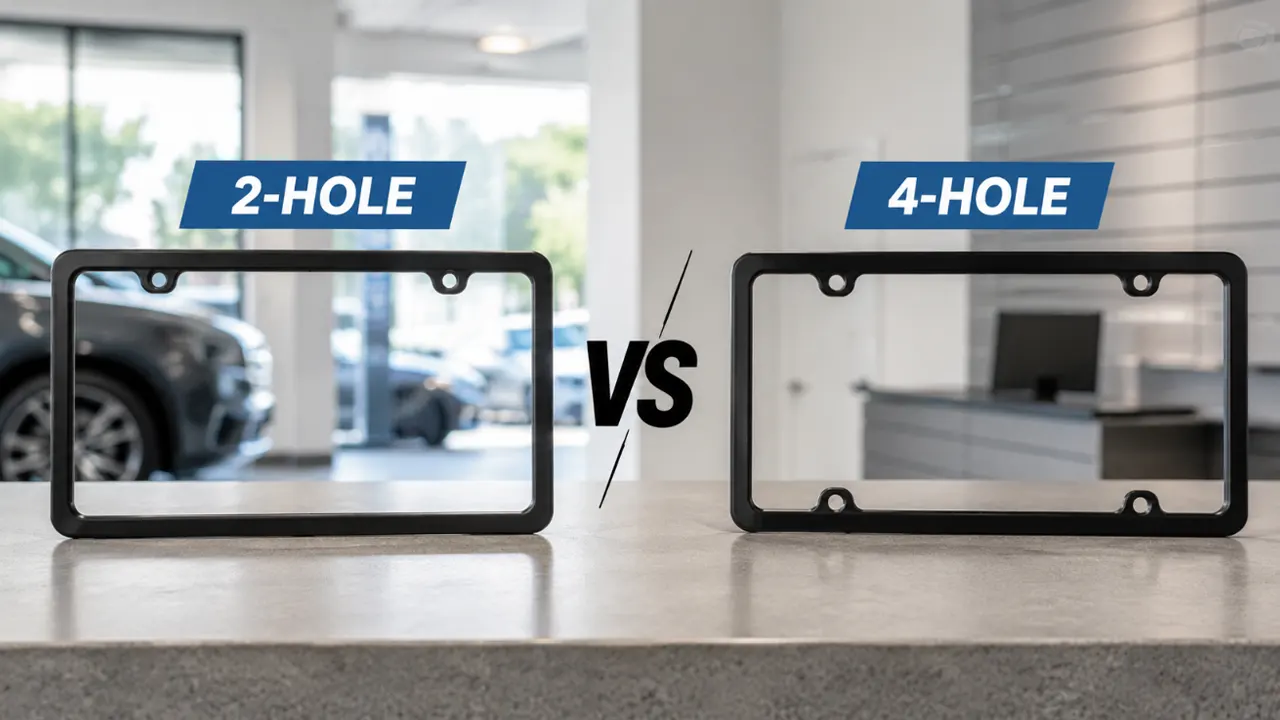
Choose a 2-hole license plate frame when your vehicle has two upper mounting points. Choose a 4-hole frame when the vehicle provides four compatible anchors and every frame, plate, and vehicle hole aligns. Four holes are not automatically better: unused lower holes add no restraint, and forcing extra fasteners into a bumper can damage the vehicle.
Stability depends on the points that are actually anchored, the frame and plate stiffness, screw engagement, mounting surface, pads or retention tabs, and correct tightening. Hole count alone does not prove fit, anti-rattle performance, theft resistan
What 2-hole and 4-hole actually mean
A 2-hole frame normally has two primary openings along the upper edge. A 4-hole frame adds two lower openings. That description applies to the frame, not necessarily to the vehicle. You have to compare four separate layers:
- Frame holes: the openings built into the decorative border.
- License plate holes: the holes in the issued plate.
- Vehicle mounting points: threaded inserts, clips, nuts, bracket holes, or approved self-tapping locations.
- Hardware: screw diameter, pitch, length, head, washers, caps, and nuts that connect the layers.
A frame and plate may both show four holes while the vehicle offers only two threaded inserts. In that case, lower screws may be used only to connect the frame and plate to each other if the product is designed for rear nuts or clips. They do not become vehicle anchors.
Quick decision table
| Vehicle condition | Preferred starting frame | Reason | What to verify |
| Two upper vehicle anchors only | 2-hole | Uses the available attachment points without creating unsupported expectations | Hole spacing, lower-edge support, screw fit, plate visibility, camera and sensor clearance |
| Four aligned vehicle anchors | 4-hole | All four points can add restraint when properly fastened | All hole positions, screw specification, surface flatness, tightening sequence, and border opening</t |
| Two upper anchors plus bracket tabs or lower clips | Use the system specified for the bracket | Tabs or clips may control the lower edge without two additional vehicle screws | Correct insertion, plate thickness, frame clearance, and rattle control |
| Four-hole frame with a two-anchor vehicle | Acceptable only after fit is verified | Upper points may secure the assembly, but lower holes do not add vehicle anchorage | Whether open lower holes are acceptable and whether designed nuts, tabs, or pads stabilize the lower edge |
| No factory plate mount | Vehicle-specific bracket or approved procedure first | The issue is vehicle attachment, not frame hole count | Owner’s manual, approved bracket, wiring, sensors, radar, air paths, |
Standard plate dimensions do not guarantee four vehicle anchors
The AAMVA License Plate Standard lists the standard full-size North American plate as 12 × 6 inches and specifies nominal bolt-hole positions at 2.5 inches from the sides and 0.5 inch from the upper and lower borders. Those plate dimensions support interchangeability, but they do not require every bumper, hatch, grille, or bracket to provide four threaded anchors.
Vehicle interfaces vary. Some use two top inserts; some use four points; some rely on a separate bracket, lower tabs, removable clips, or a shaped recess. Motorcycle, trailer, specialty, and non-US plates may use different formats. Check the actual installation instead of assigning a hole pattern by vehicle class, state, or country from an unverified chart.
The license plate frame size guide helps you identify the plate format, but you still need a vehicle-side measurement.
Is a 4-hole license plate frame more secure?
It can provide more restraint only when four fasteners connect to four suitable vehicle anchors. Two extra screws may reduce movement of the lower edge, distribute load, and help keep a thin plate flat. That benefit disappears when the lower screws at
A well-designed 2-hole installation can be stable. The upper screws must engage correctly, the frame needs adequate stiffness, and the lower edge may use thin backing pads, molded tabs, or bracket retention features. The frame should not rub directly against a painted panel, trap thick debris, or bow because the recess is incompatible.
| Factor | Why it matters more than the printed hole count |
| Actual vehicle anchors | Only compatible attachment points transfer load to the vehicle |
| Screw diameter, pitch, and length | Wrong hardware can strip, bottom out, contact hidden components, or remain loose |
| Thread engagement | A screw must engage enough sound thread without contacting something behind the mounting point |
| Frame section and plate flatness | Stiffness and geometry control flex between attachment points |
| Backing pads or retention tabs | They can control vibration and contact when correctly placed |
| Tightening sequence | Even tightening reduces distortion and uneven gaps |
| Vehicle recess shape | A flat frame may bridge or rock on a curved or stepped surface |
Four holes do not automatically make a frame theft-proof
Theft resistance depends on fastener access, head type, security feature, tool availability, rear access, and the strength of the vehicle-side anchor. Two security fasteners can be harder to remove than four ordinary slotted screws. Decorative caps may hide a head but should not be marketed as theft-proof unless the complete system has defined evidence.
Security hardware can also complicate legitimate plate replacement. If you specify tamper-resistant screws, include the correct driver, document replacement availability, and confirm that installers can reach every fastener without damaging the vehicle. Do not rely on hole count as a security claim.
Will a 2-hole frame rattle?
It should not rattle when the assembly is compatible and secure. Rattle usually comes from an unsupported lower edge, loose or incorrect screws, a warped plate, a thin flexible frame, a stepped mounting surface, or direct contact with the body panel. Adding lower holes will not solve those causes unless aligned vehicle anchors exist.
Thin nonabrasive pads can separate the lower plate or frame edge from the mounting surface. Retention tabs can also help if they are designed for the plate thickness. Pads should not block drainage, cover sensors, change the screw stack so much that engagement becomes inadequate, or use an adhesive that damages the vehicle finish.
Hole pattern and branding area
Hole count affects more than installation. Top and bottom openings consume space that may otherwise carry a logo, slogan, dealer name, phone number, website, or molded detail. A 2-hole frame may offer an uninterrupted lower branding panel. A 4-hole frame may require artwork to clear both lower fasteners and cap diameters.
Do not reduce the plate opening to recover lost artwork space. The frame must leave the required plate number, jurisdiction name, validation decals, and other identifiers visible. Treat opening geometry and branding geometry as separate requirements.
How to measure before buying
- Remove or carefully lift the existing frame enough to see the actual vehicle bracket and anchors.
- Count the usable vehicle mounting points, not just the holes in the plate.
- Measure horizontal and vertical center-to-center spacing.
- Record whether each point is a threaded insert, clip nut, through-bolt location, bracket opening, or approved self-tapping point.
- Check the recess width, height, corner radius, curvature, steps, and clearance behind the plate.
- Note cameras, lamps, parking sensors, radar modules, trunk releases, tow equipment, and ventilation openings.
- Compare the frame’s outside dimensions, opening, hole drawing, cap diameter, and hardware with the vehicle data.
- Place the frame over the issued plate and confirm that every required detail remains visible.
If the supplier cannot provide a dimensioned hole drawing, the labels 2-hole and 4-hole are not enough to approve compatibility. Browse US license plate frames as a format starting point, then verify the target vehicles.
Planning 2-hole and 4-hole SKUs for wholesale or OEM programs
A reliable assortment should define compatibility by measurements and installation system, not unsupported regional shorthand. Record the plate format, frame opening, frame hole pattern, vehicle anchor assumptions, hardware variants, cap stack, lower-edge support, and packaging label for every SKU.
| Control item | Minimum information |
| Drawing | Outside dimensions, opening, border width, all hole centers and diameters, thickness, section, corners, and tolerances |
| Compatibility statement | Exact mounting pattern and assumptions; avoid universal fit unless verified against a defined range |
| Hardware set | Screw type, pitch, diameter, length, head, washers, caps, nuts, clips, pads, and intended stack |
| Installation instructions | Layer order, hand-start requirement, tightening sequence, visibility check, and no-drill warning unless vehicle-approved |
| Packaging | Clear 2-hole or 4-hole identification, fit drawing or QR link, hardware variant, and protection against cosmetic damage |
| Validation | Fit, vibration, cap retention, finish rub, corrosion interfaces, visibility, and vehicle-representative samples |
For a controlled mounting pattern, artwork area, hardware set, and pack-out, submit the data through the custom license plate frame service.
Frequently asked questions
Can I use a 4-hole frame on a vehicle with two mounting holes?
Often yes, if the two upper holes align and the lower edge remains stable without unsafe drilling. The lower frame holes will not become vehicle anchors. Verify appearance, rattle control, plate visibility, and whether the product uses intended lower
Can I use a 2-hole frame on a four-hole plate mount?
Possibly. The two upper vehicle anchors may secure the assembly, but you give up the potential restraint from two lower anchors. Check the frame stiffness, lower-edge movement, recess geometry, and vehicle or bracket requirements before deciding.
Are 4-hole frames better for trucks?
Not as a general rule. Vehicle class does not prove a mounting pattern. Inspect the specific truck’s bracket and anchors. Choose four holes when four compatible points are actually available and useful.
Do more holes prevent license plate theft?
No. More ordinary screws may add removal time, but theft resistance depends on the complete fastener and anchor system. Hole count alone is not a security rating.
What if the frame holes do not align?
Do not force angled screws, enlarge the issued plate, or drill the bumper without an approved vehicle procedure. Confirm the frame drawing, plate format, and bracket. Select a compatible frame or vehicle-specific mounting solution.
Does hole count affect legality?
Legality usually turns on secure attachment and unobstructed, legible plate information rather than hole count itself. A 2-hole or 4-hole frame can be unsuitable if its border, caps, artwork, or position hides required details. Verify current local rules.