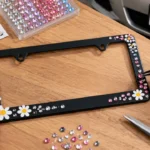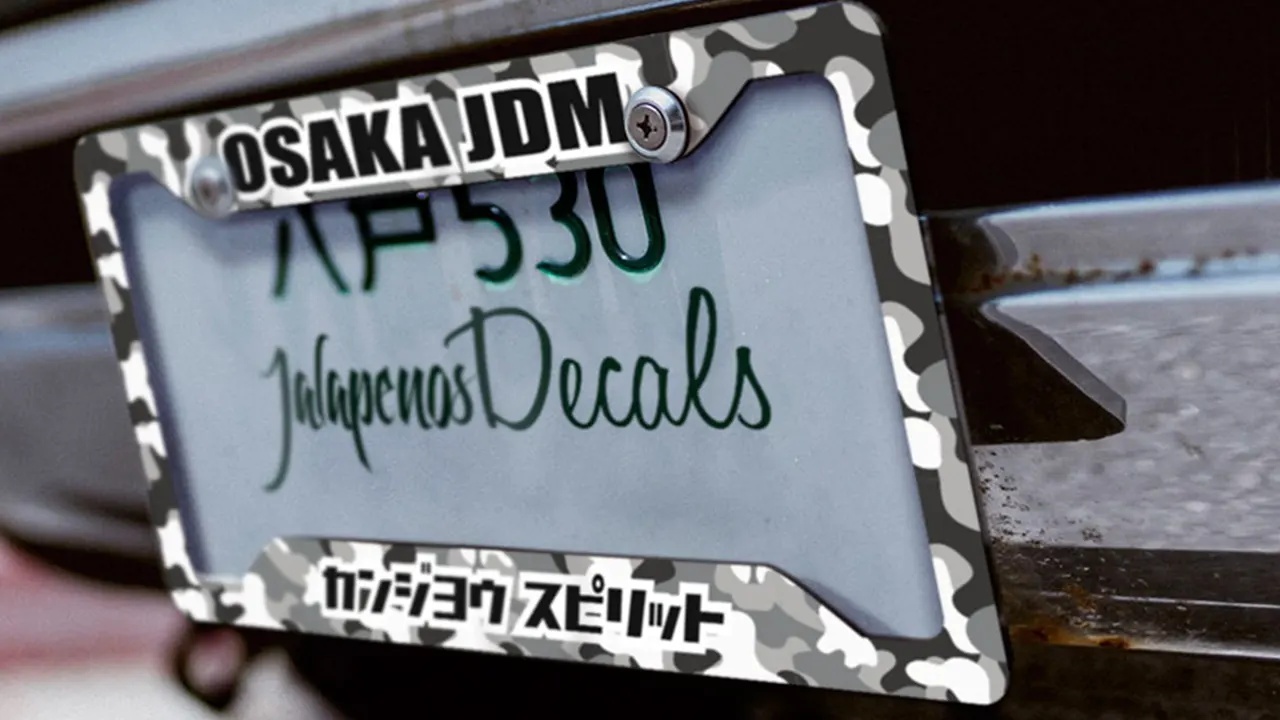
The best JDM license plate frame is the one that fits your actual plate and mounting setup without covering required information, then suits the look of your build. One detail trips people up: a frame marketed as “JDM style” may be made for a standard North American plate, while a frame made for a Japanese-market plate is a different size. Decide which one you need before you compare colors, lettering, or materials.
There is no single best frame for every car. A subtle black surround can suit a daily driver; a graphic or raised-letter design may make sense on a show build; a Japanese-size frame is necessary if you are mounting a genuine Japanese plate. The right choice starts with dimensions and fit, not a product photo.
First decide what “JDM” means for your setup
JDM is short for Japanese Domestic Market. Strictly speaking, it describes products intended for sale in Japan. In car culture and online shopping, “JDM” is also used more loosely for Japanese-inspired styling: tuner graphics, Japanese typography, motorsport references, minimalist details, or designs associated with Japanese cars. Those two meanings are related, but they are not interchangeable.
If you have a US-size plate and want a Japanese-inspired look, shop for a frame that matches the US plate format and mounting position. The frame may be JDM-inspired in appearance, but it is not automatically a Japanese-market-size part. If you have a Japanese vehicle registered in Japan, or you are displaying a Japanese-size plate for a legitimate use, verify the plate dimensions and frame opening directly. A style label alone tells you little about fit.
| What you have | What to shop for | What to verify |
| US or Canadian plate with Japanese-inspired styling | A frame made for your local plate format | Plate outline, mounting holes, frame opening, local visibility rules |
| Japanese-market plate | A frame made for the actual Japanese plate format and vehicle application | Plate dimensions, hole position, rear clearance, visible markings |
| Show plate or decorative display | A frame sized to the display plate | Whether it is for display only or permitted for road use |
For common Japanese passenger-vehicle applications, the live XCLPF Japan frame listing gives a 330 × 165 mm plate format. Treat that as a starting point, not proof that any frame with a “Japan” label fits your vehicle. Compare your plate, mounting locations, and frame opening. The site’s Japan-size frame range is intended for Japanese-format frames, while its JDM decorative designs are styling choices rather than a substitute for checking fit.
What makes a JDM frame a good choice?
A good frame should do three things well: hold the plate in the intended position, leave important plate information visible, and look appropriate on your car. Those requirements sound simple, but they rule out many impulse buys. A frame can look perfect in a close-up product shot and still be too wide, have the wrong hole layout, or clash with the bumper recess.
Think of “best” as a match between your plate, vehicle, and taste rather than a universal ranking. Most review roundups do not publish repeatable fit measurements or test methods for every item. Unless you have hands-on test data for a specific model, it is more honest to compare designs by criteria than to claim one frame is the best-performing product on the market.
Check plate size and opening before the design
Measure the plate itself edge to edge: width, height, and thickness if the frame has a channel or retaining lip. Then compare those measurements with the frame’s usable opening, not only its outside dimensions. A frame that is too tight can pinch an edge or sit crooked. One that is too loose may let the plate shift, buzz, or look off-center. A product listing that says “universal” still needs a stated plate format and usable dimensions.
Next, check whether the frame covers any part of the plate face. The opening must leave the plate number, jurisdiction name, validation stickers, and other required markings visible where applicable. The exact visibility rules depend on where the vehicle is registered. Don’t rely on a product photo, because display plates and sample photography may not reflect your local plate design.
If you are ordering internationally, don’t convert a market label into an assumption. A US-size frame, European surround, and Japanese-format frame have different proportions. Our license plate frame size guide helps you compare common formats, but the plate in your hand and the frame drawing are the deciding references for a specific installation.
Match the mounting holes and vehicle recess
Measure the center-to-center spacing of the holes in your plate and compare it with the frame’s holes or slots. Then inspect the vehicle-side mounting points. The car may use a shallow recess, a separate bracket, a curved bumper, or a plate holder that is already part of the trim. Two frames can fit the plate but not line up with the car.
Check the screw head clearance, the height of the recess, and whether the plate sits flat. If the bumper curves, a rigid flat frame can leave a gap or put stress on one corner. That does not mean you should bend the frame to force a fit. Use the vehicle’s intended mount or an appropriate bracket, and check whether it keeps the plate in the orientation required where you drive.
Some vehicles have a front camera, parking sensors, radar hardware, active grille shutters, or a tow-hook receiver near the plate area. A frame does not relocate those components, and a plate positioned across their field of view may interfere with them. Review the owner’s manual or ask a qualified installer if you are unsure. Avoid guessing from a generic fitment chart when the front fascia differs by year or trim.
Choose a frame profile that suits the plate
Slimline frames
A slim frame leaves more of the plate visible and tends to disappear into the bumper from a distance. It works well when you want the car, paint, or plate graphic to remain the focus. The tradeoff is limited space for artwork or lettering, and a narrow border may offer less visual contrast around a busy plate. Check that “slim” describes the inner border as well as the outer shape; sellers sometimes use the word inconsistently.
Full-surround frames
A full-surround design creates a continuous border. It can make the plate area look finished and visually balanced, particularly when the bumper has a defined recess. Pay attention to the lower lip and the top edge: even a modest border can overlap small text or registration marks if the opening is poorly laid out. Ask for a straight-on view with a plate inserted, not just a photo of the empty frame.
Wide-bottom and graphic frames
A wider lower bar gives room for a short phrase, logo, or graphic. This can be the most expressive option, but it is also the easiest to overdo. A long message, tiny type, and multiple graphic elements can turn a clean build into visual clutter. Make sure the frame does not cover required plate information and use original or properly licensed artwork. A familiar automotive logo or anime graphic is not free to reproduce just because it appears on many marketplace listings.
Pick a style that complements the car rather than competing with it
For an understated build, a black, silver, or body-color frame with little or no text usually sits quietly around the plate. A brushed or matte-looking finish can feel restrained; a glossy or bright finish catches more light and draws attention. The exact appearance varies by material and finish, so online color names are only approximate. If color matching matters, compare a real sample under daylight and shade.
For a motorsport-inspired setup, a simple stripe, compact lettering, or restrained racing reference may work better than a large slogan. For an anime, manga, or pop-culture theme, one clear image or short line is easier to read than a collage of small graphics. If the frame sits beside decals, wheel details, or a large rear wing, leave some visual breathing room. The plate area is small; every extra element competes for attention.
Look at the car from several feet away. Product photos are often shot close and brightly lit, which makes small details look larger. Ask yourself whether the border is still legible at normal viewing distance, whether it matches the rest of the car, and whether it makes the plate harder to read. A frame should finish the plate area, not become the only thing you notice.
Material affects feel and construction, not just appearance
Plastic, aluminum, stainless steel, and other metal constructions can all be used for frames, but the material name alone does not tell you the frame’s quality or service life. Thickness, edge treatment, shape, finish, mounting design, and exposure all matter. A thin metal edge can feel less substantial than a well-shaped plastic frame; a metal frame with a poor finish can mark or corrode. Compare the exact model rather than assuming one material is automatically best.
| Material family | Why people choose it | What to inspect |
| Plastic | Lightweight, shape and color flexibility, often suitable for graphic designs | Edge finish, molding consistency, flexibility, surface and print condition |
| Aluminum | Metal appearance with a lighter feel than many steel frames | Edge smoothness, flatness, finish, and the way the corners are formed |
| Stainless steel | Rigid metal appearance and a more substantial feel | Edge treatment, finish quality, fasteners, and signs of damage or staining |
When the frame touches painted trim or a painted bumper, look for burrs, sharp corners, and exposed fastener edges. Keep the contact surface clean during installation so trapped grit does not rub against the finish. A soft washer or backing layer may be appropriate for some vehicle setups, but it should not interfere with secure mounting or conceal plate information. Follow the frame and vehicle instructions rather than improvising thick padding.
Compare decoration methods with the artwork you want
A plain frame can be enough if the JDM look comes from the rest of the build. If you want lettering or graphics, the way they are applied affects detail, texture, and how the design reads. Printed designs can carry multiple colors and fine artwork, depending on the process and the frame surface. Raised lettering adds depth and shadow but needs enough space and a design that remains legible at a glance. A laser-marked or engraved appearance is usually more restrained and depends on the base material and finish.
Ask for a proof that shows the design at the actual frame size. Check character height, line thickness, color contrast, safe distance from the edge, and whether the design crosses a bend or corner. Tiny Japanese text may look authentic in a large mockup but become unreadable once scaled down. If a symbol or phrase is in a language you do not read, verify its meaning and orientation before approving it.
Do not treat “carbon fiber” as a material claim unless it is documented as a genuine carbon-fiber composite. Many frames use a carbon-fiber-look pattern on plastic or metal. That can give you the visual effect without being real carbon fiber; product wording should describe the appearance accurately. Our custom license plate frame options show the kinds of styles and decoration offered for frame programs, but the exact material and process remain model-specific.
Check local rules before choosing a bold border
A frame should not obscure plate numbers, state or country identifiers, stickers, validation marks, or required reflectivity. What counts as an obstruction depends on the jurisdiction and the plate. Some places regulate the frame’s coverage directly; others focus on whether information remains legible. A rule that applies in one state or country is not a worldwide standard.
Before you buy, check the current government guidance for the vehicle’s registration location. If a decorative phrase or frame edge overlaps any characters or stickers, choose a narrower design. Avoid tinted overlays, reflective effects that mask characters, or covers intended to alter how the plate appears to a camera. A “show” look is not worth a stop or citation, and a seller’s claim that a frame is universally street-legal is not a substitute for local rules.
Install it without stressing the plate or bumper
- Park on a level surface and check the plate area, frame, and hardware. If the current frame is damaged or the plate is bent, deal with that before installing the new one.
- Hold the plate and frame in position without tightening anything. Confirm the plate orientation, visibility, hole alignment, and clearance from cameras, sensors, trim, and nearby bodywork.
- Use the vehicle’s intended mounting points and suitable hardware. Start each fastener by hand so you can catch cross-threading early. If holes do not line up, stop and reassess rather than forcing the frame.
- Tighten evenly. The goal is a secure, flat installation, not maximum force. Over-tightening can distort a plastic frame, damage a plate, or strip a mounting point.
- Check the result from directly behind and from a normal viewing distance. Make sure the plate is readable, the frame is not rattling, and no edge is rubbing paint.
If you are replacing a factory holder, removing trim, or working near wiring, cameras, radar, or sensors, follow the vehicle-specific service instructions. A basic frame installation should not require you to guess at bumper structure or drill into an unknown area.
Common buying mistakes to avoid
- Buying by the JDM label alone. The label may describe a style, not a Japanese plate size. Confirm the dimensions.
- Measuring only the outer frame. The usable opening and plate-retaining lip determine what remains visible.
- Ignoring the car-side mount. Plate fit does not prove hole alignment or bumper clearance.
- Assuming “universal” means universal. Ask which plate formats and mounting patterns are included.
- Choosing a design before checking visibility. A deep border, raised letters, or wide bottom can overlap a sticker or plate text.
- Expecting a frame to act as a bracket. A frame surrounds or retains the plate; it does not necessarily adapt the plate to a vehicle with a different mounting position.
- Assuming material proves durability. A material label does not replace model-specific finish, construction, or exposure information.
- Using unlicensed graphics. Popular characters, team marks, and brand logos may be protected artwork or trademarks.
A quick checklist before you order
- Is your plate North American, Japanese-size, European, or another format?
- What are its actual width, height, and thickness?
- What are the hole count and center-to-center spacing?
- Does the frame opening leave characters, stickers, and identifiers clear?
- Will the frame sit flat in your vehicle’s recess without touching a sensor or camera area?
- Do you want a subtle, motorsport, graphic, or wide-bottom style?
- Does the stated material and finish refer to the exact model?
- Are the graphics original or licensed, and do you understand any text used?
- Have you checked the rules where the vehicle is registered?
Frequently asked questions
Does a JDM license plate frame fit a US plate?
Some do, but the word “JDM” does not confirm dimensions. Many Japanese-inspired frames sold in North America are made for local plates. Check the product’s plate size, frame opening, and mounting pattern before ordering.
Is a Japanese-size frame the same as a JDM-style frame?
No. “Japanese-size” describes a physical plate format. “JDM-style” often describes visual influence. A frame can have Japanese-inspired graphics and still be built for a US plate, or it can be designed for a Japanese-format plate without decorative graphics.
What size is a common Japanese passenger-car plate?
XCLPF’s Japan frame listing identifies 330 × 165 mm for common Japanese passenger-vehicle applications. Verify your actual plate and mounting points before choosing a frame, especially for non-passenger vehicles or a custom display.
Can a JDM frame go on any Japanese car?
Not automatically. The plate format, vehicle year and trim, mounting hardware, recess, and available clearance can differ. Compare the frame to the plate and vehicle rather than relying on the make or country name alone.
Are wide-bottom frames legal?
They can be usable if the frame leaves required plate information visible, but the rule depends on where the vehicle is registered and on the exact plate layout. Check current local guidance and inspect the frame with your plate installed.
Is a metal frame better than a plastic frame?
Neither material wins in every situation. Metal may give a more rigid or metallic appearance; plastic can allow different shapes and printed designs. Construction, finish, edge treatment, fit, and exposure matter as much as the material category.
Will a license plate frame protect my plate?
A frame may support or cover parts of the plate edge, depending on its design, but it is not a guarantee against impact damage, vibration, corrosion, or theft. Keep the plate properly mounted and choose a frame that does not pinch or distort it.
Can I use Japanese characters or anime artwork?
You can choose original or properly licensed artwork, but make sure the text means what you intend and remains readable at the frame’s real size. Avoid using a character, team emblem, or brand mark without permission.
What is the best JDM frame for a daily driver?
For a daily driver, start with a correctly sized frame that fits the mounting points, keeps all required details visible, and uses a design you will still like after the novelty wears off. A restrained, easy-to-clean style is often simpler to live with than a large graphic or very wide border.
Choose fit first, then the look
Once you know whether you need a local-size plate frame or a Japanese-format one, the rest of the decision becomes much easier. Compare the opening, mounting holes, plate visibility, and bumper clearance, then choose a profile and finish that suit your build. If those basics are right, the JDM-inspired detail can add personality without making the plate area harder to use.