If you’ve ever ordered a license plate frame that arrived a fraction too tight — or floating loosely around a plate — you’ve already discovered the truth the hard way: license plate frame size is not one universal number. It shifts by country, by vehicle class, and sometimes even by whether the plate is mounted front or rear. This guide breaks down the real dimensions behind US, European, Japanese, and other regional plates, so you (or your customers) order the correct fit the first time.
Are All License Plate Frames the Same Size?

It’s a fair question, because the frame itself often looks generic from a distance — a rectangle of plastic, steel, or aluminum with a cutout in the middle. But that cutout has to match the plate underneath it, and plate dimensions are set by national transport authorities, not by frame manufacturers. That means:
- Country matters. A US plate (12″ × 6″) and a European plate (520mm × 110mm) have almost nothing in common in shape — one is closer to square, the other is a long, narrow strip.
- Vehicle type matters. Motorcycles, trailers, and kei cars often use smaller or differently proportioned plates than standard passenger cars, even within the same country.
- Mounting position can matter. Several European countries issue a slightly taller rear plate than the front plate on the same vehicle.
The practical takeaway: always confirm the plate’s country and vehicle class before choosing a frame — a frame built for one market will rarely bolt onto another without gaps, overhang, or covered digits.
License Plate Frame Size at a Glance
| Region / Vehicle | Plate Size (mm) | Plate Size (in) | Typical Frame Opening |
|---|---|---|---|
| US — Passenger Car | 300 × 150 | 12 × 6″ | ~311 × 162 mm |
| US — Motorcycle | 178 × 100 | 7 × 4″ | ~188 × 110 mm |
| Europe — Standard (most EU) | 520 × 110 | 20.5 × 4.3″ | ~530 × 125 mm |
| Europe — Rear (UK / FR / ES) | 520 × 120 | 20.5 × 4.7″ | ~530 × 135 mm |
| Japan — Standard & Kei | 330 × 165 | 13 × 6.5″ | ~340 × 178 mm |
| Japan — Truck / Bus (large) | 440 × 220 | 17.3 × 8.7″ | ~452 × 232 mm |
| Thailand — Passenger Car | 340 × 150 | 13.4 × 5.9″ | ~350 × 162 mm |
Frame openings are commonly manufactured with a 5–15 mm allowance over the bare plate so the plate seats without binding. Always confirm tolerances with your supplier — XCLPF machines each country profile to its own opening spec rather than using one universal die.
License Plate Frame Sizes in Different Countries
US License Plate Frame Size
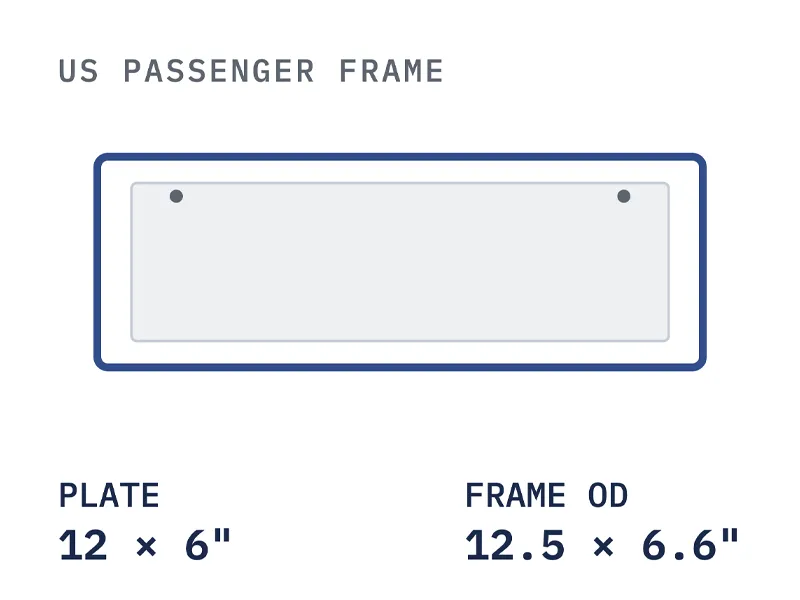
The US passenger vehicle plate is standardized at 12″ × 6″ (300mm × 150mm) across all 50 states, a size adopted industry-wide since the 1950s under AAMVA guidance. Because the plate itself is uniform, license plate frame size for cars and trucks is fairly predictable: most universal frames measure roughly 12¼” × 6⅜” on the inside opening, just enough to slide over the plate without pinching it.
Two details matter more than the outer frame size: the mounting hole spacing, typically 7″ apart horizontally, and keeping the frame’s inner lip clear of the state name, registration sticker box, and validation tabs — many states enforce visibility rules on these elements.
Euro License Plate Frame Size
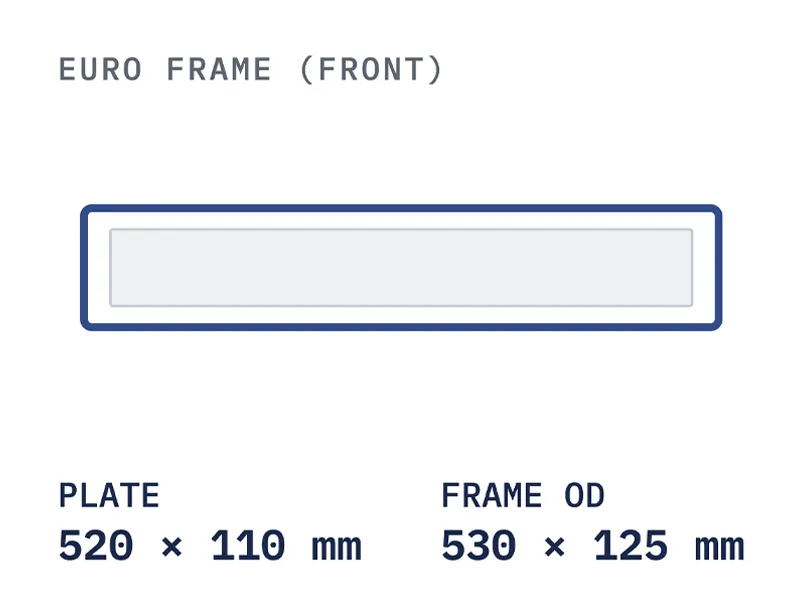
Euro license plate frame size revolves around one dominant format: 520mm × 110mm (20.5″ × 4.3″), used as the front-plate standard across Germany, France, Spain, Italy, Belgium, and most of the wider EU and EEA. It’s a long, low strip — visually and dimensionally the opposite of a US plate — which is why a US-profile frame will never fit a European plate correctly, and vice versa.
Where it gets more nuanced is the rear plate: several countries (the UK, France, Spain, and Belgium among them) issue a taller rear plate at 520mm × 120mm, so a single “Euro” frame doesn’t always serve both ends of the same car. A handful of markets also depart from the 520mm-wide format entirely for square or compact front plates. For this reason, XCLPF machines Euro frames with a small tolerance band (roughly +2mm) and offers both front and rear profiles rather than a single fixed die.
Japanese Size License Plate Frame
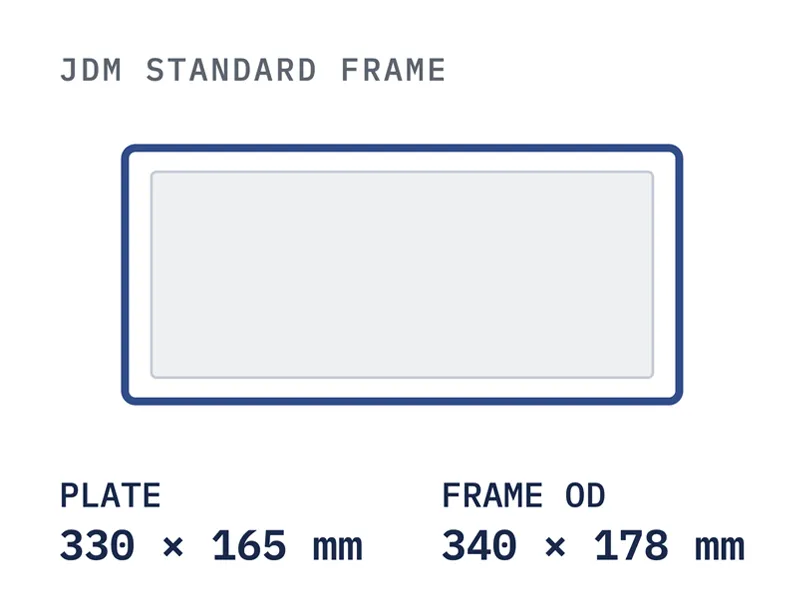
Japan uses a single national standard set by the Ministry of Land, Infrastructure, Transport and Tourism: 330mm × 165mm (13″ × 6.5″). What surprises a lot of overseas buyers is that this footprint is identical whether the vehicle carries a white-and-green regular plate or a yellow-and-black kei car plate — the color and text layout differ by vehicle class, but the physical plate size does not. So a Japanese size license plate frame is really one profile that covers ordinary passenger cars, commercial vehicles, and kei cars alike.
The exception is heavy trucks and buses (gross weight over 8 tons, or seating 30+ passengers), which step up to a larger 440mm × 220mm plate. Because the standard JDM plate is close in proportion to — but not interchangeable with — a US plate, frames need to be cut to the 330 × 165mm opening specifically; a “universal” frame sized for a 12″ × 6″ plate will typically sit loose on all four sides of a genuine Japanese plate.
Thailand and Other Regional Sizes
Outside the US, Europe, and Japan, plate dimensions still vary enough to trip up a generic frame order. Thailand’s passenger plates run roughly 340mm × 150mm (13.4″ × 5.9″) — narrower than the JDM standard, and not quite the same ratio as the European strip either — while motorcycle plates there run smaller still, closer to 220mm × 170mm. Many other markets in Southeast Asia, the Middle East, and Latin America either follow the European 520 × 110mm convention loosely or maintain their own local variant.
This is exactly why XCLPF organizes its catalog by destination country first, then by material and customization — a plastic frame cut for Thailand and a stainless steel frame cut for the US start from two entirely different opening specs, even before finish or printing enters the picture.
Motorcycle License Plate Frame Size
Motorcycle license plate frame size is one of the most common fitment mistakes we see — riders assume “smaller version of the car frame” and order the wrong ratio. In nearly every US state, motorcycle plates measure 7″ × 4″ (178mm × 100mm), noticeably squarer than the elongated car plate. Minnesota is the lone exception, issuing a slightly larger 7-3/16″ × 4-3/16″ plate.
Because the plate is so much smaller, the frame border itself needs to be proportionally narrow — a thick 1-inch car-style border can easily creep over the digits or the state name on a motorcycle plate. Aluminum and stainless steel are the preferred materials here, since the frame also has to survive constant vibration and road spray at speed.
How to Measure for the Right Frame Size
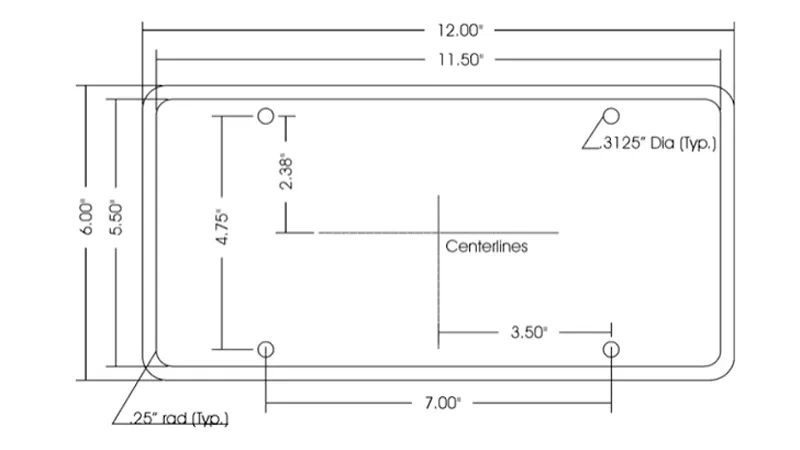
- Measure the plate, not the panel opening. Take the plate’s outer width and height edge to edge, in both mm and inches, before assuming a “standard” size applies.
- Check mounting hole spacing separately. Two plates can share the same outer dimensions but use different bolt patterns.
- Add a small tolerance, not a large one. A frame that’s 5–15mm larger on each dimension seats cleanly; anything looser lets the plate rattle or rotate.
- Confirm vehicle class, not just country. “Made for Japan” isn’t specific enough if the vehicle is a heavy truck rather than a passenger car.
- Re-check local visibility rules. A frame that’s the right size can still be non-compliant if its border overlaps a state name, sticker box, or QR/validation mark.
Material and Finish Don’t Change the Size — But They Do Change the Fit
Once the correct opening dimensions are locked in, material and process are a separate decision layer. Stainless steel and aluminum frames hold tighter tolerances over time and suit larger Euro and JDM openings well; plastic frames are lighter and more economical for high-volume US-market orders. Customization methods — custom printing, UV printing, silk screen, raised letter, and chrome plating — sit on top of the same base dimensions, though raised-letter and chrome-plated frames typically need a marginally deeper channel to keep the plate seated flush.
FAQs
Are all license plate frames the same size?
No. License plate frame size follows the plate size set by each country’s transport authority, and it also changes by vehicle type — a US car frame, a US motorcycle frame, a European frame, and a Japanese frame are all built to different openings.
What is the standard license plate frame size in the US?
US passenger plates measure 12″ × 6″ (300 × 150mm), with frames typically opening to about 12¼” × 6⅜” to slide over the plate without binding.
What is the motorcycle license plate frame size?
Most US states use a 7″ × 4″ (178 × 100mm) motorcycle plate, with Minnesota issuing a slightly larger 7-3/16″ × 4-3/16″ version.
Is a Japanese size license plate frame the same as a US one?
No. Japan’s standard plate is 330mm × 165mm for both regular and kei-car vehicles — a different footprint from the US 12″ × 6″ plate, so the two frame types are not interchangeable.
What is the Euro license plate frame size?
The dominant European front-plate size is 520mm × 110mm; several countries issue a taller 520mm × 120mm rear plate, so front and rear frames aren’t always identical.