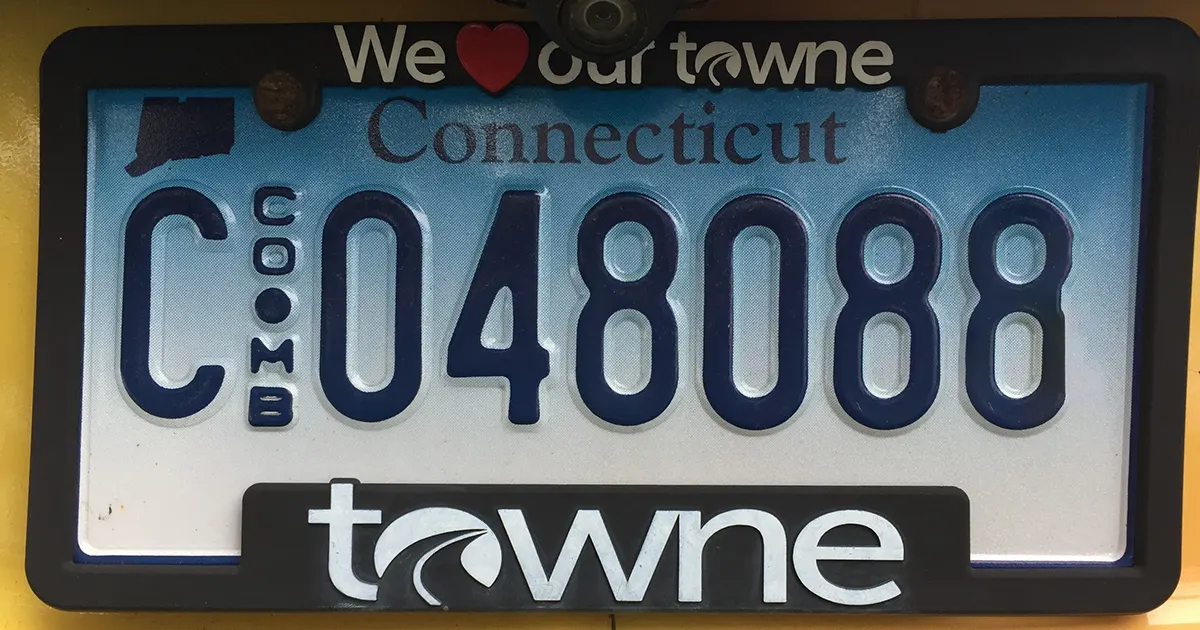
No—Connecticut does not prohibit every license plate frame. A frame becomes a legal problem when it significantly blocks or conceals the plate so that its numerals and letters are not plainly legible to a reasonable person or a device capable of recording or photographing the vehicle or plate.
That is the practical rule in Connecticut General Statutes §14-18 as amended effective October 1, 2025. For 2026, a slim, open-face frame that leaves every registration character readable is the safer choice. A thick inner lip, oversized decoration, tinted cover, dirt, or a shifted frame can move the installation outside that standard.
Short answer: The frame itself is not automatically illegal. The installed plate must remain substantially unobscured, and its numerals and letters must stay plainly legible at all times.
What Connecticut §14-18 Requires in 2026
The 2026 Supplement to the Connecticut General Statutes sets out several related requirements:
- Official number plates must be substantially unobscured.
- The numerals and letters must be plainly legible at all times.
- The plate must be horizontal and fastened so it does not swing.
- Nothing attached to the vehicle or plate may obscure or impair visibility of the numerals and letters.
- A violation of subsection (a) or (c), among the listed provisions, is an infraction.
The statute defines “substantially unobscured” around a real-world reading test. The plate cannot be significantly blocked or concealed to the point that a reasonable person—or an electronic device capable of recording data or taking a photograph—cannot read its numerals and letters.
This matters because a plate can look acceptable from directly behind the car yet become difficult to read from a modest side angle or camera height. The law’s wording is not limited to your own close-up view in daylight.
The Rule Changed on October 1, 2025
Older articles and forum answers often quote a stricter version of §14-18. Public Act 25-19 changed the relevant text, effective October 1, 2025. If you see advice based on the old wording, check the date before relying on it.
| Issue | Earlier wording | Rule used in 2026 |
|---|---|---|
| Obstruction standard | Plate had to be entirely unobscured | Plate must be substantially unobscured |
| What an attachment may not impair | Any information on the plate | The numerals and letters on the plate |
| Reading test | No specific definition of “entirely unobscured” in this subsection | Includes readability by a reasonable person or a capable electronic device |
The change does not create a blanket approval for wide frames. It replaces an absolute-sounding standard with a defined substantial-obstruction test. Your actual installation still needs to preserve legibility.
What a Lower-Risk Frame Looks Like
A lower-risk setup has narrow inner rails, no material over the plate face, correctly aligned mounting holes, and enough clearance around every registration character. The frame should remain flat after the screws are tightened and should not slide or curl inward.
If the plate layout is tight, compare a full border with a slim license plate frame. Do not judge by the outside dimensions alone; the opening is the dimension that controls how much of the plate stays exposed.
Common Ways a Frame Can Create a Problem
A Thick Inner Lip Covers Part of a Character
Even a small overlap can cut through the top, bottom, or side of a numeral or letter. If you can see only most of a character, the conservative fix is to use a thinner frame rather than debate whether it is still recognizable.
Raised Text Projects Into the Opening
Decorative lettering may sit on the rail but cast a shadow or physically overlap the plate from an angle. Check the finished frame, including badges and screw caps, not just the base shape.
The Frame Shifts After Installation
Slotted holes, loose screws, vibration, or a flexible border can let the frame move. Center the opening, use appropriate washers or spacers, and recheck it after the first few drives.
A Clear or Tinted Cover Changes Readability
A cover sits over the plate rather than around it. Tint, scratches, condensation, glare, or optical distortion can impair how a person or camera reads the characters. Treat a cover as a separate visibility risk; an open frame is easier to assess.
Road Dirt or Snow Fills the Opening
The statute requires legibility at all times, so the issue is not limited to the frame material itself. A deep rail can collect snow or road grime along the characters. Clean the plate and drainage areas whenever visibility starts to deteriorate.
Front and Rear Plate Display Still Matters
Section 14-18 distinguishes vehicles issued one plate from vehicles issued two. If one plate was issued, it must be displayed conspicuously at the rear while the vehicle is used on a public highway. If two were issued, both front and rear plates must be displayed conspicuously.
The amended text allows a rear plate to be displayed against a vehicle’s rear window, but only when the numerals and letters are plainly legible. That exception does not excuse a blocked, tilted, swinging, or unreadable plate.
A Two-Minute Connecticut Plate Check
- Clean the plate and frame so dirt is not influencing the result.
- Confirm every registration numeral and letter is complete from straight behind.
- Move to both sides and view the plate from normal traffic and camera heights.
- Check that the frame, screw caps, hitch, plate mount, and vehicle trim do not intrude.
- Make sure the plate is horizontal, secure, and unable to swing.
- Repeat the check at night and after tightening the screws.
If any character is clipped, the simplest answer is to remove the frame or replace it with a slimmer one. Keeping the full plate visible is also the safest general approach when you drive across state lines; the broader license plate frame legality overview explains why rules differ.
Frequently Asked Questions
Can a frame cover the word Connecticut?
The current §14-18 language specifically focuses on numerals and letters, but it is unwise to design around hiding official plate information. Plate layouts vary, another rule or jurisdiction may apply, and a border that reaches the state name may also reach registration characters from an angle. Keep the entire issued plate visible when possible.
Is a slim frame automatically legal in Connecticut?
No product style is automatically legal in every installation. A slim frame is less likely to overlap the plate, but you still need to check the actual plate, screw caps, mounting position, and viewing angles.
Are smoked license plate covers legal in Connecticut?
A smoked cover can reduce contrast or interfere with human and camera readability. Because §14-18 prohibits attachments that obscure or impair visibility of the plate’s numerals and letters, removing a tinted cover is the conservative choice.
Does the rule apply to the front plate too?
When two plates have been issued, Connecticut requires conspicuous display at the front and rear. The unobscured and legibility requirements apply to official plates displayed on motor vehicles.
What happens if the frame violates §14-18?
The statute classifies a violation of the listed provisions, including subsection (c), as an infraction. The circumstances of a stop or citation depend on the facts and current enforcement rules.
Bottom Line
License plate frames are not categorically illegal in Connecticut in 2026. Keep the plate substantially unobscured, preserve clear reading of every numeral and letter by people and capable cameras, and secure the plate horizontally. When a rail, badge, cap, cover, or vehicle part clips a character, remove or replace it.
This is general information, not legal advice. Statutes and enforcement practices can change; check the official Connecticut text if your situation is uncertain.