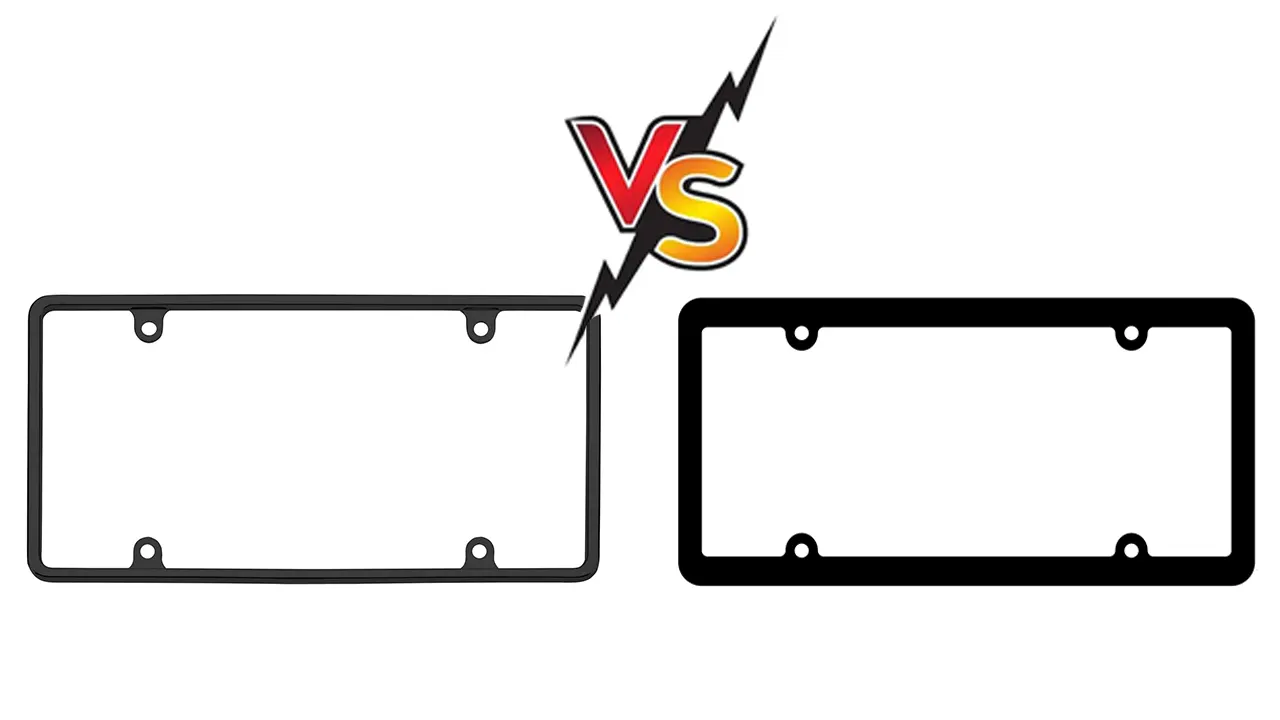
A slim license plate frame uses a narrow visible border to keep more of the plate exposed. A full frame surrounds all four edges, but “full” does not automatically mean bulky. You can have a slim full-surround frame, a wide-bottom promotional frame, or a partial frame with a heavy logo panel.
So which should you choose? Start with the plate information and vehicle clearance. Then decide how much branding, edge coverage, stiffness, and visual weight the product needs. The marketing label comes last.
What slim and full usually describe
| Design | Typical purpose | Main tradeoff |
|---|---|---|
| Slim border | Minimal appearance and more exposed plate area | Less space for large artwork or dimensional branding |
| Full surround | Finished edge on all four sides and balanced appearance | Must be checked carefully around all plate details |
| Wide-bottom frame | Dealer name, website, slogan, or campaign | Lower plate text or stickers may be close to the branding rail |
| Partial or top-only style | Specific styling or mounting concept | Less edge coverage and potentially uneven support |
Ask for the actual outer dimensions, visible opening, top/bottom/side border widths, and section profile. Two suppliers can call their products “slim” while providing noticeably different openings.
Choose slim when visibility and clearance lead
A slim frame is often the easier starting point when your program spans several state plate designs, the vehicle has a tight recess, or the brand wants a quiet factory-style appearance. The narrower face also leaves more room around registration stickers and jurisdiction names.
That does not make every slim frame automatically compliant or compatible. Screw caps, corner radii, lateral shift, and the installed position can still overlap plate details. Narrow sections also need enough strength and finish coverage for the chosen material and process.
Choose a fuller frame when the border has more work to do
A full surround can visually contain the plate, cover sharp or unfinished plate edges, provide balanced decoration, or add a controlled retention feature. A wider local panel may support dealer lettering, raised text, a badge, or multicolor artwork that would be cramped on a uniformly slim rim.
The useful question is not “How much border can we add?” It’s “What function needs that area?” If the extra width provides no structural, decorative, or retention value, it may only consume visible plate space and vehicle clearance.
Visibility comes before branding
Full-size North American plates share a common nominal envelope, but the printed layouts and validation features are not identical. AAMVA’s standard emphasizes legibility for people and plate-reading systems. Use the real target plate set to define a safe opening and artwork zone.
For a multi-state retail program, overlay representative plate designs and test the worst-case installed shift. For a dealer program in one state, you can work from that jurisdiction’s current plate layouts and rules. Either way, avoid a blanket legal promise based only on “slim” packaging.
Material and decoration can change the best choice
| Requirement | Design implication |
|---|---|
| Fine printed border graphic | A slim face may work if the printable zone and registration are controlled |
| Large dealer name | A wider lower panel may be more readable than shrinking the text |
| Raised lettering or attached badge | Allow local width, attachment space, projection, and packaging protection |
| Thin metal appearance | Review formed edges, flatness, coating coverage, and corner behavior |
| Molded plastic structure | Use ribs, radii, bosses, or rear geometry where needed instead of widening every visible edge |
| Flexible sleeve | Control channel grip, drainage, insertion, and visible overlap |
Review the whole installed envelope
A full border may contact a recessed body panel even when it fits the plate. A top rail can approach a camera or hatch release. A wide lower panel can project beyond a bumper pocket or vibrate if it lacks support.
Build the stack from the vehicle outward: mounting surface or bracket, optional pad, plate, frame, washer or cap, and screw. Check thread engagement, flatness, camera view, drainage, and access for installation tools.
Use a controlled sample comparison
- Fit both samples to the same target plate and vehicle fixture.
- Center them, then shift them within the available hole or slot clearance.
- Check every required plate feature at the worst position.
- Compare branding readability from normal viewing distance.
- Inspect flatness, edge contact, hardware clearance, and lower-edge movement.
- Repeat after the production-intent finish and decoration are applied.
Use the license plate frame size guide to establish the plate format, then review the available custom frame structures around your branding and mounting needs.
Frequently asked questions
Is a full frame wider than a slim frame?
Not always. “Full” usually means the frame surrounds all four edges; “slim” describes border width. One frame can be both.
Which style leaves more branding space?
A wider top or bottom panel usually offers more usable artwork area. Confirm the plate layout, hole keep-outs, and decoration process before setting the panel size.
Is a slim frame stronger?
Border width alone does not determine strength. Material, thickness, bends, ribs, corners, mounting points, and installed support all matter.
Which style works better across several states?
A narrow visible overlap can reduce the risk of covering edge information, but you still need to review the actual plate layouts and current local rules in your sales area.
Pick the frame your buyer can approve
For an efficient quote, send the target plate set, vehicle envelope, preferred border style, artwork, material, finish, hardware, packaging, and quantity. Ask for both front and section drawings. You’ll see quickly whether a slim, full-surround, or locally widened design makes the most sense.