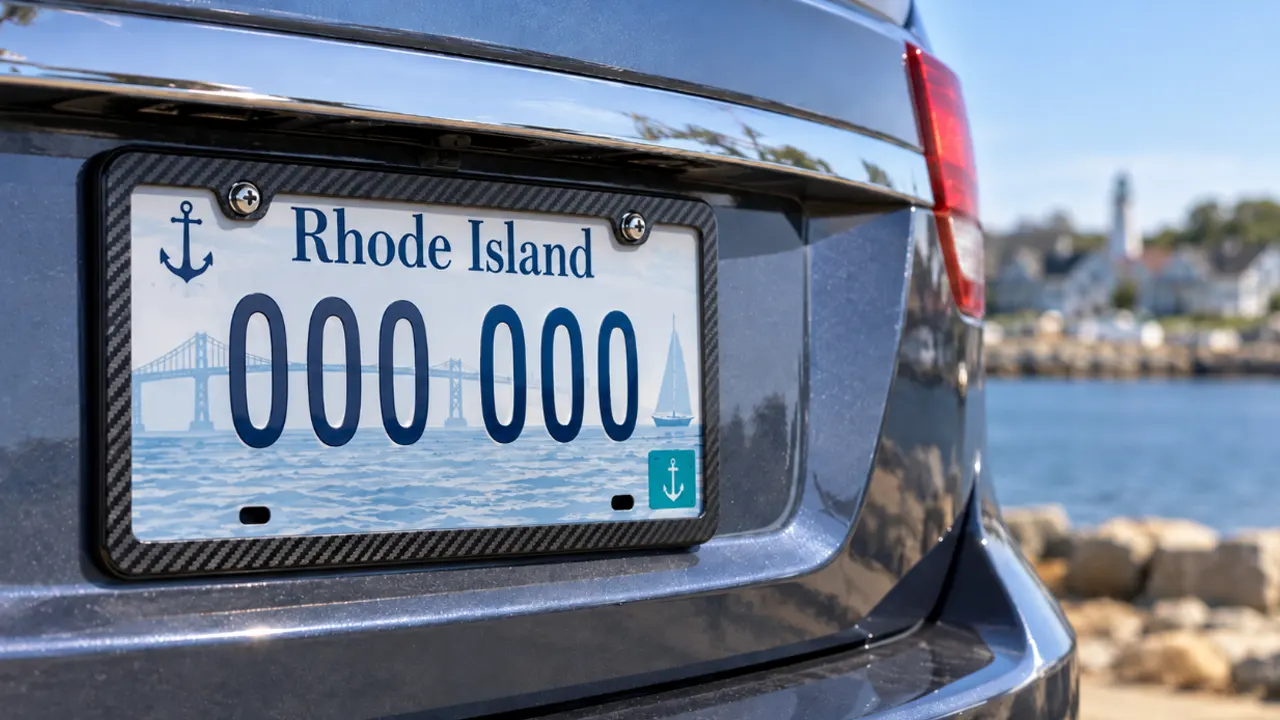
Rhode Island’s plate-display statute does not ban license plate frames by name. It requires a plate to be clearly visible, clearly legible, securely fastened horizontally, and kept free from foreign materials. State inspection rules also reject plates obscured by items that interfere with identification. So an open frame is not automatically unlawful, but a frame that overlaps plate information or affects visibility can create a problem.
What Rhode Island’s display law requires
Under R.I. Gen. Laws §31-3-18(b), a registration plate must be held horizontally so it does not swing, mounted at least 12 inches from the ground measured from its bottom edge, positioned so it is clearly visible, and maintained free from foreign materials and clearly legible. Section 31-3-12 adds that the required letters and numerals must be plainly readable from 100 feet during daylight.
The language does not say “frames are prohibited.” It also does not spell out a frame design that is guaranteed to pass. The important question is whether the finished installation leaves the plate visible and identifiable. If a border, badge, screw cap, or cover interferes with that, the accessory may be the issue even if it was sold as decorative trim.
What inspection rules add
Rhode Island’s official vehicle inspection regulations list plate obstructions as a reason for rejection. They identify slogans, colored glass or plastic, decals, and other implements that may interfere with identification. They also require the rear plate lamp to illuminate the plate so it can be clearly read from 60 feet during inspection.
That makes a wide dealer frame or novelty border worth checking closely. If its bar covers a letter, number, decal, or other identifying detail, or if the frame blocks the plate lamp, the installation may fail the practical visibility test even though the statute does not use the word “frame.”
Frame versus cover: why the difference matters
A frame sits around the plate’s edge and leaves most of the face open. A cover places a layer over the plate itself. The inspection regulations specifically call out colored glass or plastic and other devices that interfere with identification, so a clear or tinted cover is not just another style of frame.
If an accessory crosses onto the plate face, adds glare, changes contrast, or makes a character harder to distinguish, remove it. A “clear” cover can still reflect light or make the plate image harder to read. Don’t rely on appearance at arm’s length or on the seller’s claim that it is legal.
Check the installed frame, not just the product photo
Place the frame on your actual Rhode Island plate and check every edge. Leave the complete serial number, state name, decals, and other official markings visible. Then read the plate from behind the vehicle and from normal side angles. Tighten the screws only after the frame is aligned; a small shift can move a bar or cap over a character.
Check the mounting too. The plate should stay horizontal and not swing, and the bottom edge must meet the 12-inch minimum in §31-3-18(b). At night, make sure the frame or its hardware does not shadow the rear plate or interfere with the white plate light.
Choosing a frame for a Rhode Island plate
Measure the opening against the exact plate design and decal placement. Frames with narrow borders may be easier to fit around the printed area, but the label “slim” does not guarantee that every Rhode Island plate will remain clear. Specialty plates can place artwork and text differently from a standard design.
If you are comparing U.S. license plate frame options, check each model’s opening and hardware layout against your plate and vehicle. Our overview of frame visibility rules explains why one design should not be assumed legal in every state.
Common questions
Are license plate frames illegal in Rhode Island?
Rhode Island law does not expressly ban frames by name. It requires plates to be visible, legible, securely mounted, and free from foreign materials; inspection rules reject obstructions that interfere with identifying the plate. A frame that stays outside those areas is a lower-risk choice, but no product receives a blanket approval from the statute.
Can a frame cover the state name or a registration decal?
Keep both visible. Even where the statute does not list each design element in detail, covering official information can interfere with the required visibility and identification of the plate.
Are clear license plate covers allowed in Rhode Island?
Do not assume so. Rhode Island inspection rules reject colored glass or plastic and other implements that interfere with plate identification. A transparent cover can still create glare or reduce legibility.
How high must the plate be mounted?
Section 31-3-18(b) sets a minimum of 12 inches from the ground to the bottom of the plate. It must also stay horizontal and be securely fastened so it does not swing.