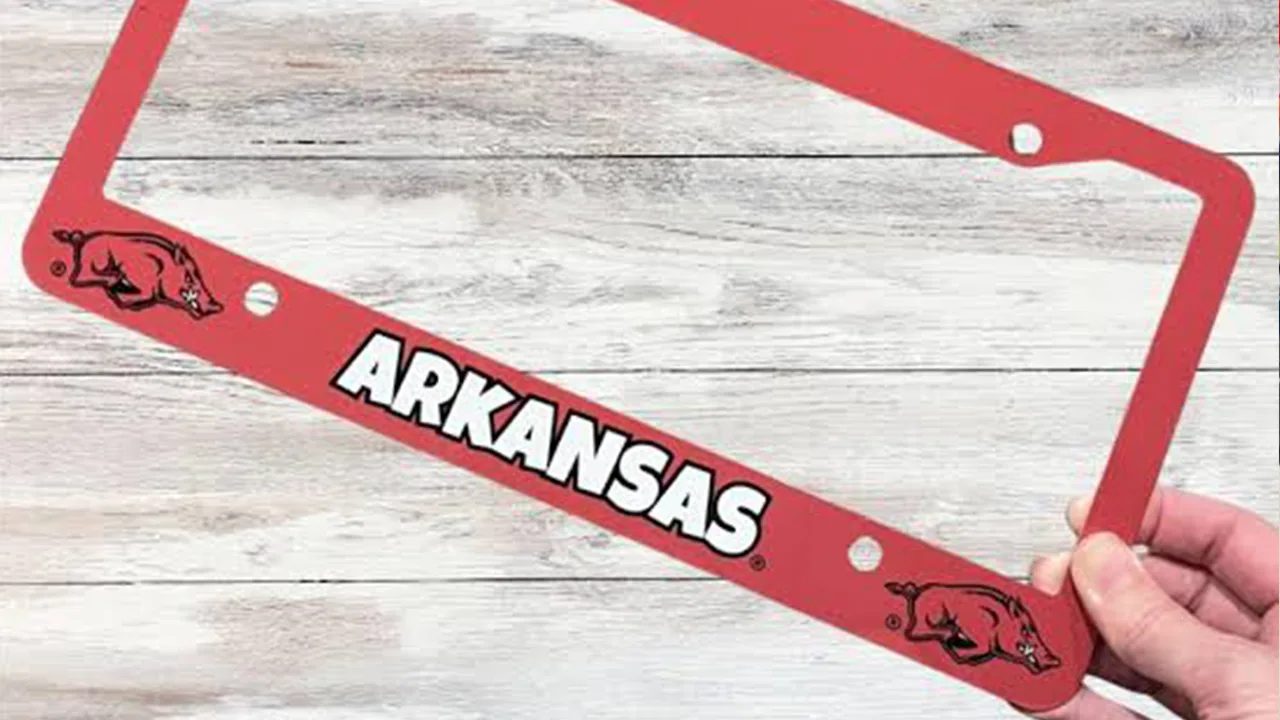
You may use a license plate frame in Arkansas if the finished installation leaves the plate clearly visible and legible. A frame or cover that hides the registration number, state name, or other identifying information can create a violation. Arkansas courts have also treated a frame that obscured the issuing state as a valid reason for a traffic stop.
So the useful answer is not “all frames are legal” or “all frames are illegal.” A slim, properly centered frame is usually the sensible choice; a thick border that overlaps printed plate information is not.
The rule in Arkansas Code § 27-14-716
Arkansas requires a license plate to be securely fastened in a horizontal position, at least 12 inches above the ground, in a place where it is clearly visible. The plate must be kept free from foreign materials and in a condition that is clearly legible.
The law also addresses covers. A cover is prohibited when it makes the plate more difficult to read or reduces the plate’s reflective properties. Transparency alone is therefore not a safe harbor: a clear cover can still become hazy, reflective, dirty, or scratched enough to interfere with the plate.
Does the word “Arkansas” need to stay visible?
Yes—do not cover it. In Hinojosa v. State, the Arkansas Supreme Court considered a vehicle with a thin frame that obscured the word “Arizona.” The court concluded that the obscured state name meant the plate was not clearly visible and legible under the Arkansas display statute, supporting the traffic stop.
That decision is especially useful because it answers a common assumption: leaving the registration number exposed is not necessarily enough. An officer needs to be able to identify the jurisdiction that issued the plate as well.
What a compliant-looking frame leaves uncovered
- every letter and number in the registration sequence;
- the full state name;
- registration stickers or decals;
- any other identifying text required on the plate; and
- enough reflective surface for the plate to remain easy to see.
If the plate design places the state name close to the top edge, pay special attention to the frame’s upper rail. If a decal sits near a corner, make sure the frame does not overlap it after the screws are tightened.
What about bicycle racks, hitches, and mobility equipment?
Arkansas Act 538 created limited exceptions for certain properly installed equipment, including a trailer hitch, trailer, wheelchair lift or carrier, and bicycle rack. Those exceptions address obstruction caused by the listed equipment. They do not turn a decorative frame into an exception, and they do not give permission to intentionally hide the plate.
If removable equipment blocks the plate, follow the specific equipment and plate-display rules that apply to the setup. A rack that qualifies for an exception is a different legal issue from a thick frame that sits directly over the plate’s wording.
Frame versus cover: why the distinction matters
An edge frame surrounds the plate. A cover or shield places material over its face. Arkansas law gives you a concrete reason to treat these products differently: a cover that reduces readability or reflectivity is expressly prohibited.
A narrow open frame generally creates fewer visibility problems because there is no plastic layer over the characters. If you are deciding between the two, compare how a frame and a plate cover affect visibility after months of sun, washing, and road grime—not only how they look when new.
How to check your Arkansas plate frame
- Center the plate and frame. A few millimeters of misalignment can cover a state name or decal.
- Tighten the fasteners evenly. The plate should not swing, tilt, or bow.
- Read the entire plate from behind the vehicle. Include the state name and decals in the check.
- Look at it under headlights. Remove any accessory that creates glare or dims reflectivity.
- Recheck after driving. Vibration can shift a loose frame or allow dirt to build up around its lower edge.
When a frame seems close to the printed areas, measure the inside opening before installing it. A guide to frame opening dimensions can help you compare the usable window rather than the outside size alone.
Common setups that create trouble
| Setup | Why it is risky |
| Thick top rail | May hide the state name, even when the number remains visible |
| Wide corner decoration | Can overlap registration decals |
| Smoked or tinted shield | May reduce legibility and reflectivity |
| Loose two-screw installation | Can let the plate swing or sit at an angle |
| Deep lower channel | Can collect dirt that covers characters |
Frequently asked questions
Are dealer frames legal in Arkansas?
A dealer frame is judged by the same visibility standard as any other frame. Advertising text is not the issue; an oversized rail that obscures the plate is.
Can a frame cover the slogan at the bottom?
The lower-risk choice is to leave all plate wording visible. Arkansas requires the plate to be clearly visible and legible, and the state-name court decision shows that information beyond the serial number can matter.
Is a clear license plate cover allowed?
Not if it makes the plate harder to read or reduces its reflective qualities. A cover can fail that test because of tint, glare, scratches, condensation, or dirt even if the plastic began completely clear.
What should you do if the frame overlaps “Arkansas”?
Remove or replace the frame. Re-centering may solve a small alignment problem, but do not alter the official plate to make the accessory fit.
Bottom line
Arkansas does not require you to drive without a frame. It requires you to display a secure, horizontal, clearly visible, and clearly legible plate. Leave the number, state name, decals, and reflective face unobstructed, and avoid covers that change how the plate reads in real conditions.
This information reflects official sources reviewed on September 24, 2026. It is general information, not legal advice; check current Arkansas law if your installation or vehicle type is unusual.