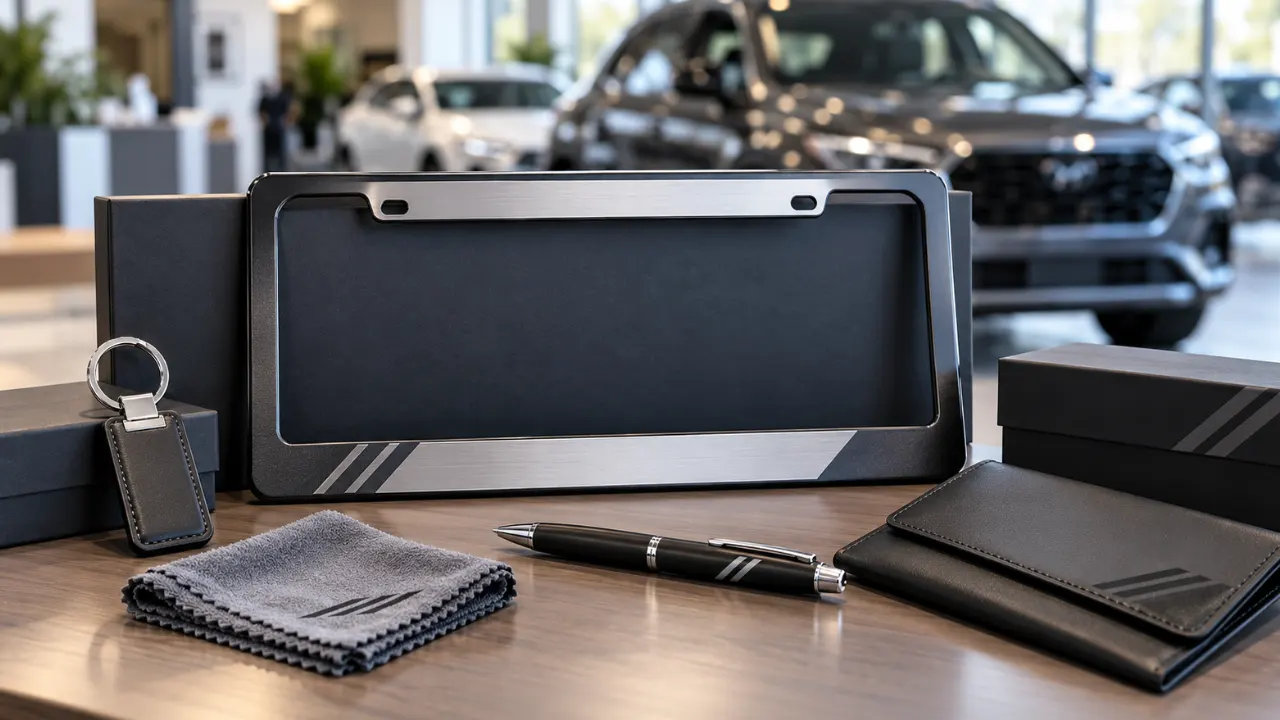
Choose automotive promotional products around the moment you hand them over and what the recipient will actually do with them. A key tag can suit a vehicle handover, a clean microfiber cloth can fit a detailing promotion, and a branded license plate frame can work when the vehicle owner wants it and the frame fits correctly. Those are different jobs, not interchangeable logo spaces.
Start with the audience, the intended use, and a realistic delivered budget. Then compare the item, the decoration, and the way it will be distributed. A cheap product that stays in a carton is not a successful giveaway, and a more expensive one is not automatically a better advertisement.
Start With the Customer Moment, Not the Catalog
A dealership delivery, an oil-change visit, a repair-shop open house, and an automotive trade meeting call for different gifts. At a delivery, you have time to explain an item and check its fit. At a busy event, you may have only a few seconds, and the visitor may need to carry everything for hours.
Write a short sentence describing the handover before browsing products: “A customer collects a serviced car and receives a useful reminder of how to book again.” That might lead to a document wallet or key tag with a readable booking address. It probably does not require a heavy presentation box.
For a new customer, your business name and service may need to be obvious. For an established club or enthusiast community, a restrained symbol might be enough. The recipient’s relationship with your business changes how much explanation the product needs.
Also decide what success means. Are you supporting a smooth delivery, encouraging a return visit, thanking a customer, or introducing your business? Pick one primary purpose. Trying to make one item perform every marketing task usually produces crowded artwork and an unclear message.
Match the Product to Its Actual Use
| Product category | Useful occasion | What to check before ordering |
|---|---|---|
| Key tags and keychains | Vehicle delivery, service collection, membership gifts | Bulk, sharp edges, attachment, readable contact details |
| Microfiber cloths | Detailing promotions, clean-care bundles | Intended surface, edge finish, decoration, individual cleanliness |
| License plate frames | Owner-approved handovers and vehicle branding | Plate opening, mounting points, required information, vehicle clearance |
| Document wallets | Service records or vehicle handover | Document size, closure, privacy, printing that remains readable |
| Ice scrapers | Relevant cold-weather campaigns | Intended application, usable grip, instructions, regional relevance |
| Bags and organizers | Events or selected ownership programs | Packed size, attachment method, storage location, carrying burden |
The table is a shortlist, not a promise that one supplier sells everything in it. You can source the frame from a frame specialist and buy the other items separately. Keeping that distinction clear makes it easier to ask the right technical questions instead of accepting an all-purpose catalog description.
Key Tags: Useful Only if the Key Set Stays Manageable
Key-related merchandise makes sense in automotive settings, but think about the full key set rather than the tag on its own. A large decorative piece can be awkward beside a modern remote, an access card, and house keys. Hard corners can also make a pocket item unpleasant to carry.
Handle a finished sample with a realistic set of keys. Check the ring, joint, edge finish, and how easily the text can be read without turning it repeatedly. If customers use a removable service tag only briefly, prioritize easy identification rather than pretending it is a permanent keepsake.
Be careful with the information printed on it. A recognizable business name and a short contact route may be useful; the customer’s full address is usually unnecessary. Avoid embedding personal vehicle details into mass-produced gifts without a clear need and the owner’s agreement.
For a multi-location business, decide whether the tag should identify a particular branch or a central booking system. That choice affects how much stock becomes outdated when a location changes. A timeless design may be easier to reuse, while a campaign-specific design needs a more controlled quantity.
Cleaning Cloths: Keep the Care Advice as Useful as the Logo
A cleaning cloth can be a sensible promotional item for a detailing business or car-care event. Its usefulness depends on the intended surface and the condition in which it reaches the customer. A cloth for glasses or a phone is not automatically the right choice for painted bodywork.
Ask what the supplied cloth is intended to clean and whether the printed area, seams, or edge treatment change how it should be used. Do not advertise scratch prevention simply because a product is described as microfiber. Dirt trapped in any cloth can turn a casual wipe into an avoidable problem.
Keep cloths clean during packing and distribution. An uncovered stack on a dusty event table defeats the point. Packaging can be minimal, but it should protect the usable surface and make the care instructions easy to find.
A small card can explain the intended use and where to get further care advice. Keep the explanation specific rather than printing broad claims such as “safe on everything.” For a mixed bundle, separate chemicals or fragranced items so the cloth does not arrive carrying residue or a strong scent.
License Plate Frames: Check Fit Before Treating Them as Advertising
Promotional license plate frames put the message around an existing vehicle component rather than inside a gift bag. That makes fit and owner consent part of the selection decision. A frame should not be installed as an assumed condition of receiving a vehicle or service.
Start with the actual plate format and the information that must remain visible. Outer dimensions alone are not enough: the opening, border width, mounting-hole arrangement, and nearby camera or lamp all matter. A frame that hides a registration sticker is a poor choice even if the logo looks excellent.
Compare the vehicle recess and the assembled plate, frame, and hardware. Do not assume the screws already fitted will remain suitable after adding another layer. The correct hardware depends on the mounting system, not on a generic promise that a frame is universal.
For mixed fleets or international campaigns, separate plate formats before ordering. Cars and motorcycles may need different layouts, and a country name on a catalog listing does not confirm every local plate variation. Use the frame size measurements to organize the checks, then compare the exact product drawing with the actual installation.
Choose the Message Before the Decoration Method
A useful promotional message normally has one clear priority. That might be the business name, a short web address, a club identity, or a campaign phrase. If the product has a small printable area, choose the priority rather than shrinking everything until nothing reads comfortably.
Check the proof at actual size. A website that looks clear on a large monitor can become a row of indistinct marks on a narrow frame rail. Telephone numbers add another long string; include one only if customers are likely to use it and the finished text remains readable.
Printing, engraving, and raised decoration have different visual effects, but none is automatically the best method for every item. Ask which methods suit the selected base material, finish, artwork, and quantity. Do not transfer an attractive result from one sample onto an unrelated material by assumption.
Keep original artwork and approved text in one controlled record. Spell out the business name, capitalization, and punctuation so the supplier does not reconstruct them from a low-resolution screenshot. If the logo belongs to a franchise, event partner, or vehicle brand, obtain the relevant permission before production.
Make a Sample Review Look Like Real Use
An attractive photograph is useful for appearance, but it cannot show every edge, joint, surface, or attachment. Request a representative decorated sample when the order’s value or fit risk justifies it. Agree whether it uses the intended material, finish, artwork method, and packaging.
For a keychain, check how it feels when handled. For a cloth, inspect the usable surface and the way it arrives. For a frame, compare the opening and holes with the target plate and mounting arrangement. These are different sample reviews because the products have different jobs.
Record what you accepted rather than writing only “sample approved.” Note the artwork version, color reference, item identification, and any changes still needed. A color shown on a phone screen is not a dependable substitute for an agreed physical reference.
If outdoor performance matters, ask for evidence tied to the actual item and decoration system. A general claim about metal, plastic, or ink does not establish a service life. A short sample inspection can reveal obvious problems, but it cannot prove years of sunlight or road exposure.
Compare Total Cost, Not Just the Item Price
The useful comparison is the cost of getting acceptable, usable items into the right hands. Include decoration setup, samples, freight, applicable import costs, packaging, assembly, local delivery, and staff time. An inexpensive component can become a costly project when several people need to sort and rebag it.
Use the same specification when comparing quotations. A decorated frame and an undecorated blank are not comparable; neither are individually protected items and loose pieces that still need packing. Ask what is included instead of assuming every quotation uses the same starting point.
A simple planning calculation helps: divide the total campaign cost by the number of items you expect to distribute appropriately. If a hypothetical campaign costs 1,200 dollars and you plan 300 suitable handovers, that is 4 dollars per planned handover. It is a budgeting example, not a supplier quote or a predicted customer acquisition cost.
Keep a separate allowance for replacements and unexpected handling needs. Do not turn that allowance into a fixed percentage without looking at the actual product and distribution plan. A multi-piece set with several assembly steps needs a different review from a single loose key tag.
Order Quantity Should Follow the Distribution Plan
For a service campaign, begin with realistic customer appointments during the campaign period. For vehicle deliveries, use the relevant delivery forecast and confirmed plate formats. For an event, distinguish registered participants, staff, invited guests, and casual visitors rather than using one overall attendance number.
Not every recipient will want every item. A frame requires a compatible plate and willingness to install it; a bulky organizer may be unwelcome to someone flying home. An optional choice can be more useful than handing the same bundle to everyone.
Separate initial stock from replenishment. If the design will remain useful for months, staged ordering might reduce storage pressure, provided the supplier’s terms and delivery timing support it. If the item carries a specific date, oversized stock can become obsolete immediately after the campaign.
Ask about minimum quantities, repeat-order conditions, and production timing for the exact item. These are commercial details to confirm, not numbers to copy from a different product. Leave time for artwork changes, sample review, and transport before setting a public promise.
Keep Bundles Small and Coherent
A good bundle combines items that belong in the same customer moment. A detailing thank-you might pair a protected cloth with a concise care card. A vehicle handover might include an organized document wallet and an optional frame whose fit has already been checked.
Avoid adding unrelated objects just to make the bag look full. More components mean more purchasing, packing, and disposal, and they can make the main gift harder to recognize. Count the handling steps as well as the products.
Think about what the recipient will do immediately after receiving the bundle. Someone collecting a car needs room for documents and keys, not a collection of loose pieces that fall into the footwell. A visitor at a crowded show may need a flat, lightweight package that closes securely.
Use packaging to explain what the item is and protect it appropriately. Do not let the packaging make a modest giveaway look like expensive equipment with capabilities it does not have. If a component needs instructions, keep them with that component rather than relying on a staff member to remember every detail.
Be Specific About Safety and Environmental Claims
Responsible sourcing starts with the actual product and intended audience. Ask for the relevant material information, instructions, and compliance documents for the destination market. A general company certificate is not the same as evidence that a specific decorated item suits a particular use.
PPAI’s responsibility resources distinguish product, social, and environmental considerations. That is a useful reminder to look beyond the logo proof. For electronics, children’s items, chemicals, or emergency equipment, involve a supplier with the appropriate product knowledge; do not treat those categories as ordinary printed souvenirs.
For U.S. campaigns, the FTC cautions against broad environmental claims such as unqualified “eco-friendly” wording. Ask what a recycled-content or recyclability statement actually refers to: the item, one component, or its packaging. Retain the supporting record rather than copying a green icon from a catalog.
A restrained description is better than an impressive but unsupported claim. You can also reduce unnecessary packing or choose an evergreen design without claiming a measured environmental benefit that nobody has calculated.
Make Distribution Respectful and Easy
Train the people handing out the items. They should know who the product is for, whether there are format options, and whether any fitting or explanation is needed. A quick choice between suitable options can prevent an otherwise useful gift from becoming unwanted clutter.
Get agreement before attaching a frame, applying a decal, or changing anything on a customer’s vehicle. A thank-you gift should remain a gift, not an unexpected modification. Keep removed parts if the owner wants them and avoid suggesting that a decorative frame replaces a mounting bracket.
If you collect contact details, explain the purpose and keep marketing permission distinct from the gift where required. Do not create a distribution method that encourages staff to enter invented details just to clear stock.
For a multi-branch program, label cartons by location, item format, and artwork version. Put the correct instructions in each package. A well-made product sent to the wrong branch or plate market still creates a poor customer experience.
Give Each Branch a Clear Handover Plan
Before shipping stock to several locations, decide who will receive it, where it will be stored, and who will check the cartons. Include the item name, quantity, artwork version, and intended customer occasion in the packing information. A branch should not have to infer the purpose of an unfamiliar carton from the logo printed on the product.
For frames, keep different plate formats physically separated. A mixed box can look efficient at the warehouse but leave staff guessing at the counter. If hardware is included, identify which installation it belongs to and prevent loose metal parts from rubbing against decorated surfaces. Do not let an unlabelled bag of screws become a substitute for a fitting instruction.
Send a short handover script that explains the item without exaggerated claims. Staff might say that a frame is optional and offer to check the plate opening before fitting it. For a cloth, they can explain the intended surface and remind the customer to keep it clean. The point is useful information, not a rehearsed sales pitch.
Cross-border programs need an additional check. Review destination-specific labeling, language, import arrangements, and product requirements with the responsible supplier or adviser. A quotation delivered to one country does not establish the cost or paperwork for another. Split the destination plan early enough that packaging and instructions can be prepared correctly.
Keep a simple route for branch feedback and replacements. Ask staff to report the item identification and problem, with a photograph when useful, rather than ordering a different substitute on their own. That gives you a consistent record and makes it easier to decide whether the next campaign needs different artwork, another format, or a different product altogether.
Review the Campaign Without Inventing Advertising Results
Count what you actually know: accepted items, items distributed, remaining stock, fit-related refusals, damaged pieces, and relevant customer feedback. These observations help you improve the next order without pretending that every item generated a sale.
If you use a campaign-specific booking link or code, test it before printing and keep it active for the item’s expected use. Record responses, but distinguish them from attributable sales. A person who scans a link might already be an existing customer.
Ask staff why recipients declined an item. The answer may be practical: the frame did not match the plate, the keychain was too large, or the visitor did not want fragrance in the car. Such comments can be more helpful than a large distribution total.
Keep leftover stock in the review. If the business identity remains current, suitable items may support another relevant occasion. Date-specific or incorrect merchandise should not be pushed onto customers simply to improve a distribution figure.
Frequently Asked Questions
What is a good automotive giveaway when you know little about the recipient?
Choose something that needs little vehicle-specific fitting, such as a modest key tag or appropriately specified cleaning cloth. Keep fragrance, personal taste, and storage burden in mind. Offer vehicle-mounted items as an informed choice rather than assuming compatibility.
Should every promotional item include a QR code?
No. A QR code needs enough space, contrast, and a useful destination. Test the finished sample with ordinary phones in realistic light. A short readable address may work better on a narrow or curved item, and it remains useful without opening a camera.
Can one frame design cover a global campaign?
One visual identity can carry across several frame formats, but the physical product may need to change. Group orders by actual plate dimensions, visible information, hole layout, and vehicle mounting arrangement. Keep those format variants identifiable in both proofs and cartons.
Is a free giveaway automatically a good choice for a customer?
No. The item should still be wanted, suitable, and easy to use. Avoid safety-critical products chosen only for low price, and give owners a say before installing branded accessories on their vehicles.
What should you send when discussing custom frames?
Send the target plate format, measurements or drawing, mounting reference, artwork, preferred appearance, quantity, destination, and required timing. Custom frame options are easiest to narrow down when the installation and message are clear before the quotation.