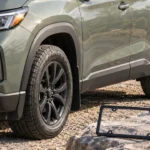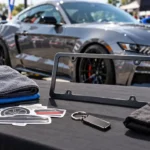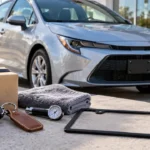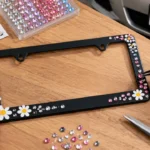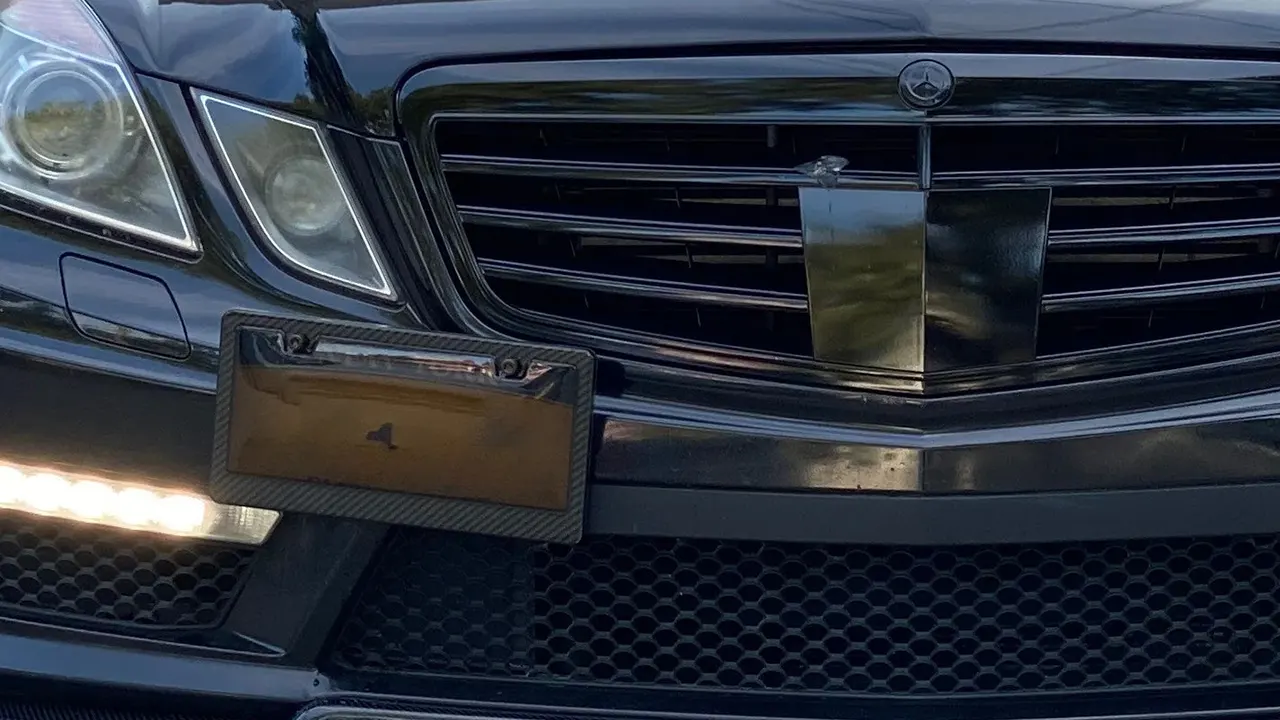
If you are looking for the best smoked license plate cover because you like the darker, more subdued look, there is one practical issue to settle before comparing tint shades: a smoked cover puts a tinted layer directly over the plate face. That can change how easily the plate’s characters, state or regional mark, and validation details can be seen. Rules vary by jurisdiction, and a cover that looks readable in a product photo or under showroom lighting is not proof it is permitted or clear under real driving conditions.
For ordinary public-road use, the most sensible choice may be no face cover at all. If you mainly want a darker styling detail, an open-face license plate frame changes the border around the plate without putting a tinted sheet over the numbers. A frame is not the same as a cover, and it still needs to leave required plate information visible.
This distinction matters because many product listings use “cover,” “shield,” “protector,” and “frame” loosely. Look at what the product actually covers. If a transparent or smoked panel sits in front of the printed plate, it is a cover—even if it is sold as a frame accessory.
Is a Smoked License Plate Cover a Good Choice?
It can make sense for a display vehicle, a photo shoot, or a vehicle that is not driven on public roads, provided the rules for that use permit it. For a daily driver, the tradeoff is less favorable: the darker surface changes the appearance of information that must remain identifiable, and legal rules may apply to the cover itself rather than only to whether you can personally read the plate.
There is no universal tint percentage that makes a cover safe or permitted in every jurisdiction. Product descriptions such as “light smoke,” “night visible,” “camera friendly,” or “legal tint” are not substitutes for a current rule from the authority that issued your plate. The exact product, plate, lighting, viewing angle, and local law all matter. Do not assume that a cover passes because it is advertised for road use, has a small amount of tint, or seems clear when you hold it in your hand.
Some listings are explicitly marketed to hide a plate from cameras or make identification harder. Skip those. A product designed to interfere with recognition is not a normal protective accessory. It can create legal problems and undermine the purpose of vehicle identification. This content focuses on appearance and fit, not concealment.
What Counts as a Smoked License Plate Cover?
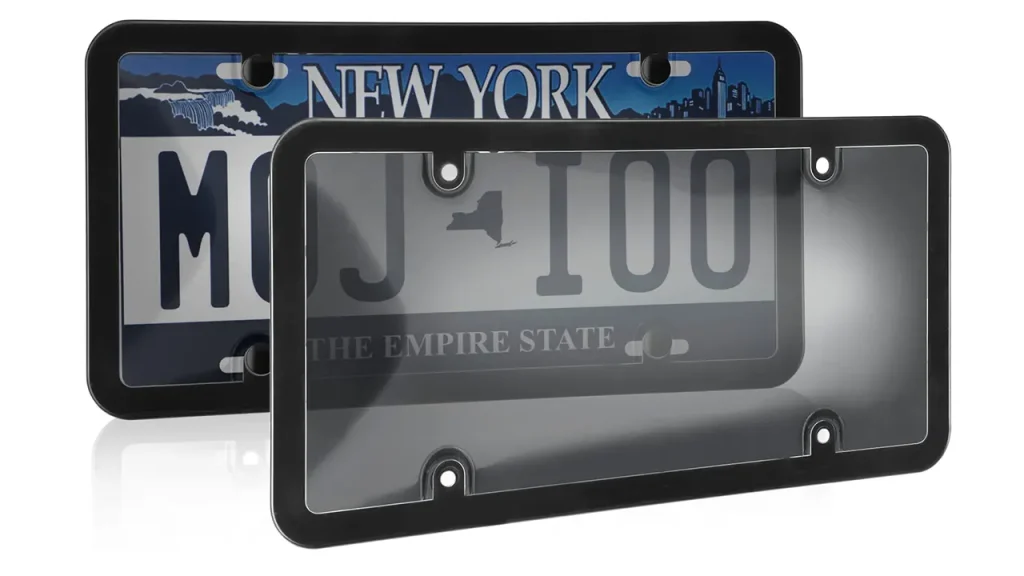
A smoked license plate cover is a panel with a gray, charcoal, or black tint that sits in front of a license plate. The tint can be molded into the material, applied as a surface treatment, or produced by a film. In each case, the plate is viewed through an additional optical layer. The name does not guarantee a particular darkness, material, optical quality, or legal status.
Some covers are flat panels retained by a separate border. Others have a curved profile or a built-in edge. Some kits combine a plate surround with a face shield. When inspecting a listing, focus on the layers: the plate itself, anything directly over its face, and any separate frame around its perimeter.
A standard open-face license plate frame leaves the central plate face exposed. It may border the top, bottom, or sides, and some styles have a wider area for decoration. The frame can change the vehicle’s appearance, but it does not darken the plate face. That difference makes frames a useful alternative for drivers seeking a coordinated look without adding a tinted panel over the plate.
| Accessory | Where it sits | Main styling effect | Key visibility check |
|---|---|---|---|
| Smoked cover | Over the plate face | Darkens or tones the plate’s appearance | Whether all information remains visible in the conditions and jurisdictions that apply |
| Clear cover | Over the plate face | Creates a transparent barrier or glossy look | Clarity, glare, distortion, and any rule on covering the plate at all |
| Open-face frame | Around the plate edge | Adds a border, color, finish, or logo area | Whether the border overlaps numbers, jurisdiction name, stickers, or other required details |
| Frame-and-cover kit | Frame around the edge plus a panel over the face | Combines border styling with a face shield | Assess the panel as a cover; the frame does not make the cover exempt |
Why Smoked Covers Can Be Harder to Read
A tint reduces or changes the light reaching the plate and the light returning from it. That can make characters less distinct against the background, especially when the plate is already dirty, weathered, reflective, or viewed at an angle. The result depends on the cover’s construction and the conditions around the car. A quick look from one position in daylight does not tell you what a driver, officer, toll system, parking camera, or roadside camera can see at night or in glare.
Headlights, street lighting, direct sun, rain, road spray, condensation, dust, and scratches all affect the view through a cover. A panel that appears almost invisible in a static product photo may reflect light from another angle. A curved or uneven panel may create reflections or visual distortion. A dark tint can reduce contrast, and added surface reflections can complicate the image further.
It is not responsible to promise that a particular smoked cover will work with every camera or automated plate reader. Systems use different camera positions, illumination, optics, and image processing. Without transparent, independently documented testing for the exact product and test conditions, phrases like “ALPR proof,” “camera safe,” or “night readable” are marketing, not a reliable guarantee. Avoid buying a cover based on a claim that it blocks or defeats cameras.
There is also a human visibility issue. Someone may need to identify the plate from a car park, driveway, road shoulder, or roadside incident. A darker layer gives you another variable to maintain: the cover must stay clean, clear, undamaged, and properly seated. If you have to keep asking whether it is dark enough to look good but clear enough to read, the simplest choice is to leave the plate uncovered.
Check Your Local Rules Before Comparing Shades
License plate accessory rules are set by the jurisdiction where the vehicle is registered and, in some cases, by the places where it is operated. The law may speak about legibility, a specific material over the plate, distortion, camera recognition, state or regional identifiers, registration stickers, or an outright prohibition on plate covers. A rule for an open frame does not automatically apply to a panel over the plate.
For a concrete example, New York Vehicle and Traffic Law §402 requires plates to be kept easily readable and prohibits knowingly covering them with material that conceals or obscures them or distorts a recorded or photographic image. It separately says plates may not be covered by glass or plastic material. That is a New York rule; it should not be treated as a summary of every state’s law. Check the current statute or motor-vehicle authority guidance for your registration jurisdiction before installing any face cover.
When reviewing the rule, search the official government source for terms such as “cover,” “shield,” “tint,” “obstruct,” “readable,” and “recognition.” Confirm the current version and whether it applies to any cover or only to a cover that impairs identification. If your vehicle crosses state or national borders, consider the places where you routinely drive. When the wording is unclear, contact the relevant motor-vehicle authority or leave the plate uncovered.
The broader tinted license plate cover law overview summarizes how rules differ across U.S. states and links to official authorities. It is a starting point, not individualized legal advice. The current law in the jurisdiction that issued your plate remains the source to check.
What Does “Best” Mean for a Smoked Cover?
Because there is no reliable one-size-fits-all winner, “best” should mean the product that meets your intended use without compromising required identification. For a show-only display, your priorities may be appearance, clean edges, a close fit, and easy removal. For public-road use, local rules and unobstructed visibility come first. If the exact product is not clearly permitted for the vehicle and jurisdiction, do not treat it as a road-use choice.
Before comparing any smoked cover, answer these questions:
- Is the vehicle used on public roads, or only for static display or off-road use?
- Does the issuing authority allow a cover over the plate face at all?
- Are the plate number, issuing jurisdiction, expiration details, and any required stickers unobstructed?
- Does the rule address tint, color, reflective surfaces, glare, distortion, or camera recognition?
- Can the product be removed without scratching the plate or damaging nearby trim?
- Does it fit the exact plate dimensions and mounting location without bending the plate?
- Will water, dust, or condensation become trapped between the panel and plate?
- Is the seller’s claim about legality or camera compatibility backed by a named authority or test?
If the seller cannot answer the relevant fit and material questions, that is a reason to pause. Do not rely on a photograph from a different vehicle or a customer review that says “looks fine to me.” Those can help you understand appearance, but they do not establish legal compliance or visibility in every condition.
Smoked vs. Clear License Plate Covers
A clear cover avoids the deliberate darkening of a smoked panel, but “clear” does not mean optically invisible or automatically permitted. A transparent cover can reflect light, collect scratches, haze, or distort what appears behind it. Some jurisdictions regulate covers regardless of whether the panel is tinted. If your local rule prohibits a cover over the plate, switching from smoked to clear does not solve the issue.
Smoked panels add the extra concern of reduced light and altered contrast. Clear panels may preserve more of the plate’s original appearance when new and clean, but they still add a surface between the viewer and the plate. Neither type should be judged only by how it looks in a listing photo. Check the rule, the product’s optical clarity, the actual fit, and whether the plate remains fully identifiable under ordinary use.
If your goal is to protect the plate, find out whether a cover is allowed before you buy. The plate is designed for exterior display, and adding a panel can create more maintenance: cleaning both surfaces, preventing moisture or grit from being trapped, and checking that the edges remain secure. For some drivers, an uncovered plate with a correctly fitted frame is the simpler answer.
Smoked Cover vs. License Plate Frame
A frame and a cover solve different styling problems. A smoked cover changes the appearance of the plate face; a frame changes the border around it. If you want a darker or more finished look, a black, charcoal, brushed-metal, or custom frame can coordinate with the vehicle while leaving the plate’s central surface open. That doesn’t make every frame legal in every jurisdiction: the border still must not hide required plate information. But it avoids the added tinted layer across the numbers and reflective background.
Before selecting a frame, compare the plate’s dimensions and hole layout with the frame’s opening. A frame that is too wide can overlap characters, the issuing name, or a sticker. A frame that is too loose may rattle or shift. Check the plate format for your country or vehicle type rather than assuming all frames share one size. The plate and frame size guide shows why a U.S. passenger plate, motorcycle plate, and regional plate formats require different fits.
The frame may be secured by the same screws that hold the plate, but it does not replace the vehicle’s bracket. A bracket attaches the plate assembly to the car; the frame surrounds the plate; a cover overlays its face. If you are deciding between a plate cover and frame, those separate functions help avoid buying the wrong part.
Xingchang’s product focus is license plate frames, including regional, material, and customization options; it is not a smoked-cover recommendation. You can browse the U.S. frame range for an open-face styling alternative, then confirm the dimensions and local visibility requirements for your plate.
Fit and Installation Details That Are Easy to Miss
Even a panel with the right nominal size can fit poorly if the corners, curvature, mounting holes, or retaining tabs do not match the plate and vehicle. Measure the plate itself, not the outside of an existing frame. Confirm the cover’s internal opening, the way it attaches, and whether it sits flat. Do not force a rigid panel onto a curved plate or use screws to pull a warped product into shape.
Check the hardware stack as well. If the cover, frame, plate, and bracket all use the same mounting screws, the combined thickness changes how much thread engages the vehicle-side insert. A screw that is too short may not hold; one that is too long can bottom out or contact something behind the mounting point. Follow the vehicle maker’s instructions and the hardware maker’s specified fasteners. Don’t guess based only on screw diameter.
Keep the plate flat and the fasteners secure, but do not overtighten against brittle plastic or thin sheet material. Tightening one corner fully before aligning the others can twist the assembly. After mounting, check that the panel does not press on the plate, that no required area is covered, and that the cover cannot vibrate against the finish. Recheck after the first drive and after any impact or car wash.
Cleaning, Scratches, Glare, and Long-Term Appearance
A smoked cover will look its best only when it is clean and free of marks. Dust trapped between a plate and panel can rub during vibration. Grit on the outside can scratch during wiping. Use a gentle cleaning approach that is safe for the specific cover material, and rinse loose dirt away before rubbing. Avoid assuming that an automotive glass cleaner, solvent, or abrasive polish is suitable for every plastic panel or coating.
Inspect the cover periodically for haze, cracks, crazing, yellowing, deep scratches, loose tabs, water intrusion, or a surface that has become highly reflective. A scratched or cloudy cover may scatter light and make the plate harder to see. Do not keep an aging panel merely because it was clear enough when new. If it changes the appearance of the plate or compromises identification, remove it.
Care matters for the plate beneath it too. Moisture or road salt trapped between two surfaces can leave residue or staining. Remove the cover only if you can do so without damaging the plate or its mounting; clean and dry the parts before reinstalling. If the plate’s reflective layer is already peeling or badly damaged, a cover is not a repair. Contact the issuing authority about replacement rules.
When a Smoked Cover Is Better Left Off
Leave it off for road use if the law in your jurisdiction prohibits plate covers, if you cannot verify whether a smoked tint is allowed, or if the panel obscures any plate information from a normal viewing position. Also remove it if it causes glare, looks cloudy, has become scratched, traps moisture, or interferes with a camera or other vehicle equipment. A product marketed for privacy or to avoid automated recognition should not be installed on a road vehicle.
If you want the same visual direction without tinting the plate face, consider an open-frame design in a dark finish, a coordinated fastener cap, or a clean plate with no added overlay. You can choose a frame border to echo black trim or other exterior accents while keeping the central plate visible. Keep the border narrow enough to preserve all required information and use a frame size made for the plate format.
For a static display vehicle, show plate, or collection, check the rules of the venue and whether the vehicle might be driven on public roads with the cover still installed. A cover suitable for a display case may not be suitable for road use. If you move the vehicle between locations, remove the cover before entering public roads unless official rules clearly permit it.
A Practical Decision Checklist
- Confirm the use: daily road driving, off-road use, show display, or storage.
- Read the current rule: start with the plate-issuing authority and official statute.
- Inspect the exact product: tinted panel, clear panel, open-face frame, or a combined kit.
- Protect readability: numbers, jurisdiction, registration marks, and required stickers must remain identifiable.
- Check real fit: measure the plate and opening; confirm mounting holes, curve, screw length, and surrounding trim.
- Reject concealment claims: avoid products marketed to hide the plate from cameras or enforcement.
- Consider an open-face frame: if the goal is style rather than face protection, a frame may provide the look without an overlay.
- Recheck after installation: inspect visibility, glare, water, scratches, movement, and any sensor or camera changes.
There is no responsible universal “best smoked cover” for every driver. The right decision is the one that respects local rules, preserves legibility, fits the plate without forcing it, and does not interfere with identification. If any of those points is uncertain, leave the plate face uncovered and use a properly sized frame for appearance instead.
Frequently Asked Questions
Are smoked license plate covers legal?
It depends on the jurisdiction and the exact wording of its current rules. Some laws address covers directly; others focus on whether the plate is concealed, distorted, or difficult to identify. Check the official source for the place that issued your plate. Don’t use another state’s rule or a retailer’s “legal” label as your answer.
Is a clear plate cover safer than a smoked one?
A clear cover avoids intentional tint, but it may still create glare, distortion, scratches, or a legal issue where covers are restricted. Clear does not automatically mean permitted. Check the local rule and the exact product.
Can a smoked cover make a plate unreadable at night?
It can make visibility more difficult depending on tint, lighting, angle, dirt, and surface condition. A casual daylight check does not establish night visibility or camera performance. If the plate looks darker or less distinct through the panel, remove it.
Do smoked covers block license plate cameras?
Camera systems differ, and a product should not be chosen to block or defeat them. Claims of universal camera compatibility or interference need transparent evidence for the exact system and product. Avoid accessories advertised for concealment.
Will an open-face license plate frame darken my plate?
No. A typical open-face frame borders the plate and leaves the center exposed. It can still obscure edge information if too wide or misaligned, so choose a correct size and check the full plate after installation.
Does a frame replace a license plate cover?
No. A frame surrounds the plate; a cover sits over its face. A frame does not provide a shield over the plate surface, and a cover’s visibility or legal issues remain even when a frame is included in the kit.
Can I use a smoked cover on a show car?
Possibly for static display where allowed, but remove it before public-road use unless the applicable rules permit it. Check event rules too; a show venue may set its own requirements.
What should I use instead of a smoked plate cover?
If you want a darker look, consider an open-face frame in a dark finish, with an opening that leaves all required plate information visible. If you wanted protection rather than style, first check whether any cover is allowed where you drive.