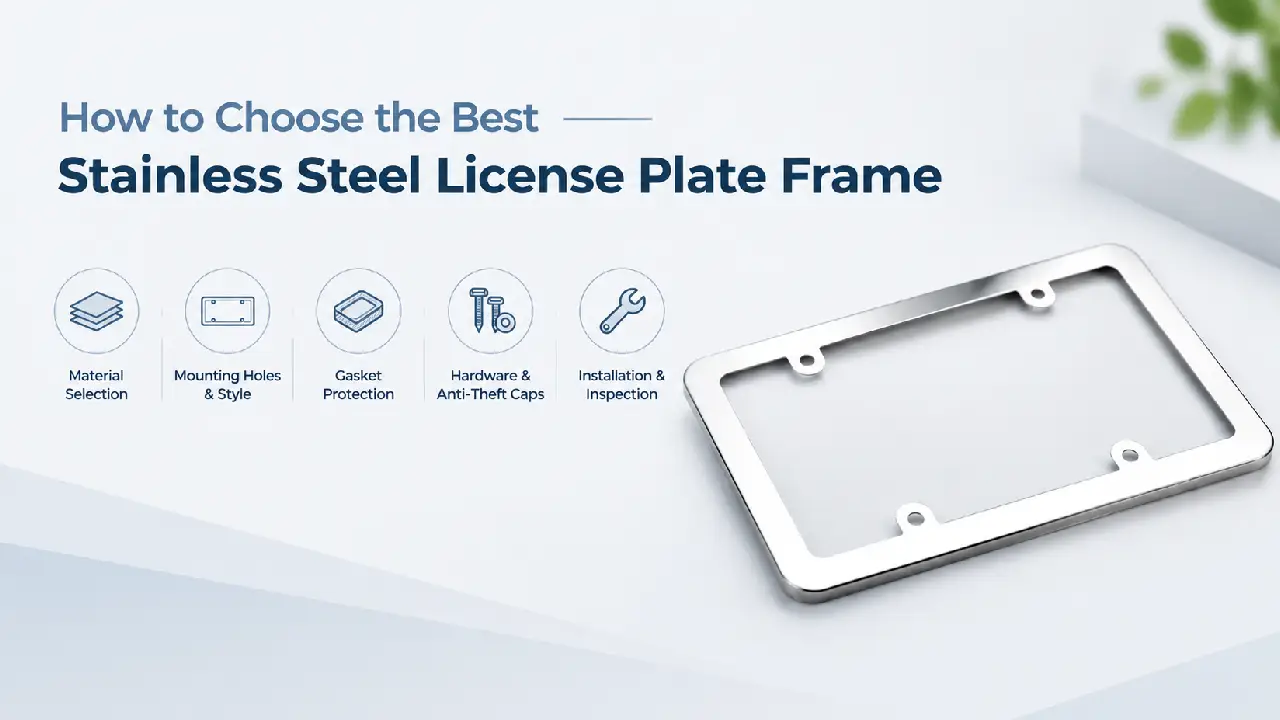
Choosing the best stainless steel license plate frame involves more than selecting a design that looks good. Material quality, mounting-hole alignment, protective accessories, and installation all affect how well the frame performs over time.
Whether you are replacing an existing frame or sourcing products for a dealership, retailer, or private-label brand, following a structured selection process can help you find a suitable solution.
In this guide, we explain what stainless steel license plate frames are and walk through five practical steps to help you choose the right frame and installation accessories.
What Is a Stainless Steel License Plate Frame?
A stainless steel license plate frame is a metal holder designed to secure and surround a vehicle’s license plate. It helps keep the plate in position while providing a finished appearance that complements the vehicle’s exterior.
Compared with some other materials, stainless steel offers a combination of strength, corrosion resistance, and a premium metallic finish. Depending on the design, frames may feature polished, brushed, satin, or other surface finishes.
However, the overall performance of a frame depends on more than its material. Proper fit, mounting hardware, protective components, and installation quality are also important.
Step 1: Check the Mounting Holes and Frame Style
Before selecting a stainless steel frame, confirm that its dimensions and mounting configuration are compatible with your license plate and vehicle.
Check the mounting-hole positions
License plates come in different sizes and mounting configurations across countries and regions. Measure the plate and compare its mounting holes with those of the frame and vehicle.
Pay attention to:
- Plate dimensions: Confirm the width and height of the license plate.
- Mounting-hole alignment: Ensure the holes match the intended mounting points or determine whether suitable adapters are required.
- Plate clearance: Make sure the frame does not cover registration stickers, plate numbers, or other legally required information.
- Vehicle compatibility: Check the available mounting space and whether the vehicle requires specific hardware.
For businesses serving international markets, confirming regional specifications before placing a bulk order can help avoid compatibility problems.
Choose a suitable frame style
Once the fit is confirmed, consider which design best matches the vehicle and intended application.
- Classic style: A straightforward metal border for everyday vehicles.
- Slim-border style: A narrow profile that creates a clean, understated appearance.
- Polished style: A reflective finish for a more premium look.
- Brushed style: A subtle metallic texture suited to modern vehicle styling.
- Custom style: A design that accommodates approved logos, text, or branding requirements.
For dealers and retailers, offering different styles can help address varied customer preferences without compromising basic fit requirements.
Step 2: Select and Verify the Frame Material
The material of a license plate frame affects its durability, corrosion resistance, weight, appearance, and overall cost. While stainless steel is a popular choice for its strength and premium metallic finish, different stainless steel grades and alternative materials offer different advantages.
Before purchasing, consider the environment in which the frame will be used, the desired appearance, and the performance requirements of your application.
Compare Common License Plate Frame Materials
| Material | Corrosion Resistance | Weight | Appearance | Best Suited For |
|---|---|---|---|---|
| 304 Stainless Steel | Good for most general automotive applications | Relatively heavy | Polished, brushed, or satin metallic finishes | Everyday use, premium accessories, and retail products |
| 316 Stainless Steel | Very good, including improved resistance to chloride exposure | Relatively heavy | Similar metallic finishes to 304 stainless steel | Coastal environments and applications with greater salt exposure |
| Aluminum | Generally good, depending on the alloy and surface treatment | Lightweight | Natural metal, brushed, anodized, or coated finishes | Lightweight designs and cost-conscious applications |
| Carbon Steel | Depends heavily on protective coatings and maintenance | Relatively heavy | Can support painted, plated, or coated finishes | Applications where cost and specific construction requirements are priorities |
| Plastic / ABS | Does not rust, but weathering and UV resistance depend on the formulation | Lightweight | Available in many colors, textures, and designs | Economical products, decorative styles, and lightweight frames |
No material is universally best. The right choice depends on the intended application, construction quality, surface treatment, and expected service conditions.
Understanding Stainless Steel Grades
For buyers specifically considering stainless steel license plate frames, the grade is an important part of the material specification.
304 Stainless Steel
Grade 304 is a widely used stainless steel that offers a useful balance of corrosion resistance, strength, and cost. It is suitable for many everyday automotive applications and can support polished, brushed, and other surface finishes.
For general retail products, dealership accessories, and many standard license plate frame designs, 304 stainless steel is often a practical starting point.
316 Stainless Steel
Grade 316 contains molybdenum, which improves its resistance to chloride-related corrosion compared with 304 in many environments. This makes it worth considering for vehicles frequently exposed to coastal air, road salt, or other chloride sources.
However, 316 stainless steel generally costs more. Its additional corrosion resistance should be evaluated against the actual operating environment and purchasing budget.
Other Stainless Steel Grades
Other grades, including 201 stainless steel, may be considered for certain cost-sensitive product designs. However, 201 generally offers lower corrosion resistance than 304, particularly in chloride-rich environments. Its suitability depends on the intended application and required service life.
When comparing grades, do not rely solely on product descriptions or appearance. Ask the manufacturer to confirm the specified grade and provide appropriate material documentation where necessary.
Consider Thickness, Construction, and Surface Finish
Material grade alone does not determine the overall quality of a frame. The following factors should also be evaluated:
- Material thickness: The thickness and frame geometry affect rigidity, weight, and fit. A thicker frame is not automatically better if its design or mounting compatibility is unsuitable.
- Manufacturing quality: Consistent forming, smooth edges, accurate dimensions, and reliable finishing contribute to the quality of the finished product.
- Surface finish: Polished stainless steel provides a reflective appearance, while brushed and satin finishes offer a more understated look. Surface condition and finishing quality can also influence maintenance requirements.
- Corrosion protection: Stainless steel is corrosion-resistant, not completely rust-proof. Surface contamination, salt exposure, and inadequate maintenance can still contribute to corrosion.
- Hardware compatibility: Screws, washers, and other mounting components should be suitable for the frame and intended environment to help reduce corrosion and installation problems.
How to Verify Material Quality Before Purchasing
For individual buyers, reviewing the product specifications and intended application is a useful starting point. For dealerships, distributors, retailers, and private-label brands, material verification becomes especially important when sourcing products in bulk.
Before confirming an order, consider asking the manufacturer:
- Which stainless steel grade is used, and is supporting material documentation available?
- What are the frame thickness, dimensions, and construction specifications?
- Which surface finishes are available, and how consistent are they across production batches?
- Are corrosion-test results or other relevant quality records available?
- Can the manufacturer provide samples for evaluation before mass production?
By evaluating the material grade, construction, finish, and supporting documentation together, you can make a more informed decision and select a frame that matches your durability, appearance, and budget requirements.
Step 3: Choose the Right Gasket for Protection
A gasket is an accessory placed between contacting components, depending on the frame’s design. In a license plate frame assembly, a suitable protective gasket or pad can help reduce direct contact, rattling, and surface abrasion.
This is particularly relevant when a metal frame and license plate are exposed to repeated vibration during driving.
What should you consider when choosing a gasket?
Material compatibility: Select a material suitable for outdoor automotive use, moisture exposure, and the expected temperature range.
Thickness and fit: The gasket should fit the intended contact area without preventing the frame from sitting correctly or interfering with secure mounting.
Protective performance: A properly positioned pad can help reduce metal-to-plate contact and limit movement that may contribute to scratches or paint damage.
Durability: Consider whether the material is resistant to compression, weathering, and deterioration over time.
Not every license plate frame requires a separate gasket. Some designs incorporate protective pads or other contact-reducing features. Check the frame construction before choosing additional accessories.
The goal is to create a secure installation while minimizing unnecessary friction between the frame, plate, and vehicle surface.
Step 4: Use Compatible Stainless Steel Hardware and Anti-Theft Caps
The mounting hardware is another important part of a reliable license plate frame assembly. Even a well-made stainless steel frame can perform poorly if the screws are unsuitable, the fit is loose, or the installation is incorrect.
Choose suitable stainless steel hardware
Stainless steel screws and compatible mounting hardware can help improve corrosion resistance, particularly in wet or salty environments.
When selecting hardware, check:
- Screw length and thread compatibility.
- Compatibility with the vehicle’s mounting points.
- Resistance to corrosion under the intended conditions.
- Whether washers or other protective components are needed.
- The recommended tightening method and torque, where specified.
Avoid overtightening fasteners, as excessive force may deform components, damage the plate, or affect the mounting surface.
Consider anti-theft screw covers
Anti-theft caps or covers can conceal fastener heads and make unauthorized removal more difficult, depending on the design. They can also provide a more finished appearance.
However, not all decorative screw covers offer meaningful theft resistance. If security is a priority, choose a compatible security fastener system rather than relying on appearance alone.
Reduce vibration and potential paint damage
A secure mounting arrangement helps prevent excessive movement of the license plate and frame. When combined with suitable protective pads, properly fitted hardware can help reduce rattling and abrasion around contact points.
Before purchasing a complete accessory set, confirm that the screws, caps, washers, and protective components are compatible with the selected frame and vehicle.
For manufacturers, dealers, and retailers, offering coordinated mounting accessories can also simplify product selection and provide customers with a more complete installation solution.
Step 5: Install the Frame and Inspect the Final Fit
After selecting the frame and accessories, complete the installation and check that every component is properly positioned.
Follow the vehicle manufacturer’s instructions and any installation guidance supplied with the frame.
Installation checklist
1. Prepare the mounting area.
Clean the license plate and mounting surface to remove dirt and debris that could become trapped between components and cause scratches.
2. Position the plate and frame.
Align the license plate with the frame and vehicle mounting points. Check that the frame sits evenly and does not obstruct required information.
3. Install the protective components and hardware.
Position the gasket or protective pads where specified. Fit the screws and any compatible anti-theft caps according to the manufacturer’s instructions.
4. Tighten the fasteners securely.
Tighten the hardware evenly, using the recommended method. Avoid excessive force that could damage the plate, frame, or vehicle mounting surface.
5. Inspect the finished installation.
Check that the frame is stable, the plate is correctly aligned, and no components interfere with required plate visibility. Look for uneven contact, loose hardware, or excessive movement.
6. Recheck after use if necessary.
Follow the manufacturer’s maintenance recommendations and inspect the mounting assembly periodically, particularly if you notice rattling or looseness.
For a more detailed walkthrough, refer to our [license plate frame installation guide] for additional installation instructions and fitment considerations.
Final Thoughts
Choosing the best stainless steel license plate frame is a process that begins with compatibility and ends with a properly installed assembly.
First, check the mounting holes and select a suitable design. Next, verify the stainless steel grade and construction. Then consider the right gasket, compatible stainless steel hardware, and appropriate anti-theft covers. Finally, install the components correctly and inspect the finished fit.
These steps help you evaluate not only the frame itself but also the accessories that contribute to a stable, well-finished installation.
For dealerships, retailers, distributors, and private-label brands, the same principles can guide product sourcing. Confirm material specifications, mounting compatibility, accessory options, and quality-control requirements before committing to a larger order.
A well-selected frame, paired with compatible protective components and properly installed hardware, can provide a more durable and professional result.