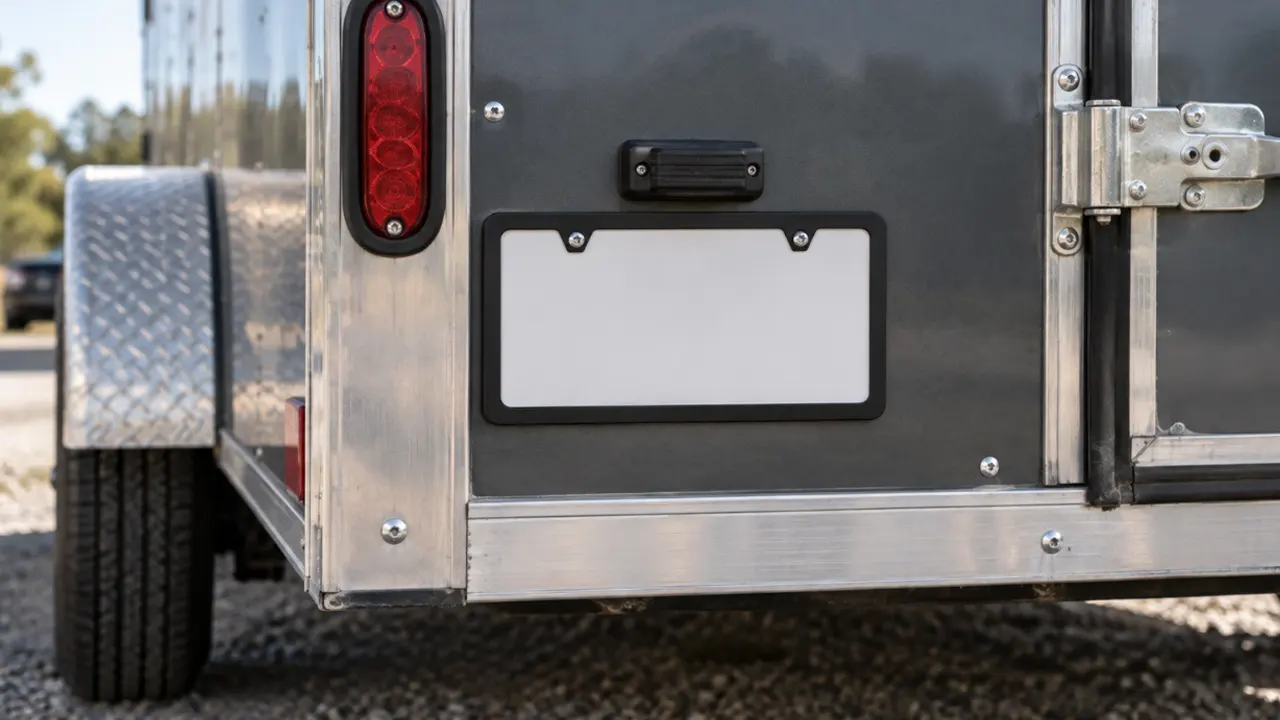
A good trailer license plate frame fits the plate without covering its identifying information, works with the existing bracket and plate light, and stays secure through vibration, spray, and road debris. Start by inspecting the mounting point. If the trailer has only a thin tab below the tail light, you may need a supporting bracket first; a decorative frame alone is not meant to carry the plate.
That distinction saves a lot of frustration. A frame borders the plate and may add edge support or a finished look. A holder or bracket connects the plate to the trailer. Some assemblies combine the bracket, frame, and light, but the three jobs are still different.
First, Identify What Is Already on the Trailer
Look behind the plate before shopping. You may find a metal tab attached to the trailer body, a flexible plastic bracket hanging below the left tail light, or a molded holder with an integrated lamp. Check for cracks, enlarged holes, rust around fasteners, loose wiring, and contact marks from a ramp or tailgate.
If the mounting piece moves independently of the plate, the bracket—not the frame—is probably the weak point. Replace or reinforce that part before adding a new frame. The comparison between a license plate frame and license plate holder is useful when the existing assembly is hard to identify.
Measure the Plate, Holes, Opening, and Mounting Surface
Do not rely on a “standard” label by itself. Measure the actual plate width and height, the center-to-center distance between mounting holes, and the flat area available around the plate. Trailer plates and mounting arrangements can differ by jurisdiction and trailer type.
- Plate dimensions: The outer frame must accept the plate without forcing or bowing it.
- Hole spacing: Frame slots or holes must align with both the plate and supporting bracket.
- Visible opening: The inner edge should leave the serial, state name, stickers, and other required information visible.
- Rear clearance: Nuts and screw ends need room behind the bracket.
If you are unsure where to take the measurements, use the mounting-hole spacing reference together with the broader license plate frame size guide.
Check the Plate Light Before Choosing a Border
Many trailers illuminate the plate from a clear lens on the bottom or side of a tail light. A thick top border, tall raised lettering, or a frame mounted at the wrong height can block part of that beam. Turn on the running lights after dark and look at the whole plate, not just the lamp.
In the United States, federal vehicle lighting rules include rear registration-plate illumination requirements for trailers. State display rules can add their own conditions. Treat the original light position as a functional part of the mount rather than an empty space available for decoration.
Match the Frame to the Trailer’s Working Environment
| Trailer use | Common exposure | Useful frame priorities |
| Utility or landscape trailer | Vibration, gravel, loading impacts | Low profile, secure hardware, clearance from ramps and gates |
| Enclosed cargo trailer | Highway spray, long trips, door movement | Flat mounting, readable opening, light clearance |
| Travel trailer | Weather, storage, rear accessories | Corrosion-conscious hardware and clearance from cameras or ladders |
| Boat trailer | Repeated water exposure | Drainage, compatible materials, easy inspection after launching |
A rigid frame can make a plate feel more finished, but stiffness is not always the only goal. On a very low mount, a little flexibility in the supporting bracket may help it survive contact that would permanently bend a rigid metal tab. Keep the frame inside the trailer’s rear profile where practical.
Choose a Material Without Relying on One-Word Claims
Plastic
Plastic frames are light and do not create red rust. They can be a sensible choice on a flexible trailer bracket, but their performance depends on resin, section thickness, UV exposure, temperature, and molding quality. Check screw areas for cracking and do not overtighten them.
Aluminum
Aluminum keeps weight low and does not rust like ordinary steel. Its surface can still stain, oxidize, or react at contact points in harsh environments. Thin aluminum frames may bend if they hang below the tail light or are struck during loading.
Stainless Steel and Coated Steel
These materials can provide a firm border, but the finish, edges, fasteners, and contact with other metals matter. A “stainless” description does not tell you the grade, while a coating only protects the areas it continues to cover. Inspect chips and fastener holes rather than assuming any metal is maintenance-free.
Use Hardware That Stays Tight Without Damaging the Mount
Trailer vibration works on every joint. Use fasteners that match the hole diameter and leave enough thread engagement for the selected nut or insert. Washers can spread load over a thin bracket. A locking nut, prevailing-torque fastener, or suitable thread-locking method may help where the assembly permits it, but it should still be serviceable when the plate must be renewed or replaced.
Do not tighten a frame until it bows. Tighten evenly, confirm the plate cannot rattle, and recheck it after the first few trips. The same practical checks used to prevent loose license plate frame screws apply especially well to trailers.
Check Clearance Through the Trailer’s Full Range of Use
A frame that looks fine in the driveway may collide with a fold-down ramp, swing door, stabilizer, spare-tire carrier, or loading equipment. Move each component through its normal range. Also look at departure angle: a plate mounted below the frame rail can be the first part to touch a steep driveway.
For a tilt trailer, confirm the plate and light remain clear while the bed tilts. For a dump trailer, check the bed, tailgate, and wiring in both positions. If the mount must move, support the wiring so it is not pulled by the plate assembly.
A Practical Pre-Purchase Checklist
- Confirm whether you need a frame, a structural bracket, or a combined holder and light.
- Measure the plate, mounting holes, visible opening, and space behind the mount.
- Check that the border will not cover plate text, stickers, or the illumination path.
- Choose material and hardware for the trailer’s actual exposure, not just its appearance.
- Cycle ramps, doors, tilt beds, and accessories to find collision points.
- Install without bending the plate or crushing the frame, then test the running lights.
- Recheck tightness, cracking, and visibility after the first trip and during routine light checks.
Frequently Asked Questions
Can I use a car license plate frame on a trailer?
You can if the actual plate dimensions, hole spacing, visible opening, mounting surface, and light clearance all match. The word “car” or “trailer” on a listing is less reliable than those measurements.
Does a trailer frame need an integrated light?
Not necessarily. If the existing plate lamp illuminates the full plate and the new frame does not block it, a separate lighted frame may add needless wiring. Use a combined assembly when the mounting design or replacement need calls for one.
Should a trailer plate frame use two screws or four?
Use the secure mounting points the plate and bracket actually provide. Four points can reduce movement when the bracket supports them, but drilling extra plate or trailer holes without confirming the design and local rules is not a good shortcut.
Why does my trailer license plate keep bending?
The usual causes are a low or unsupported bracket, contact with ramps or road surfaces, loose fasteners, and repeated vibration. A stronger decorative frame will not solve a badly positioned or cracked bracket.
How wide can the border be?
Wide enough to support the edge, but not so wide that it covers the plate’s readable information or registration stickers. Compare the frame’s opening with the exact plate design and the rules where the trailer is registered and used.