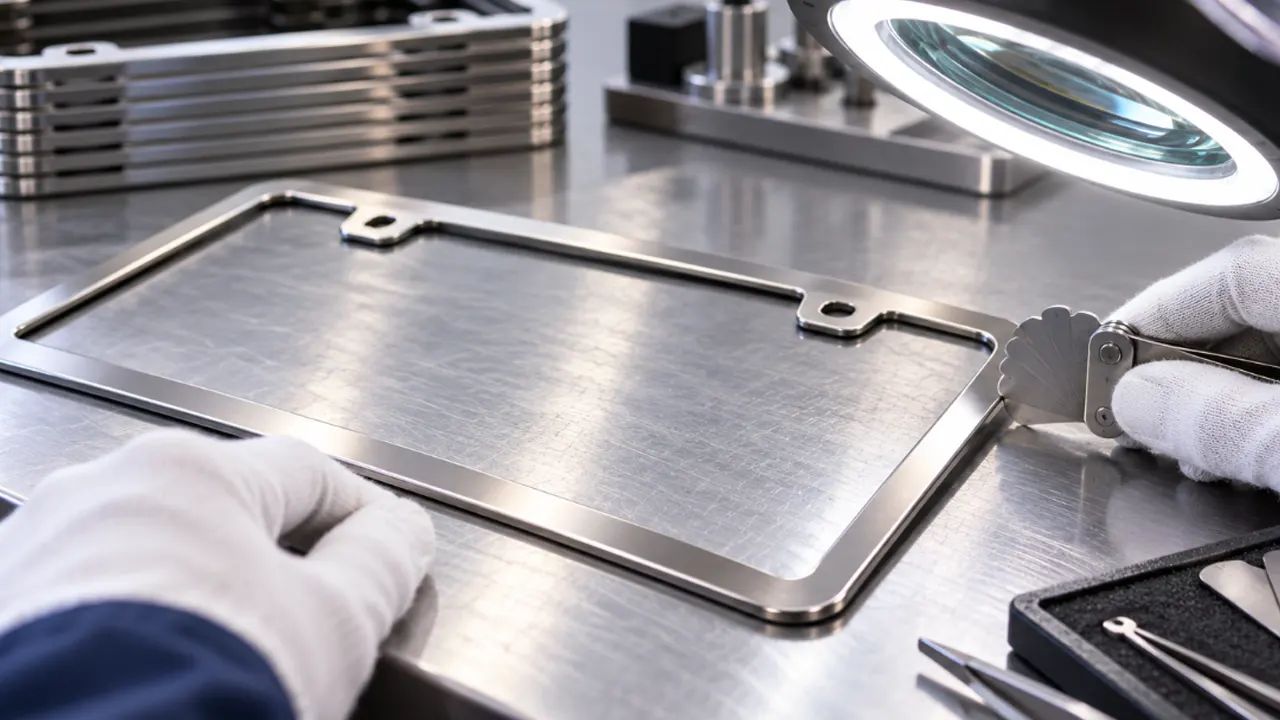
A license plate frame edge sharpness inspection should cover every place a person, plate, cloth, wire, or vehicle surface can contact: outer corners, inner opening, mounting holes, stamped cut edges, molded parting lines, gate vestiges, raised lettering, and plating buildup. Visual inspection alone can miss a thin burr that catches skin or scratches paint.
The acceptance rule needs to separate a functional edge from a hazardous or damaging one. “No sharp edges” is a good design goal but a weak inspection instruction unless the drawing or quality plan defines edge break, burr, flash, radius, comparator, gauge, or approved sample.
Different Processes Create Different Edge Risks
| Process or feature | Typical edge concern | Where to look |
|---|---|---|
| Stamped metal | Cutting burr, rollover, sharp corner, secondary distortion | Inner opening, outer profile, holes, and tool exit side |
| Injection-molded plastic | Parting-line flash, gate vestige, ejector damage, brittle corner | Perimeter, clips, holes, and decorative features |
| Machined or laser-cut metal | Unbroken edge, dross, recast or rough cut area | Profiles, slots, holes, and engraving |
| Plated or coated frame | Nodules, flaking edge, coating bridge, exposed base edge | Corners, recesses, hanging points, and holes |
| Raised letters or inserts | Sharp tips, proud seams, incomplete seating | Logo perimeter and attachment points |
The articles on stamped metal frames and injection-molded plastic frames help trace an edge defect back to the relevant process without assuming every frame is made the same way.
Start With Controlled Visual Inspection
Use clean samples and consistent lighting. Rotate the frame so light rakes across the edge; thin flash and metal burrs are often easier to see by shadow than straight-on viewing. Magnification can help classify a defect, but the inspection plan should state when it is required.
Mark the defect location and identify whether it is on the front, back, inner opening, outer perimeter, or mounting feature. Check both sides of stamped holes and cutouts. A smooth show surface can hide a sharp rear edge facing the vehicle.
Use Touch Carefully and Consistently
A light gloved sweep can screen for snags, but bare-finger testing risks injury and varies by operator. Do not drag skin along an unknown metal edge. Use an approved tactile medium, swab, cloth, or standardized sharp-edge tester when the specification calls for it.
UL 1439 defines a procedure for evaluating the injury potential of sharp edges on equipment. It does not automatically apply to every license plate frame, but a customer may invoke it or adapt a controlled sharp-edge method. Record the exact edition and test procedure instead of writing only “UL edge test.”
Define Burr, Flash, and Edge Break Separately
A burr is displaced material at an edge, often from cutting or machining. Flash is excess material along a mold split or gap. Edge break or radius describes intentional removal or rounding. They should not share one vague limit.
The drawing can specify a maximum burr or flash where measurement is practical, a minimum radius on exposed corners, and removal of loose or projecting material. Cosmetic surfaces may also need a visual standard. Keep safety, fit, and appearance criteria distinct so rework targets the real problem.
Inspect the Inner Opening for Plate Damage
The inner border sits closest to the license plate’s reflective or printed surface. A burr, rough plating edge, or hard flash line can scratch the plate as the assembly vibrates. Check the full perimeter, especially corners and retention tabs.
Confirm the frame opening also leaves required plate information visible. The opening-size specification protects visibility, while edge inspection protects handling and contact surfaces.
Mounting Holes Need a Separate Check
Sharp hole edges can shave plastic from a washer, cut a coating, damage a screw cap, or start a crack. Inspect slot ends, countersinks, rear burrs, and any plating buildup that narrows the opening. Run the correct gauge or production fastener through the hole only if the method permits it.
Do not remove a burr by forcing the screw through. That creates uncontrolled debris and can hide the original defect. Rework should use an approved deburring or trimming process followed by finish and dimension checks.
Check After Every Process That Can Recreate a Sharp Edge
Deburring before coating is not the final answer if plating creates nodules, paint bridges a slot, trimming exposes a brittle edge, or assembly leaves a protruding insert. Inspect the finished part at the stage the customer receives it.
Durability tests can create new sharpness as well. Cracked plastic, peeling plating, or fractured decoration after vibration or temperature cycling should trigger another edge inspection even if the original sample passed.
Write a Reproducible Acceptance Rule
A complete rule identifies the accessible edge, allowed burr or flash, required radius or edge break where applicable, test medium or gauge, force and motion when standardized, and visual standard. It should also name areas where a crisp functional edge is allowed because it cannot be contacted in normal handling.
Record defect type, location, extent, sample identity, inspection method, lighting or magnification where controlled, and disposition. Photos should include scale and orientation.
Common Inspection Mistakes
- Checking only the front show surface.
- Using bare fingers as the sole acceptance tool.
- Calling mold flash, metal burr, and rough coating the same defect.
- Inspecting before plating, painting, trimming, or assembly but not after.
- Ignoring inner edges that can rub the plate or vehicle.
- Reworking an edge without rechecking dimensions and finish protection.
Frequently Asked Questions
Can a visually smooth edge still be too sharp?
Yes. A thin burr or small-radius metal edge may be hard to see. Use the defined tactile or gauge method for critical accessible edges.
Should every edge be rounded?
No. Some edges define fit, decoration, or retention. The design should remove injury and damage risks without destroying the feature’s function.
Does coating make a sharp edge safe?
Not reliably. Coating may reduce the immediate feel, but it can be thin, damaged, or bridged over a burr. Control the underlying edge and inspect the finished condition.
Is UL 1439 mandatory for license plate frames?
Not automatically. It is a recognized sharp-edge test for equipment and may be required by a customer or product program. Use it only when contractually or technically appropriate.