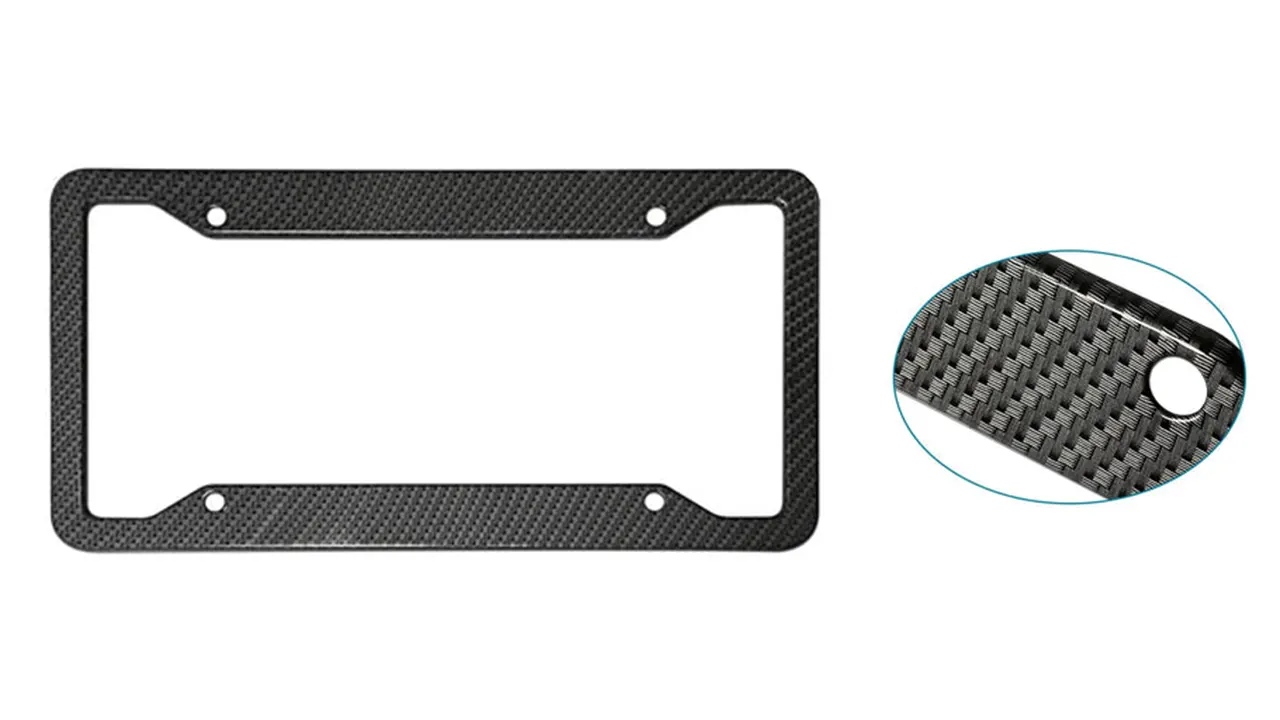
A clip-on license plate frame should not be designed around one assumed plate thickness. It needs a verified retention window: the thinnest finished plate stack it can hold without rattle or escape, and the thickest stack it can accept without excessive assembly force, whitening, cracking, or permanent clip deformation.
That answer is different from the thickness of the frame itself. If you are specifying the border section, rear channel, or installed projection, use the separate license plate frame thickness guide. Here, the subject is the plate edge captured by an integral clip, snap strip, or retaining lip.
“Plate thickness” can describe several measurements
The nominal sheet or substrate thickness is only the starting point. A clip may touch the finished edge, an embossed area, a laminate, or a stack that includes more than the plate. Define the measurement before you put a number on a drawing.
| Measurement | What it includes | Why it matters to the clip |
|---|---|---|
| Substrate thickness | The metal or plastic base before finished surface layers and local forming | Useful material information, but it may not equal the captured stack |
| Finished flat-area thickness | Substrate plus reflective sheeting, print, laminate, or other specified layers | Relevant when the clip bears on an unformed flat edge |
| Local edge thickness | The actual section at the clip contact point, including edge roll or burr condition | Often the most useful value for a retaining channel |
| Embossed height | Raised characters or features relative to the plate field | Important only if the frame or clip crosses those features |
| Installed stack thickness | Plate plus any cover, insert, protective film, backing, or decorative layer that remains in use | The clip must accept the complete approved stack, not the bare plate alone |
Temporary shipping film should be identified separately. If installers are expected to remove it, do not quietly use the film to make a loose clip pass a fit check.
There is no single U.S. plate-thickness value
U.S. passenger plates commonly share a 12-by-6-inch envelope, but dimensions and substrate specifications do not make every finished plate edge identical. Jurisdictions control their own plate construction, and specialty, temporary, vanity, motorcycle, older, and replacement plates can introduce more variation.
An official example makes the point. Ohio’s license plate specification, effective August 1, 2026, allows aluminum substrate between 0.022 and 0.032 inch, with the tolerance stated in the rule. It separately specifies galvanized steel at 0.019 inch plus or minus 0.003 inch. Those are Ohio substrate requirements—not a universal U.S. clip dimension, and not automatically the finished edge thickness after reflective sheeting and forming.
If your program covers more than one state or country, collect representative production plates from that actual market. A size chart can help you choose the frame envelope; it cannot replace thickness samples. Use the license plate frame size guide for envelope and hole-pattern planning.
Specify a retention window, not a favorite nominal
Let Tmin be the thinnest approved plate stack at the clip contact point and Tmax the thickest. The clip, channel, and frame tolerances must work across that entire range. You also need room for molding variation, part conditioning, surface texture, and any wear expected during assembly.
| Fit condition | What you may observe | Likely design concern |
|---|---|---|
| Plate stack below the useful retention range | Rattle, edge movement, incomplete hook engagement, or escape under handling | Too much free gap, too little undercut, poor contact location, or excessive part variation |
| Plate stack inside the validated range | Controlled assembly force, full seating, stable retention, and no harmful residual distortion | Target condition |
| Plate stack above the useful range | High insertion force, stress whitening, clip not fully seated, cracking, bowing, or permanent set | Insufficient clearance or deflection capacity, sharp clip root, unsuitable material, or tolerance stack too tight |
A snap feature is a spring, not just a gap. Its arm length, root thickness, taper, fillet, hook geometry, resin behavior, surface friction, and expected number of assembly cycles all affect how far it can move and how strongly it returns. A dimension that fits in CAD can still be unpleasant to assemble or unreliable after heat exposure.
Measure where the clip actually captures the plate
- Mark every clip contact point on the frame or holder.
- Measure production plates at those locations, not only at the center of a flat test coupon.
- Separate substrate, finished flat area, rolled edge, embossed region, and any approved add-on layers.
- Sample multiple plates, lots, ages, and target jurisdictions. Record the observed minimum and maximum rather than only the average.
- Use a measuring method that does not flatten a soft layer or bridge over local features. Define tool, contact faces, force, and measurement points on the inspection instruction.
If the clip captures a rolled or formed edge, a simple sheet micrometer reading away from that edge is not enough. Likewise, a thick embossed character does not matter if every clip is safely outside the character field.
Turn the measurements into a mold-ready requirement
The part drawing should identify the nominal channel or throat geometry, clip undercut, contact land, lead-in angle, clip root, draft, and the datums used to inspect them. It should also state the tested Tmin-to-Tmax plate range and the condition of the test samples.
Do not subtract the nominal plate thickness from the nominal opening and call the remainder “clip pressure.” Real performance depends on the full tolerance stack and how the clip deflects. The resin grade matters too: stiffness, strain capability, creep, moisture response, and temperature behavior can change the feel and retention of the same geometry.
Review those decisions before cutting final steel. The license plate frame mold design guide explains how gates, cooling, shrinkage, parting lines, and ejection can move a clip away from its drawing intent.
Validate the complete retention system
A useful approval plan includes the extreme plate samples and production-equivalent molded frames. Test the assembly as a customer would use it, then inspect the clip rather than judging only whether the plate stayed in place for a few minutes.
- Measure insertion and removal behavior at Tmin, nominal, and Tmax.
- Confirm every clip reaches its intended seated position.
- Check retention after handling, vibration, and the relevant hot and cold conditioning.
- Look for whitening, cracks, root damage, permanent opening, plate scratching, and frame bow.
- If the system is reusable, repeat the specified number of assembly and removal cycles.
- Test wet, dusty, or contaminated conditions when they reflect the real application.
- Inspect across mold cavities and production lots, not only one hand-selected part.
Set acceptance criteria before testing. “Easy to install” and “holds well” are observations, not measurable requirements. Depending on the application, you may specify an insertion-force range, a pull-off or displacement test, complete visual seating, maximum permanent opening, or a go/no-go plate gauge. The actual values must come from the validated product and market; they should not be copied from an unrelated clip.
Common failures and what they usually mean
The plate rattles after it snaps in
The captured stack may be below Tmin, the contact points may be too far apart, or molding variation may have opened the channel. Check the real free gap and hook engagement before adding foam as a patch.
The clip turns white during assembly
Stress whitening is a warning that local strain may be too high for the material and geometry. Review the required deflection, clip length and taper, root radius, surface interference, and actual Tmax plate.
The first samples fit, but later parts do not
Compare cavities, resin and conditioning, mold temperature, cooling, part storage, and dimensional measurement. A long frame can change shape as it cools, moving several clip locations at once.
The plate is secure but difficult to remove
The separation angle or access to the release feature may not suit a serviceable product. Decide early whether the frame is intended for one-time assembly or repeated access, then validate the correct cycle requirement.
What buyers should send with an RFQ
- target countries, jurisdictions, plate types, and vehicle categories;
- physical examples representing the thinnest and thickest expected finished stacks;
- defined clip contact locations and required plate insertion direction;
- whether assembly is permanent, occasionally serviceable, or frequently reusable;
- target resin grade or performance requirements;
- acceptable insertion, retention, removal, and cosmetic criteria;
- environmental and cycle tests relevant to the sales channel;
- packaging and instructions that prevent clip damage before installation.
If you are developing a clip-on frame or European-style retaining holder, send those inputs through the Xingchang project inquiry page. Real plate samples are especially valuable when the target market includes more than one construction.
Frequently asked questions
What is the standard license plate thickness for a clip-on frame?
There is no single thickness that safely represents every U.S. plate or finished stack. Define the target market, measure the captured edge on real plates, and approve a Tmin-to-Tmax retention range.
Should the clip touch the plate tightly at all times?
It should retain the plate within the approved conditions without damaging it or leaving harmful residual stress in the clip. Zero visible clearance by itself is not proof of a sound design.
Can I design the clip from substrate thickness alone?
Not reliably. Reflective sheeting, laminates, formed edges, embossing, and add-on layers may change the local captured stack. Measure where the clip actually bears.
Do thicker clips hold thicker plates better?
Not automatically. Clip thickness changes stiffness and strain, but arm length, taper, root radius, undercut, material, and required deflection work together. A thicker arm can raise assembly force and local stress.
Can one clip design cover U.S. and European plates?
Only after the complete frame envelope, plate construction, edge geometry, installation method, and retention range have been verified for both applications. Similar clip ideas do not guarantee interchangeable products.