Vermont law requires number plates to be kept entirely unobscured, with their numerals and letters plainly legible at all times. The statute does not name decorative frames, but its display rule leaves little room for a border that overlaps the plate. Keep the whole plate face clear, mount it horizontally, and fasten it so it does not swing.
The rule in 23 V.S.A. §511
Section 511 says a vehicle must display one or two plates as the Commissioner requires. A plate must be securely attached, kept entirely unobscured, and have numerals and letters that remain plainly legible. It must also stay horizontal and be fastened so it does not swing, subject to a specific exception for certain truck or truck-tractor devices designed to move on impact and return to position.
The same section gives a separate display rule for temporary and in-transit plates: they must be horizontal, conspicuous, entirely unobscured, and legible. If you are using a temporary tag, do not assume a frame that fits a metal plate will also fit the temporary document or its display holder.
Does Vermont ban license plate frames?
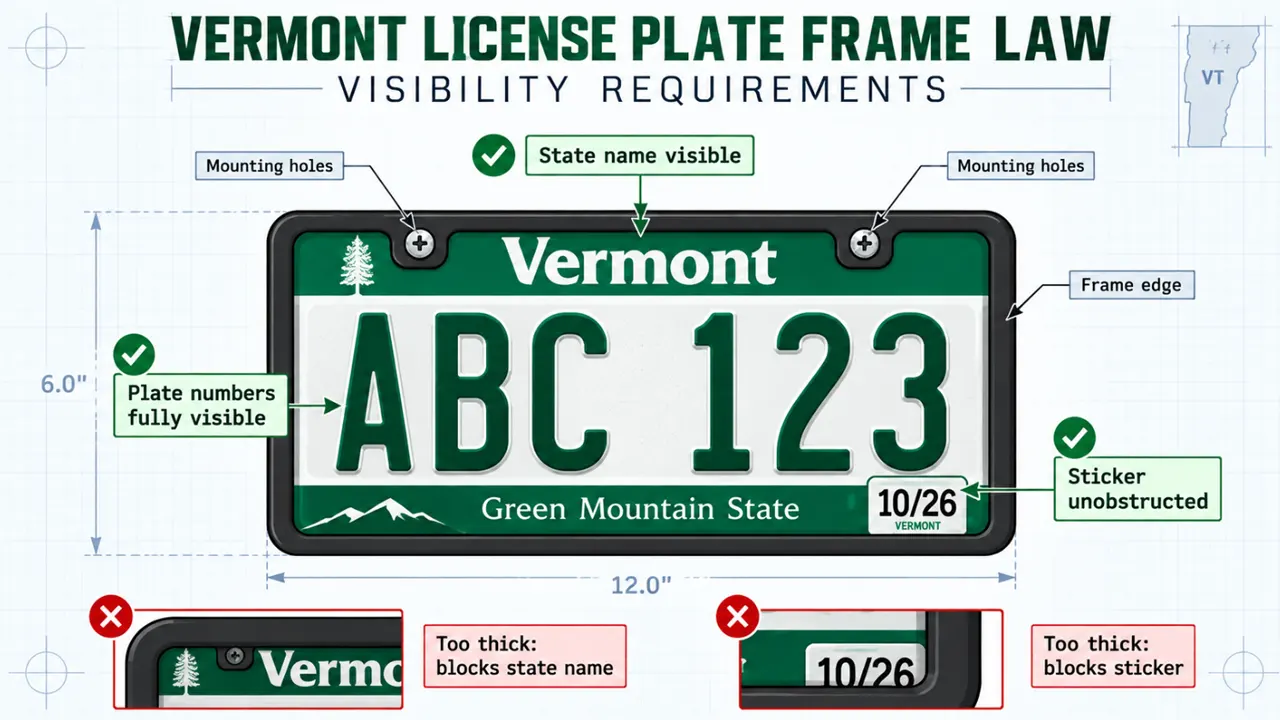
The statute does not use the word “frame” or impose a statewide frame-width limit. Instead, it sets a result: the plate must be entirely unobscured. A frame that stays outside the plate face may meet that display condition, but one that covers even part of a letter or number conflicts with the plain wording of §511.
Don’t judge only by the registration number. A frame can cover the state name, a slogan, or other plate artwork even when the serial remains readable. Section 511 expressly calls out numerals and letters and says the plate must be entirely unobscured, so the low-risk choice is to keep all printed and stamped content in view.
Check the frame and mounting position together
Put the frame on the exact plate you use and check the full perimeter. Confirm there is no overlap at the top or bottom, the plate sits horizontally, and tightening the screws does not pull the border inward. If the frame has raised corners, caps, or a logo bar, inspect those details too.
Then check how the plate sits on the vehicle. It should be conspicuous and securely fastened. A recessed mount, bumper lip, hitch accessory, or loose bracket can block the plate even when the frame opening itself is clear. If your plate can swing or tilt, fix the mounting point rather than adding more force to the frame screws.
Temporary tags need the same attention
Vermont’s §511(e) says temporary and in-transit plates must be displayed horizontally in a conspicuous place at the rear, including in the rear window, and kept entirely unobscured with their letters and numbers plainly legible. A temporary tag is often paper or another printed format, so a metal-frame solution may be inappropriate. Follow the issuing dealer’s or DMV’s display instructions and keep the full tag visible.
Choosing a frame for a Vermont plate
Check the inner opening against the plate’s actual printed area, not just its outside dimensions. State and specialty designs can place words and graphics close to the edge. A thin border may reduce the chance of overlap, but it is the installed clearance—not the marketing label—that matters.
If you are looking at U.S. license plate frame options, compare the exact opening and hole placement with your plate and mounting points. For a state-by-state perspective, see our license plate frame visibility overview.
Before you drive
- Read every letter and number without a frame edge crossing it.
- Check the state name and other plate markings for overlap.
- Make sure the plate is horizontal, firmly attached, and does not swing.
- For a temporary tag, follow its specific display instructions and keep the entire tag visible.
Common questions
Are license plate frames illegal in Vermont?
Vermont’s law does not mention frames by name, but §511 requires plates to be entirely unobscured and legible. A frame that overlaps letters, numbers, or other plate details is not consistent with that requirement.
Can a frame cover the state name if the number is visible?
Keep the state name and the rest of the plate design clear. The statute’s “entirely unobscured” language makes partial coverage a poor choice even when the assigned number can still be read.
Does Vermont require plates to be horizontal?
Yes. Section 511 says plates must be kept horizontal and fastened so they do not swing, with a narrow exception for certain truck or truck-tractor devices designed to move on impact and return to position.
Can you put a frame around a temporary Vermont plate?
Section 511(e) requires a temporary or in-transit plate to remain entirely unobscured and plainly legible. Use only a holder that does not cover the tag and follow the issuing authority’s display instructions.