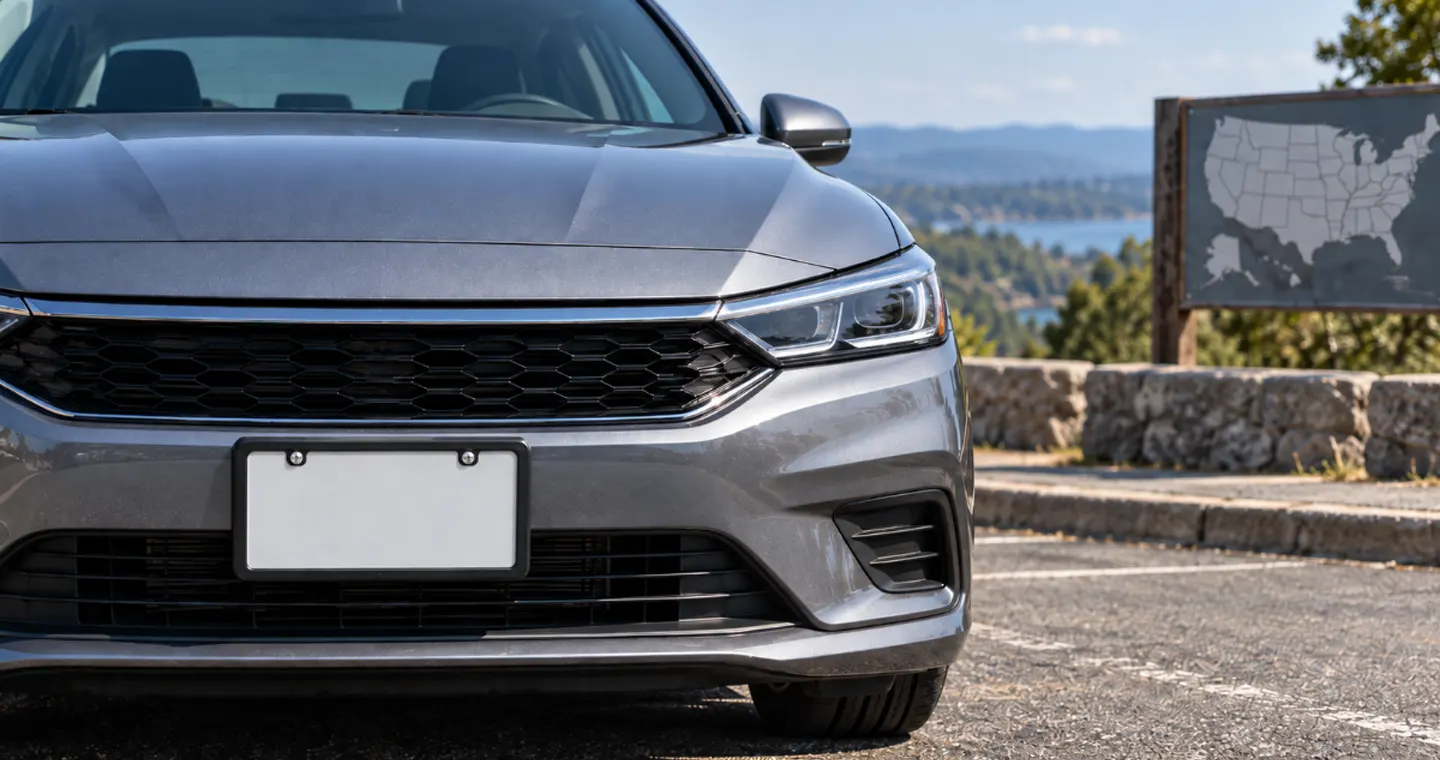
As of September 18, 2026, 28 states generally require a front and rear license plate on ordinary passenger vehicles. The other 22 states generally issue or require only a rear plate. Washington, D.C. also requires two current tags.
That headline needs one important qualification: a few two-plate states make exceptions when the vehicle was not built with a front bracket or another practical mounting point. Idaho, Nevada, Rhode Island, Washington, and Wyoming are the states where the vehicle’s original design deserves especially close attention.
If your vehicle is registered in a state marked “Front and rear” below, install the front plate unless a specific statutory or agency-approved exception applies to your vehicle. A dashboard plate is not a safe substitute for a properly mounted exterior plate.
Front License Plate Requirements by State
The table covers the usual rule for a privately owned passenger car. Motorcycles, trailers, apportioned trucks, historic vehicles, dealer plates, temporary registrations, and some specialty registrations can follow different rules.
| State | Usual passenger-car rule | Practical note |
|---|---|---|
| Alabama | Rear only | Ordinary passenger vehicles display one plate at the rear. |
| Alaska | Rear only | Alaska now issues one plate for most vehicles; older two-plate sets do not create a current front-display requirement. |
| Arizona | Rear only | The standard plate is mounted at the rear. |
| Arkansas | Rear only | The general display rule places the plate at the rear. |
| California | Front and rear | When two plates are issued, one belongs at the front and one at the rear. |
| Colorado | Front and rear | Two plates are required for ordinary passenger vehicles. |
| Connecticut | Front and rear | Both plates must remain visible and unobscured. |
| Delaware | Rear only | The registration plate is generally attached at the rear. |
| Florida | Rear only | Passenger vehicles generally display one plate at the rear. |
| Georgia | Rear only | The standard plate is displayed at the rear. |
| Hawaii | Front and rear | Most passenger vehicles receive and display two plates. |
| Idaho | Front and rear, conditional | The front plate requirement applies when the vehicle is equipped with a front plate bracket. |
| Illinois | Front and rear | Both plates are required on ordinary passenger vehicles. |
| Iowa | Front and rear | Display one plate at each end of the vehicle. |
| Kansas | Rear only | Most passenger vehicles receive a single plate. |
| Kentucky | Rear only | The plate is fastened at the rear in a visible position. |
| Louisiana | Rear only | Ordinary passenger vehicles display one plate at the rear. |
| Maine | Front and rear | One plate is displayed at the front and one at the rear. |
| Maryland | Front and rear | Most passenger vehicles must display both plates. |
| Massachusetts | Front and rear | Vehicles issued two plates must display both. |
| Michigan | Rear only | Michigan issues one plate and generally places it at the rear. |
| Minnesota | Front and rear | Two plates are the general rule, subject to listed statutory exceptions. |
| Mississippi | Rear only | Ordinary passenger vehicles display one plate at the rear. |
| Missouri | Front and rear | Missouri still requires two plates for most passenger vehicles; online claims of a 2026 switch are not reflected in the current statute. |
| Montana | Front and rear | Display one plate at the front and one at the rear unless a statutory exception applies. |
| Nebraska | Front and rear | Two plates remain the present rule. A one-plate system is scheduled to begin no later than January 1, 2029. |
| Nevada | Front and rear, conditional | A front plate is not required when the vehicle was not designed for a front bracket and the manufacturer provides no other means of attachment. |
| New Hampshire | Front and rear | Two plates remain the general passenger-vehicle rule. |
| New Jersey | Front and rear | Standard passenger vehicles display both plates. |
| New Mexico | Rear only | The state issues a single plate for most passenger vehicles. |
| New York | Front and rear | Number plates must be displayed at the front and rear. |
| North Carolina | Rear only | North Carolina generally issues one plate for a passenger vehicle. |
| North Dakota | Front and rear | Both plates are the general rule for passenger vehicles. |
| Ohio | Rear only | Ohio has required only a rear plate since July 1, 2020. |
| Oklahoma | Rear only | Passenger-vehicle plates are firmly affixed at the rear. |
| Oregon | Front and rear | Two plates are required for most passenger vehicles. |
| Pennsylvania | Rear only | Standard passenger registrations use one rear plate. |
| Rhode Island | Front and rear, conditional | Since June 26, 2026, qualifying vehicles manufactured and delivered without a front bracket or mounting point may omit the front plate if the second plate is carried in the vehicle. |
| South Carolina | Rear only | The plate is attached horizontally at the rear. |
| South Dakota | Front and rear | Passenger vehicles generally display both plates. |
| Tennessee | Rear only | Passenger-car plates are attached at the rear; some truck categories follow different placement rules. |
| Texas | Front and rear | Most passenger vehicles must display a plate on the front exterior and another at the rear. |
| Utah | Rear only | Utah moved to a single rear plate on January 1, 2025. |
| Vermont | Front and rear | Most passenger vehicles display two plates. |
| Virginia | Front and rear | Both plates are required and must remain visible. |
| Washington | Front and rear, limited exception | The state requires two plates, but the patrol may grant an exception when the vehicle’s body construction makes front attachment impossible. |
| West Virginia | Rear only | The registration plate is attached at the rear. |
| Wisconsin | Front and rear | When two plates are issued, both must be attached. |
| Wyoming | Front and rear, conditional | A vehicle originally manufactured without a front bracket, device, or other means of attachment can qualify for an exception. |
The 22 Rear-Plate-Only States
If you want the short list, these states generally require only a rear plate on an ordinary passenger vehicle:
Alabama, Alaska, Arizona, Arkansas, Delaware, Florida, Georgia, Indiana, Kansas, Kentucky, Louisiana, Michigan, Mississippi, New Mexico, North Carolina, Ohio, Oklahoma, Pennsylvania, South Carolina, Tennessee, Utah, and West Virginia.
“Rear only” does not mean the plate can sit anywhere. States still regulate visibility, orientation, lighting, secure attachment, and obstruction. A plate tucked behind dark plastic, bent around bodywork, or partly hidden by a frame can still attract a stop even when no front plate is required.
The 28 States That Generally Require Two Plates
The usual front-and-rear group is:
California, Colorado, Connecticut, Hawaii, Idaho, Illinois, Iowa, Maine, Maryland, Massachusetts, Minnesota, Missouri, Montana, Nebraska, Nevada, New Hampshire, New Jersey, New York, North Dakota, Oregon, Rhode Island, South Dakota, Texas, Vermont, Virginia, Washington, Wisconsin, and Wyoming.
That count treats conditional front-plate states as two-plate states because two plates remain the default. It does not mean every vehicle in those states must accept a drilled bumper mount.
Five States Where the Vehicle Design Can Change the Answer
Idaho
Idaho ties the front-display rule to whether the vehicle is equipped with a front license plate bracket. Do not remove a factory bracket and assume the exception now applies; the statutory wording focuses on the vehicle’s equipment.
Nevada
Nevada’s exception is narrower than “my bumper has no holes.” It applies when the vehicle was not designed for a front bracket and the manufacturer provides no other means of attaching the front plate. A model-specific tow-eye or grille mount may therefore matter.
Rhode Island
Rhode Island changed its rule in 2026. A qualifying vehicle manufactured and delivered without a front bracket or mounting point may run without the front plate, but the rear plate must be attached and the second plate must stay in the vehicle for inspection on demand. The exemption is not a blanket one-plate rule.
Washington
Washington law allows an exception when the state patrol determines that the body construction makes compliance impossible. That is different from a driver deciding that a front plate is unattractive or inconvenient.
Wyoming
Wyoming recognizes vehicles originally manufactured without a front bracket, front plate device, or another means of attachment. Keep the original vehicle configuration and the exact statutory conditions in mind before relying on that exception.
Recent Changes That Cause Outdated Lists
Front-plate roundups age quickly. Three current details explain many conflicting search results:
- Utah: the state moved to a single rear plate on January 1, 2025.
- Rhode Island: a vehicle-design exception took effect June 26, 2026; the state did not abolish its two-plate rule.
- Nebraska: the present rule still calls for two plates. The statute directs a change to one plate no later than January 1, 2029, so treating Nebraska as rear-only in 2026 is premature.
Missouri is another common source of confusion. Its current statute and Department of Revenue guidance still require two plates for most passenger vehicles. A blog post or social-media claim should not override the current state code.
Does a Front Plate Have to Be Bolted to the Bumper?
Usually, no single mounting method is mandatory. The practical legal test is whether the plate is at the front exterior, securely attached, correctly oriented, readable, and visible from the required direction. The exact language differs by state.
If you do not want to drill the painted bumper, look first for factory mounting points, a vehicle-specific grille bracket, or a properly designed tow-hook mount. The right choice depends on the bumper structure and on nearby parking sensors, radar units, cameras, cooling openings, and active grille shutters.
A plate resting on the dashboard is a poor substitute. Reflections, windshield angle, tint, and crash risk can make it noncompliant even when the characters are visible from some angles.
Plate, Bracket, and Frame Are Three Different Parts
The bracket attaches to the vehicle. The license plate is the government-issued identifier. A frame sits around the plate’s perimeter and is optional.
Fit the bracket first, center and secure the plate, then add a frame only if it leaves every required character, state name, validation sticker, and other identifying mark visible. The opening matters more than the outside dimensions. If you are checking clearances, compare the plate with the frame opening size, not just the frame’s overall length and height.
A narrow border is often the easier choice where the state name or sticker sits close to an edge. The difference between a slim and full-width license plate frame is therefore more than styling.
Do the Rules Follow the Driver or the Vehicle’s Registration?
Plate display normally follows the law of the jurisdiction that issued the registration, while the vehicle is also subject to traffic-enforcement rules where it is being driven. A vehicle legally registered with one plate in Florida is not expected to invent a front plate for a trip through Virginia. However, the issued rear plate must remain valid, readable, and correctly mounted.
If you move and register the vehicle in a two-plate state, the new registration changes the answer. Install both newly issued plates by the deadline given by the new state rather than relying on the old state’s one-plate practice.
Special Vehicles Need a Separate Check
Do not apply the passenger-car table automatically to every registration class:
- Motorcycles and trailers almost always use a single rear plate.
- Truck tractors and apportioned vehicles may mount a single plate at the front rather than the rear.
- Historic, antique, collector, and military vehicles can have display exceptions or alternative plates.
- Dealer, transport, and temporary plates follow their own placement and validity rules.
- Digital or alternative plates are allowed only where specifically authorized.
Use the registration class printed on your documents, not the vehicle’s everyday description. A pickup used as a personal vehicle and a commercial truck that looks similar can be treated differently.
Before You Install a Front Plate
- Confirm the current state rule. Check the DMV or current statute, especially after a move or a recent law change.
- Inspect the vehicle. Look for factory dimples, threaded inserts, a removable tow-eye cover, or an OEM bracket location.
- Check the sensor map. Keep the plate and bracket away from radar panels, cameras, parking sensors, air intakes, and active shutters.
- Use compatible hardware. Match the screw thread, length, washer, and spacer to the bracket rather than forcing generic screws.
- Verify visibility. Step back and check that the plate is upright, lit where required, and free of border or fastener obstruction.
- Recheck it after driving. Vibration can loosen a new assembly. A short follow-up inspection is easier than replacing a lost plate.
If you are assembling the parts yourself, the license plate frame installation sequence explains how the bracket, plate, frame, washers, and screws should stack.
Frequently Asked Questions
How many states do not require a front license plate in 2026?
Twenty-two states generally require only a rear plate on an ordinary passenger vehicle. Twenty-eight generally require both front and rear plates, although several of those have vehicle-design exceptions.
Is Washington, D.C. included in the 50-state count?
No. The counts refer to the 50 states. Washington, D.C. separately requires two current vehicle tags, one at the front and one at the rear.
Can I keep the front plate in the windshield?
Do not assume so. Two-plate laws usually call for the plate to be attached at the front exterior. A windshield display can be angled, reflective, obscured, or unsafe. Use an exterior mount unless the issuing authority expressly approves another arrangement.
Can I use a no-drill bracket in a two-plate state?
Usually yes, provided the finished installation meets the state’s visibility and secure-attachment rules. The bracket must also fit the vehicle without blocking safety sensors or airflow.
Can a frame make a legal plate illegal?
Yes. A decorative frame can create a violation if it covers required information or makes the plate difficult to read. Check the entire perimeter after tightening the hardware, including the state name and registration stickers.
Technical Sources
Legal status was checked against the linked state statutes and motor-vehicle agencies in the table. Recent changes were cross-checked with these primary sources:
- Utah State Tax Commission — 2025 license plate changes
- Rhode Island General Assembly — 2026 front-plate exemption text
- Nebraska Legislature — current display rule and future one-plate transition
- Missouri Revisor of Statutes — Section 301.130
- USA.gov — state motor vehicle services directory
Legal note: Vehicle laws, agency interpretations, and exemptions change. Verify the current rule with the issuing state before relying on an exception or altering the vehicle.