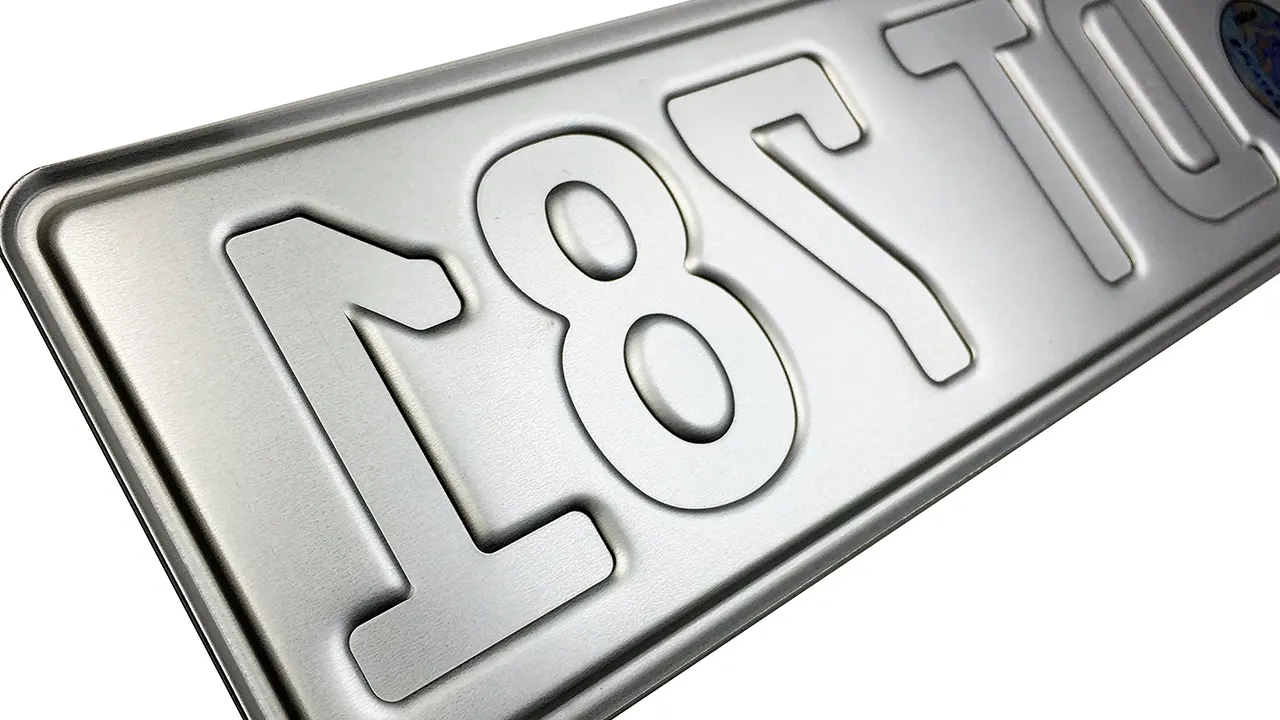
Most modern permanent license plates are made from aluminum. It is light, resists red rust, forms readily, and accepts the reflective films and printed graphics needed to keep a plate readable. That metal is only the base, though. A finished plate may also include surface pretreatment, pressure-sensitive adhesive, retroreflective sheeting, inks or foils, and security features.
Not every plate follows the same recipe. Older plates and some current specifications use steel. Some countries use plastic plates, while temporary tags may be printed on coated paper, synthetic sheet, or another weather-resistant material. The issuing authority decides the approved construction, so there is no single material specification that applies worldwide.
What Material Are Most License Plates Made Of?
For a typical permanent vehicle plate in the United States, aluminum is the best general answer. The aluminum sheet gives the plate its shape and stiffness. A separate reflective layer and printed or roll-coated details create the background, characters, colors, and nighttime visibility.
| Part of the plate | Common material or treatment | What it does |
|---|---|---|
| Base or substrate | Usually aluminum; sometimes steel or plastic | Provides shape, rigidity, formed edges, and mounting holes |
| Surface preparation | Cleaning and chemical pretreatment | Helps the reflective layer bond consistently to the metal |
| Reflective background | Adhesive-backed retroreflective sheeting | Returns light toward its source so the plate is easier to see at night |
| Characters and graphics | Ink, foil, or digitally printed layers | Creates the registration number, jurisdiction name, colors, and approved artwork |
| Security and protection | Jurisdiction-specific features and, in some systems, a protective surface layer | Supports authentication, abrasion resistance, and readable service life |
This layered construction explains why a plate can be aluminum yet still peel, fade, or lose reflectivity. The aluminum may remain intact while the sheeting, ink, adhesive, or protective surface deteriorates.
Why Is Aluminum So Common?
Aluminum solves several manufacturing and service problems at once. It is not perfect, but its balance of weight, corrosion behavior, formability, and surface compatibility makes it practical for high-volume plate production.
It keeps the plate light
A plate does not add meaningful load to a vehicle, but low weight still helps during coiling, blanking, handling, packaging, shipping, and installation. It also reduces the load carried by thin bumper brackets and plastic mounting anchors.
It does not form red rust like ordinary steel
Aluminum forms a thin oxide layer rather than the familiar reddish-brown rust associated with iron and carbon steel. That makes it useful in rain, humidity, and road spray. It can still oxidize, stain, pit, or develop deposits around damaged edges and dissimilar-metal fasteners, especially where salt and moisture remain trapped.
If you see a rusty streak on an aluminum plate, the source may be a steel screw, washer, bracket, or frame rather than the plate itself.
It is easy to cut and form
Plate blanks can be cut from sheet or coil, have their mounting holes punched, and receive formed edges or embossed characters. The exact alloy, temper, and thickness are part of the issuing authority’s or manufacturer’s production specification. A number quoted for one state or country should not be treated as a universal plate specification.
It works with reflective sheeting
A prepared aluminum surface can accept adhesive-backed retroreflective film. That film is not simply shiny vinyl. Its optical structure sends incoming light back toward the source, which is why a plate appears bright when illuminated by headlights near the viewer’s line of sight.
Aluminum vs. Steel License Plates
Steel was widely used in earlier plate production and still appears in some specifications and special applications. It is stiffer than a comparable thin aluminum sheet, but it weighs more and depends more heavily on coatings for corrosion protection.
| Characteristic | Aluminum plate | Steel plate |
|---|---|---|
| Weight | Lower for a comparable plate | Higher |
| Corrosion behavior | Does not produce ordinary red rust, but can oxidize or pit | Can form red rust where protective layers are damaged |
| Forming | Well suited to blanking, edge forming, and embossing when the specified stock is used | Also formable, usually with greater force for a comparable geometry |
| Surface system | Often pretreated and laminated with reflective sheeting | Usually relies on metallic protection, paint, sheeting, or another coating system |
| Current use | Common for modern permanent plates | More common historically, with use depending on the jurisdiction |
A magnet gives you a quick clue: it normally sticks to carbon steel but not to aluminum. That test does not identify the exact alloy or coating, and some stainless steels are also weakly magnetic or nonmagnetic, so it is only a first check.
Are Plastic License Plates Used?
Yes. Some jurisdictions and special applications use plastic plates or plastic-faced assemblies. The material may be selected for a flat printed design, local production system, weight, or resistance to conventional rust. Plastic brings its own limits: it can scratch, crack, warp, yellow, or lose print adhesion depending on the polymer, thickness, construction, and exposure.
A plastic license plate is not the same thing as a plastic license plate frame. The plate is the official identifier issued or authorized by a jurisdiction. The frame is an optional border mounted around it. One cannot legally substitute for the other.
What Are Temporary License Plates Made Of?
Temporary plates vary more than permanent plates. They may use paper, coated paper, synthetic sheet, plastic film, or another printable material chosen for the tag’s expected service period and security system. Some are weather-resistant on their own; others require an approved protective arrangement.
The material name alone is not the main test. A temporary tag needs to keep its characters, expiration date, and security information readable until it expires. Current AAMVA guidance recommends all-weather material or approved weather protection and exterior mounting in the normal plate position.
How Thick Is a License Plate?
There is no universal thickness for every license plate. Metal gauge varies with the jurisdiction, material, production process, embossing requirements, and intended service life. Temporary and plastic plates follow different specifications again.
Thickness affects more than stiffness. A thicker plate or a strongly embossed border changes how the plate sits inside a holder or behind a frame. If you are checking an installation, measure the complete stack: bracket, plate, embossed areas, frame, washers, spacers, and available screw engagement. The same principle is explained in more detail in the license plate frame thickness guide.
How Are Metal License Plates Manufactured?
There are two common paths: an embossed plate with raised characters, and a flat plate produced with digital or thermal-transfer printing. The sequence and equipment vary, but a typical metal plate moves through these stages:
- Prepare the metal. Aluminum sheet or coil is cleaned and treated so later layers can bond properly.
- Apply or print the reflective surface. Some systems laminate preprinted reflective sheeting to the metal; others apply reflective stock before variable information is printed.
- Cut the blank. A blanking press or cutting line forms the outer shape and mounting holes. Edges and corners may be formed at this stage.
- Add the registration number. Dies emboss raised characters, or a digital system prints the variable number onto a flat reflective surface.
- Color raised details when required. Roll coating or foil can contact the high points of an embossed plate without coating the background.
- Add approved security or protective features. The exact construction is controlled by the issuing jurisdiction and its production system.
- Inspect and pack. Readability, color, surface condition, adhesion, character formation, and damage are checked before distribution.
Not every plant applies those steps in that exact order. Arizona, for example, has described both its older embossed process and a newer route in which a design is thermally printed onto reflective vinyl, laminated to aluminum, and then cut into plates. Flat printing allows more complex graphics, while embossing creates characters you can feel.
The stamping idea is similar to metal frame production, but the tooling and purpose are different. If you want to see that distinction from the frame side, metal license plate frame stamping covers blanking, forming, trimming, and inspection of the surrounding part rather than the government plate.
What Makes a License Plate Reflective?
The reflective effect comes from retroreflective material, not from bare aluminum. Retroreflection sends a large portion of incoming light back toward its source. When a vehicle’s headlights illuminate a plate, light returns toward the vehicle and the nearby viewer or camera.
Different film systems use microscopic optical structures, including glass-bead or microprismatic designs. The details depend on the approved sheeting. In each case, the background, characters, color contrast, and optical performance need to work together. A glossy clear plastic cover is not a substitute for that engineered reflective layer and may introduce glare or legal visibility problems.
Can License Plates Rust?
Aluminum plates do not rust in the ordinary iron-oxide sense. They can corrode, oxidize, develop white or gray deposits, stain, or pit. Salt, trapped moisture, damaged sheeting, and contact with dissimilar metals can make those effects more visible.
Steel plates can rust when their protective coating is cut, chipped, or worn through. Edges and mounting holes are common starting points because tools and fasteners concentrate contact there.
Rust-colored marks do not always identify the plate material. Inspect the screw, washer, bracket, and frame. A corroding steel fastener can leave a streak across an aluminum plate, especially after rain.
License Plate Material vs. License Plate Frame Material
The plate and frame sit together, but they do different jobs and do not need to use the same material.
| Component | Common materials | Main purpose |
|---|---|---|
| Official license plate | Aluminum, steel, plastic, or temporary printable material | Identifies the registered vehicle |
| License plate frame | Aluminum, stainless steel, plastic, zinc alloy, silicone, or model-specific combinations | Creates a border for appearance, branding, or edge protection |
| Mounting bracket or holder | Plastic, steel, aluminum, or mixed hardware | Adapts the plate to the vehicle’s mounting location |
Confusing these parts causes practical problems. A frame should not be expected to correct a weak vehicle bracket, and a holder that supports the whole plate is not automatically interchangeable with a slim decorative frame.
Which Frame Material Works With a Metal Plate?
There isn’t one best material for every car. Start with the mounting geometry, exposure, desired finish, and the amount of support already provided by the vehicle bracket.
Aluminum frames keep weight low and pair naturally with metal plates, but alloy, section shape, finish, and fastener contact still affect stiffness and corrosion behavior. The current aluminum frame options show the category without implying that every model shares one specification.
Stainless steel frames can provide a thin, rigid metal border. Grade, edge treatment, polish or brushing, and road-salt exposure still affect corrosion behavior. See the available stainless steel frame constructions when a firmer metal look is the priority.
Plastic frames avoid red rust and can isolate some metal-to-metal contact. Their behavior depends on the actual resin, section thickness, UV exposure, temperature, and screw load. Do not assume that every black plastic frame is the same polymer.
Zinc alloy frames can support molded detail and a heavier decorative feel, but the plating or coating system and protected edges matter in wet or salty environments.
If you are choosing among those categories, the frame material comparison separates weight, stiffness, finish, corrosion conditions, and cost without declaring a universal winner.
How to Protect the Plate Surface
A plate usually needs simple care, not aggressive polishing.
- Rinse away road salt, mud, and grit before wiping the surface.
- Use a mild cleaner and a soft cloth; abrasive pads can scratch printed or reflective layers.
- Keep screws snug, but do not crush the plate, frame, or plastic anchors.
- Use washers or spacers when the hardware stack needs them to sit flat.
- Replace rusty fasteners before their runoff stains the plate.
- Make sure the frame opening does not rub printed details or cover required information.
- Ask the issuing motor vehicle agency about replacement if the plate becomes peeled, badly faded, bent, or unreadable.
Repeated screw loosening is usually a mounting problem rather than a plate-material problem. Check thread fit, usable screw length, washers, spacers, and bracket movement using the loose license plate screw checklist.
Frequently Asked Questions
Are all license plates made of aluminum?
No. Aluminum is the common modern base for permanent plates, especially in the United States, but steel, plastic, and temporary printable materials are also used. The approved construction depends on the issuing jurisdiction and plate type.
Are license plates made of stainless steel?
Not usually. When a plate is described simply as steel, it is more likely to be coated carbon steel than stainless steel. You cannot confirm the exact metal grade from appearance alone.
Why do some license plates not stick to a magnet?
Aluminum is not ferromagnetic, so a normal magnet will not stick to an aluminum plate. A magnet that does stick suggests a steel substrate, although the test does not identify the precise alloy or coating.
Why are license plates reflective?
Retroreflective sheeting sends light back toward its source, improving nighttime identification by drivers, law enforcement, toll systems, and plate readers. Bare aluminum does not create the full effect by itself.
How thick are license plates?
Thickness varies by issuing authority, material, and manufacturing process. Use the actual plate or its official specification when checking a frame, holder, screw length, or vehicle recess.
Can license plates be made from plastic?
Yes. Plastic plates are used in some jurisdictions and special applications. Their resin, layering, print method, and legal status are locally specified, so a decorative plastic plate should not be confused with an authorized registration plate.
Does a metal frame damage an aluminum plate?
Not simply because both parts are metal. Damage is more likely when a sharp or warped edge rubs the reflective surface, hardware is overtightened, grit is trapped between layers, or moisture and dissimilar metals remain in contact. A flat assembly with correct washers and clearance is the safer setup.
Can an old license plate be recycled as scrap metal?
The base metal may be recyclable, but the plate remains a government-issued identifier. Cancel, return, deface, or dispose of it only as your issuing authority directs before taking it to a recycler.
Matching a Frame to the Actual Plate
If you are specifying a custom frame, identify the country or jurisdiction, plate width and height, hole layout, embossed areas, and the information that must remain visible. Then choose the frame material and finish. That order prevents a good-looking frame from becoming a poor fit.
For a model review or custom program, send the plate drawing or a clear measured sample together with the vehicle mounting layout through the XCLPF contact form. Exact material, finish, border, fastener, and packaging details can then be matched to the intended frame rather than assumed from the plate’s appearance.