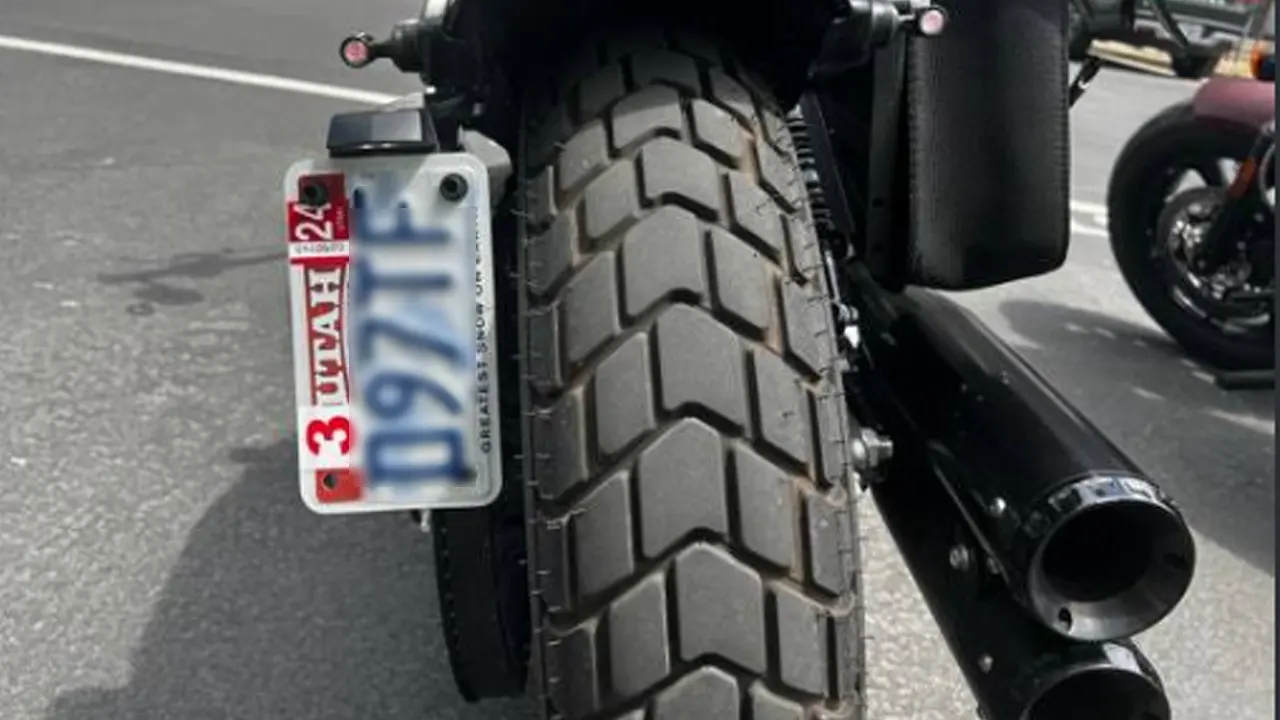
You may be able to mount a motorcycle license plate vertically, but only if the law where the motorcycle is registered and operated permits that orientation. The plate still needs to be the correct issued plate, securely attached, readable, illuminated when required, and positioned where the tire, suspension, exhaust, luggage, and your body cannot hide or damage it.
There is no reliable nationwide yes-or-no answer in the United States. Pennsylvania, for example, offers a purpose-made vertical motorcycle registration plate and says a standard horizontal motorcycle plate may not simply be turned sideways. New Jersey uses a different rule: vertical display is allowed only in a narrower set of circumstances tied to the motorcycle’s original configuration. Those two examples show why the first question is not “Will the bracket fit?” but “What does my issuing state allow?”
Quick check: Confirm orientation, mounting location, visibility, lighting, and plate-specific rules with the current motor-vehicle law for your state. Then inspect the installation through the full range of suspension and steering movement before riding.
Vertical Plate, Vertical Mount, and Side Mount Are Not the Same Thing
People often use “vertical plate” for three different setups. Keeping them separate prevents most of the confusion.
- A state-issued vertical plate has its numbers, letters, graphics, and mounting layout designed for upright vertical reading.
- A horizontal plate rotated 90 degrees keeps the original horizontal artwork but turns the entire plate on its side.
- A side-mounted plate describes the location, usually beside the rear wheel. It can hold either a horizontal or vertical plate depending on the bracket and local rule.
A bracket advertised as a “vertical side mount” proves only that the hardware can hold a plate that way. It does not prove that your issued plate may legally be rotated, that the bracket suits your motorcycle, or that the completed installation remains visible from the required directions.
Start With the Plate You Were Actually Issued
Look at the plate before shopping for a bracket or frame. If the characters and state name read normally when the short edges are at the sides, you have a conventional horizontal plate. Rotating it may put the characters, validation sticker, or state name sideways. Some states treat that as improper display even when every character remains physically exposed.
If your state offers a dedicated vertical motorcycle plate, find out whether it is optional, restricted to certain motorcycles, personalized only, or paired with a specific application. Do not assume that seeing one on another motorcycle means the same choice is available for your registration class.
Plate dimensions matter too. United States motorcycle plates are not simply smaller car plates with one universal size. Check the exact width, height, corner radius, hole spacing, and sticker location. The measurements in a motorcycle plate size and fit check help you describe the hardware, but the plate in your hand remains the final reference.
Why Riders Choose a Vertical Motorcycle Plate Mount
The usual reason is packaging. A bobber, chopper, custom cruiser, or shortened rear fender may have little room for a broad horizontal assembly. Turning the mounting footprint upright can reduce side-to-side width and give the rear of the motorcycle a cleaner silhouette.
Other riders want to move the plate away from a high-mounted exhaust, a tail tidy, a luggage rack, or a custom rear light. On some builds, a vertical side mount follows the visual line of the wheel or swingarm better than a plate across the fender. These are valid design goals, but they do not override the practical needs of a road-going plate.
The tradeoff is that a compact-looking location may create new problems: the wheel can obscure the plate from the opposite side, suspension travel can bring metal into the tire, a saddlebag can cover the upper half, or the exhaust can heat the bracket and plate light. A successful installation must work as a system, not just look right in a parked side photograph.
What Makes a Vertical Installation Roadworthy?
The plate is readable in its intended orientation
A plate should not require someone to tilt their head or mentally rotate the number. Where a state issues a dedicated vertical design, its characters are arranged for vertical display. Where it does not, turning a standard plate sideways may conflict with the display rule even if the bracket leaves the surface uncovered.
The plate has a clear view
Stand behind the motorcycle, then move several steps to both rear quarters. Check the plate at standing height and at the lower viewpoint another driver would have. A side mount that looks completely open from one angle may disappear behind the tire, shock, exhaust, chain guard, or luggage from another.
Repeat the check with the rider seated and with any normal passenger, pannier, tool roll, or travel bag installed. If the plate is visible only when the bike is unloaded, the position is not dependable for real use.
The plate light still works
Moving the plate usually moves the illumination problem with it. A tail lamp that lit the original fender location may cast little or no useful light onto a side-mounted plate. Use a plate-light solution intended for the new location, route the wiring away from heat and movement, and confirm the entire registration number is visible after dark.
Do not treat decorative accent lighting as a substitute for required plate illumination. Color, brightness, aiming, and allowed lamp placement can be regulated. Check the motorcycle equipment rules that apply where you ride.
The mount is secure without distorting the plate
A bracket should support the plate across a stable area rather than hanging it from one thin tab. Use the correct fastener diameter, thread, washer, and locking method for the bracket. Tighten evenly. Excess torque can dish a metal plate, crack a plastic frame, crush a spacer, or strip the threaded insert.
After the first short rides, check for movement, fretting marks, loose fasteners, and new vibration. If screws repeatedly back out, the solution is not simply more torque. Diagnose the joint using the same principles described for preventing loose plate-frame screws.
Choose the Mounting Location Before the Frame Style
There are three common locations, and each changes the fit problem.
| Location | Useful when | Main checks |
|---|---|---|
| Centered rear mount | You want the clearest conventional view | Fender travel, tail-light relationship, tire clearance, luggage |
| Side mount near axle or swingarm | Rear fender space is limited | Opposite-side visibility, lean clearance, wheel movement, wiring |
| Tail tidy or under-tail mount | You want a compact rear assembly | Plate angle, suspension compression, tire contact, lighting, mud and spray |
A centered rear mount is usually the easiest to inspect and keep visible. A side mount can solve a packaging problem, but it asks more of the bracket and the installer. An under-tail mount may appear tidy until the suspension compresses or the viewing angle becomes too shallow. Measure each location with the motorcycle in riding condition rather than relying on catalog photographs.
How to Check Tire and Suspension Clearance
Static clearance is not enough. The rear wheel moves relative to the fender and frame as the suspension compresses, and swingarm-mounted components move differently from chassis-mounted components.
- Identify what the bracket attaches to. A bracket fixed to the swingarm travels with the wheel; a bracket fixed to the frame or subframe does not.
- Inspect the manufacturer’s suspension-clearance information. Do not disconnect or compress a suspension assembly unless you know the safe procedure for that motorcycle.
- Check every edge and fastener. A bolt end, lamp housing, or wire can contact the tire before the plate itself does.
- Allow for tire growth, flex, and debris. A narrow gap in the garage is not a useful safety margin on the road.
- Recheck with normal load. Passenger weight and luggage change ride height and available space.
If you cannot confirm safe movement without guessing, use a different mounting point or have a qualified motorcycle technician inspect the setup. Contact between a tire and a metal bracket can be far more serious than a damaged plate.
Watch the Plate Angle, Not Just the Orientation
Vertical versus horizontal describes rotation on the face of the plate. It says nothing about how far the face tilts upward, downward, or inward. A plate can be upright in a vertical format yet still be difficult to read because it follows the curve of the tire or tucks too far under the seat.
View the plate in daylight and at night from realistic distances. Look for glare from the plate light, shadow from the bracket, and reflection that washes out the characters. Do not bend a state-issued plate to make it follow a curved mount. Use a flat carrier or appropriate spacers so the plate remains supported without being forced into shape.
Side-Mounted Plates Need a Wider Visibility Test
With a left-side mount, the tire or motorcycle body may block the plate from the right rear quarter; the reverse is true for a right-side mount. The exhaust can add another obstruction. Check from both sides before final tightening.
Also consider daily use. A passenger’s leg, a soft saddlebag that sags when loaded, or a bungee cord can cover a plate that was clear during installation. If accessories change often, mark the minimum safe position or perform the visibility check every time you pack the motorcycle.
Can You Use a License Plate Frame on a Vertical Mount?
Yes, if the frame fits the exact plate and the completed assembly is allowed. The frame should not cover the registration number, state name, validation sticker, or other information your jurisdiction requires to remain visible. Its outside dimensions must also clear the tire, exhaust, turn signals, and bracket.
A conventional motorcycle frame can sometimes be rotated with the plate, but text or graphics on the frame will then read sideways. A purpose-designed vertical frame places any decoration in the intended reading direction and can position its mounting holes around the vertical bracket. The motorcycle license plate frame options are a useful starting point for material and format, but size and hole layout still need to match the specific plate and carrier.
Keep decoration restrained. A thick border or raised element can make a small motorcycle plate feel crowded and can reduce the open area around state text or stickers. A slim border generally provides more tolerance when the plate has information close to an edge.
Bracket, Holder, and Frame: Which Part Does What?
- The bracket attaches the assembly to the motorcycle and carries the structural load.
- The plate holder or carrier supports the back of the plate and may include a lamp or wiring path.
- The frame surrounds the visible face for edge support or appearance; it is not normally the primary structural connection.
Some products combine all three functions, while others are only a decorative ring. Do not ask a thin frame to bridge a weak bracket or support a plate outside its intended mounting points. If you are unsure which component you have, the distinction between a plate frame and plate holder makes the load path easier to understand.
A Practical Installation Sequence
- Verify the rule. Check the current statute or official motor-vehicle guidance for plate orientation, location, lighting, and visibility.
- Measure the issued plate. Record overall size, hole spacing, hole shape, sticker area, and the clear opening needed around all required information.
- Confirm the bracket application. Make sure it is intended for the motorcycle model, mounting point, and exhaust layout.
- Test-fit without final torque. Assemble the bracket, carrier, plate, light, spacers, and frame loosely.
- Check movement and sightlines. Inspect tire and suspension clearance, lean clearance, rear-quarter visibility, and accessory interference.
- Route the wiring. Protect it from abrasion, pinching, heat, and moving joints. Preserve weather sealing at connections.
- Tighten to the hardware specification. Use the correct locking method and avoid bending the plate.
- Perform a night check. Confirm the plate is evenly visible without glare that overwhelms the characters.
- Reinspect after riding. Look for loose hardware, witness marks, vibration cracks, and wiring movement.
Common Mistakes With Vertical Motorcycle Plates
Rotating a normal plate because the bracket is sold as legal
Aftermarket listings cannot give one legal answer for every registration. Product fit and legal display are separate questions. Verify both.
Mounting close to the tire based on unloaded clearance
The motorcycle can sit much lower with a rider, passenger, or luggage. A bracket that clears in the garage may enter the tire’s path over a bump.
Forgetting the plate light
Relocation often leaves the original light behind. Add a compliant solution rather than assuming the tail lamp will illuminate the new position.
Using a frame that hides a sticker or state name
Motorcycle plates pack information into a small area. Measure the visible opening, not just the plate’s outside dimensions. Border width and opening size are explained in more detail in the license plate frame opening-size check.
Letting the plate act as a mudguard
A plate is not designed to take repeated tire spray, debris impact, or flex from a long unsupported bracket. Excess vibration can fatigue the plate around its holes and loosen the mounting joint.
What the State Examples Actually Tell You
Pennsylvania’s official process illustrates the difference between plate format and installation choice. The state offers a vertical motorcycle registration plate through a specific application and explicitly says a horizontal motorcycle registration plate may not be displayed vertically. If you have a Pennsylvania motorcycle, the answer is therefore not simply “buy a vertical bracket”; it is to use the plate type and process Pennsylvania provides.
New Jersey’s regulation takes another approach. It generally calls for a horizontal rear plate but recognizes vertical display when the motorcycle was originally equipped by the manufacturer that way and related conditions are satisfied. The wording and eligibility are different from Pennsylvania’s.
Your state may use a third approach, and local enforcement details can change. Read the current provision for your registration rather than copying another rider’s setup. If you cross state lines, the safest practical arrangement is one that remains plainly readable, properly lit, and securely mounted, while still complying with the rules that govern your registration and operation.
When a Horizontal Mount Is the Better Choice
Keep or restore a horizontal mount when the state does not allow your plate to be rotated, when you cannot achieve a clear rear view from both sides, or when the vertical position puts hardware near the tire or exhaust. Horizontal mounting is also sensible when you regularly carry panniers, a passenger, or luggage that would interfere with a side position.
A centered horizontal carrier may look less custom, but it often simplifies lighting, visibility, inspection, and maintenance. Good customization works within those constraints rather than hiding them.
Questions to Ask Before Ordering a Vertical Mount
- Does my state issue or permit a vertical motorcycle plate?
- Am I holding a vertical-format plate or a horizontal plate I plan to rotate?
- What are the exact plate dimensions and mounting-hole centers?
- Does the bracket fit my motorcycle model and mounting point?
- Where does the bracket sit through full suspension movement?
- Will the plate be visible from both rear quarters with normal luggage installed?
- How will the plate be illuminated?
- Can the wiring tolerate heat, water, and movement?
- Does a frame leave every required marking and sticker exposed?
- Can I inspect and tighten the hardware without removing major components?
Frequently Asked Questions
Is a vertical motorcycle license plate legal in every state?
No. Plate orientation and mounting requirements vary. Some states offer a dedicated vertical plate, some allow vertical display only in defined circumstances, and others require the issued plate to remain horizontal. Check the current rule for the state that issued the plate.
Can I turn my normal motorcycle plate sideways?
Do not assume so. A standard horizontal plate can remain physically readable yet still violate an orientation rule. Pennsylvania is a clear example: it provides a separate vertical plate and says a horizontal motorcycle plate may not be displayed vertically.
Is a side-mounted plate automatically a vertical plate?
No. “Side-mounted” describes where the bracket is installed. The plate on that bracket may be horizontal or vertical. Location and orientation must each be checked.
Do I need a light for a relocated motorcycle plate?
Road-going motorcycles commonly have plate-illumination requirements, but the precise equipment rule varies by jurisdiction. If relocation takes the plate outside the original lamp’s effective area, use a compliant lighting solution and verify it at night.
Can I mount the plate to the swingarm?
A swingarm mount can be mechanically possible on some motorcycles, but model fit, wheel clearance, lean clearance, wiring, visibility, and local mounting rules all matter. Use a bracket intended for the application and inspect the moving assembly carefully.
Will a vertical frame fit any motorcycle plate?
No. Plate sizes, hole spacing, sticker positions, and corner shapes vary. Match the frame’s outside size, opening, and holes to the actual plate and carrier.
Can I bend the plate to fit a curved side mount?
Avoid altering a state-issued plate. Bending can distort characters, damage the reflective surface, and create a stress point around the holes. Use a flat carrier or a different bracket.
Why does my vertical plate vibrate?
Common causes include a long unsupported bracket, thin mounting tab, loose joint, missing spacer, uneven fastener load, or engine and road vibration near the bracket’s natural frequency. Stop and inspect it before fatigue cracks develop.
The Bottom Line
A motorcycle license plate can be mounted vertically only when the applicable rules and the complete installation support it. Confirm whether your state permits a rotated horizontal plate, issues a separate vertical plate, or limits vertical display to specific motorcycle configurations. Then treat visibility, lighting, tire clearance, suspension movement, wiring, and fastener security as one installation problem.
If any of those checks fails, a conventional horizontal rear mount is the better answer. The cleanest-looking setup is the one you can read, inspect, and ride with confidence.
Technical Sources
- Pennsylvania Department of Transportation — Apply for a Vertical Motorcycle Registration Plate
- New Jersey Administrative Code § 13:20-24.21 — Motorcycle license plate mounting
Legal information reviewed September 21, 2026. Plate-display and motorcycle-equipment rules can change. Confirm the current requirements with the issuing motor-vehicle agency and the jurisdictions where you ride.